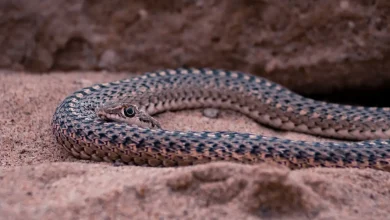
Non-Venomous Snakes of Thailand — The Beneficial Majority
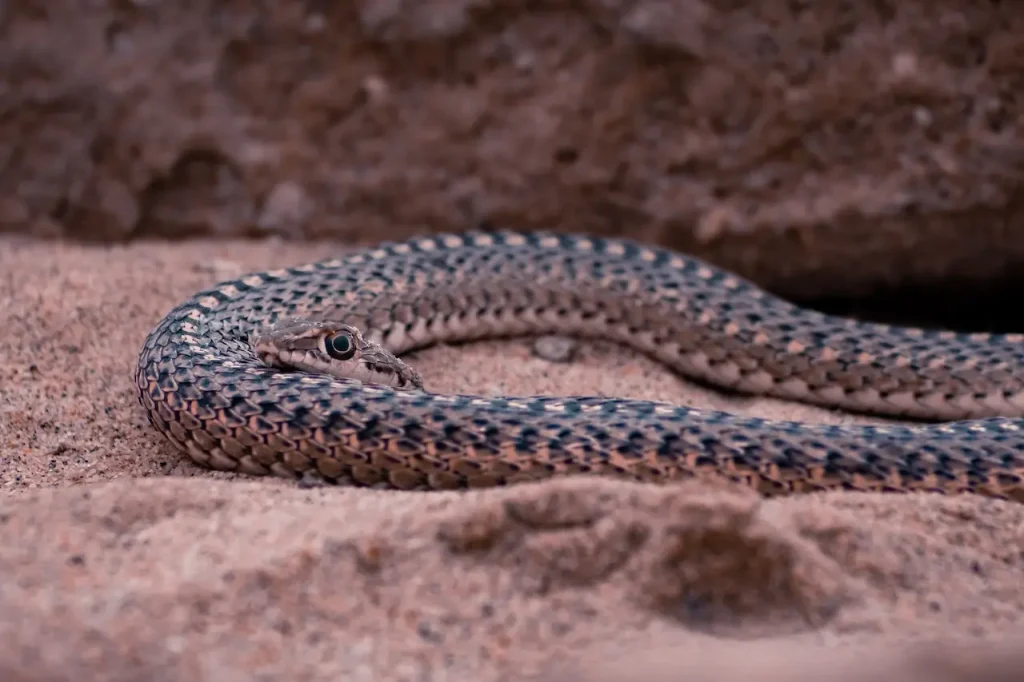
- Pythons. Burmese, Reticulated, Blood Pythons. Large constrictors, mechanical danger only. See Burmese, Reticulated, Blood.
- Rat snakes and racers. The Indo-Chinese Rat Snake, Beauty Rat Snake (and our subspecies Helfenberg’s Racer), Copperheaded Racer. Major rodent predators.
- Tree snakes. Bronzebacks (Common Painted, Wall’s Blue, Striped), Golden Tree Snake, Paradise Tree Snake. Lizard predators in canopy.
- Whip snakes. Oriental Whip Snake. Slim diurnal lizard hunters.
- Wolf snakes. Banded Wolf Snake, Common Wolf Snake. Small leaf-litter predators.
- Slug snakes (Pareas). Snail and slug specialists. See Keeled Slug Snake.
- File snakes (Acrochordus). Aquatic, fish-eating. See Javan File Snake.
- Blind snakes. Tiny worm-like, ant-and-termite eaters. The Brahminy Blind Snake is probably the single most numerous snake in Thailand by individual count.
- Water snakes. Various small Enhydris and Hypsiscopus species. Fish-eaters in lowland water bodies.
Why they matter #
Non-venomous snakes do most of the snake-related ecological work in Thailand. The major roles:
- Rodent control. A single adult Indo-Chinese Rat Snake eats 30-50 rats a year. Across a Thai village landscape, the local rat snake population probably accounts for the majority of rat predation. Removing the rat snakes leads to measurable rat-population increases.
- Lizard population balance. Tree snakes and whip snakes keep gecko populations from getting out of hand in suburban Thailand. House gecko numbers in a typical Thai house are kept down significantly by predation from the local Bronzebacks.
- Fish-population balance in waterways. Water snakes take small fish and tadpoles, contributing to the balance in farm ponds and rice paddies.
- Insect control via prey-of-prey. Blind snakes eat termite and ant brood; their presence reduces invasive ant pressure on agriculture.
The “looks dangerous” problem #
Many non-venomous Thai snakes are killed because villagers cannot tell them from venomous lookalikes. The Common Painted Bronzeback is a colour match for some pit vipers; the Banded Wolf Snake is sometimes mistaken for a juvenile Banded Krait; the Indo-Chinese Rat Snake is sometimes mistaken for a Russell’s Viper at first glance. Education is the only solution. See our snake identification decision tree for the practical separation.
What you can do #
Three things:
- Learn the common species. The 10-15 species you are likely to encounter on your property are worth knowing on sight.
- Don’t kill the harmless ones. They are doing useful work for free. See should you kill Thailand snakes.
- Photograph and submit records. Citizen science records build the database that everyone uses. See our Thailand snake database research piece.
For the wider catalogue with photos see our common non-venomous Thailand snakes page.
External references: the Reptile Database for taxonomy, and IUCN Red List for conservation status of individual species.
Key takeaways #
- Context matters more than rules of thumb. Thailand’s snake fauna varies meaningfully by region, by season, and by habitat. Advice that holds in southern wet forest does not always hold in northern hill country or in the central agricultural plains.
- Prevention is high-leverage. Most serious snake-related incidents in Thailand are downstream of three preventable behaviours — reaching where you cannot see, walking forest paths at night without a torch, and attempting to handle or kill snakes rather than call professional removal.
- Hospital access is the real safety net. Thai provincial hospitals stock the standard polyvalent antivenoms. The single biggest predictor of bad outcome from a serious bite is delay in reaching one of those hospitals.
- Citizen-science records help. Even casual photographs with location data, posted to platforms like iNaturalist, contribute to the regional knowledge base. Most Thai snake species have surprisingly thin distribution data; one well-documented sighting can fill a real gap.
Common questions #
How likely am I to see a snake on a casual visit to Thailand?
Lower than you probably expect. A casual three-hour daytime forest hike in southern Thailand has roughly a 5–10% chance of producing any snake encounter at all, and roughly a 0.5–1% chance of producing a venomous-species sighting. Visitors who deliberately go looking — at night, in good habitat — see far more, but the casual exposure is genuinely low.
What time of year has the most snake activity?
The wet season (May through October) produces by far the most snake encounters across most of Thailand. Within that, two peaks: the start of the rains (April–June) when males are moving for breeding, and late wet season (September–November) when juvenile cohorts disperse from nest sites. The dry season (December–March) is genuinely quieter for snake-watching, particularly in the north and northeast.
Are Thai snakebite outcomes really that good?
For patients who reach a hospital within an hour or two of a venomous bite, yes — Thai outcomes are excellent by international standards. Mortality with appropriate antivenom and supportive care runs under 1% for most species. The deaths that do happen are concentrated in cases of significant pre-hospital delay, mis-identification of species, or in patients with serious co-morbidities. The Thai system is robust; the failure modes are mostly upstream of the hospital.
What is the single best preventive measure?
A torch at night. The single biggest reducer of Thai snakebite risk is consistent, eyes-down torch use on every walking path after dark. Most preventable bites in southern Thailand are foot-on-snake events on the ground at night, and a torch beam on the trail at metre-down angle prevents the great majority of them. Closed footwear is the second-biggest improvement; long trousers in dense vegetation is third.
- Rodent control. A single adult Indo-Chinese Rat Snake eats 30-50 rats a year. Across a Thai village landscape, the local rat snake population probably accounts for the majority of rat predation. Removing the rat snakes leads to measurable rat-population increases.
- Lizard population balance. Tree snakes and whip snakes keep gecko populations from getting out of hand in suburban Thailand. House gecko numbers in a typical Thai house are kept down significantly by predation from the local Bronzebacks.
- Fish-population balance in waterways. Water snakes take small fish and tadpoles, contributing to the balance in farm ponds and rice paddies.
- Insect control via prey-of-prey. Blind snakes eat termite and ant brood; their presence reduces invasive ant pressure on agriculture.
The “looks dangerous” problem #
Many non-venomous Thai snakes are killed because villagers cannot tell them from venomous lookalikes. The Common Painted Bronzeback is a colour match for some pit vipers; the Banded Wolf Snake is sometimes mistaken for a juvenile Banded Krait; the Indo-Chinese Rat Snake is sometimes mistaken for a Russell’s Viper at first glance. Education is the only solution. See our snake identification decision tree for the practical separation.
What you can do #
Three things:
- Learn the common species. The 10-15 species you are likely to encounter on your property are worth knowing on sight.
- Don’t kill the harmless ones. They are doing useful work for free. See should you kill Thailand snakes.
- Photograph and submit records. Citizen science records build the database that everyone uses. See our Thailand snake database research piece.
For the wider catalogue with photos see our common non-venomous Thailand snakes page.
External references: the Reptile Database for taxonomy, and IUCN Red List for conservation status of individual species.
- Pythons. Burmese, Reticulated, Blood Pythons. Large constrictors, mechanical danger only. See Burmese, Reticulated, Blood.
- Rat snakes and racers. The Indo-Chinese Rat Snake, Beauty Rat Snake (and our subspecies Helfenberg’s Racer), Copperheaded Racer. Major rodent predators.
- Tree snakes. Bronzebacks (Common Painted, Wall’s Blue, Striped), Golden Tree Snake, Paradise Tree Snake. Lizard predators in canopy.
- Whip snakes. Oriental Whip Snake. Slim diurnal lizard hunters.
- Wolf snakes. Banded Wolf Snake, Common Wolf Snake. Small leaf-litter predators.
- Slug snakes (Pareas). Snail and slug specialists. See Keeled Slug Snake.
- File snakes (Acrochordus). Aquatic, fish-eating. See Javan File Snake.
- Blind snakes. Tiny worm-like, ant-and-termite eaters. The Brahminy Blind Snake is probably the single most numerous snake in Thailand by individual count.
- Water snakes. Various small Enhydris and Hypsiscopus species. Fish-eaters in lowland water bodies.
Why they matter #
Non-venomous snakes do most of the snake-related ecological work in Thailand. The major roles:
- Rodent control. A single adult Indo-Chinese Rat Snake eats 30-50 rats a year. Across a Thai village landscape, the local rat snake population probably accounts for the majority of rat predation. Removing the rat snakes leads to measurable rat-population increases.
- Lizard population balance. Tree snakes and whip snakes keep gecko populations from getting out of hand in suburban Thailand. House gecko numbers in a typical Thai house are kept down significantly by predation from the local Bronzebacks.
- Fish-population balance in waterways. Water snakes take small fish and tadpoles, contributing to the balance in farm ponds and rice paddies.
- Insect control via prey-of-prey. Blind snakes eat termite and ant brood; their presence reduces invasive ant pressure on agriculture.
The “looks dangerous” problem #
Many non-venomous Thai snakes are killed because villagers cannot tell them from venomous lookalikes. The Common Painted Bronzeback is a colour match for some pit vipers; the Banded Wolf Snake is sometimes mistaken for a juvenile Banded Krait; the Indo-Chinese Rat Snake is sometimes mistaken for a Russell’s Viper at first glance. Education is the only solution. See our snake identification decision tree for the practical separation.
What you can do #
Three things:
- Learn the common species. The 10-15 species you are likely to encounter on your property are worth knowing on sight.
- Don’t kill the harmless ones. They are doing useful work for free. See should you kill Thailand snakes.
- Photograph and submit records. Citizen science records build the database that everyone uses. See our Thailand snake database research piece.
For the wider catalogue with photos see our common non-venomous Thailand snakes page.
External references: the Reptile Database for taxonomy, and IUCN Red List for conservation status of individual species.
Key takeaways #
- Context matters more than rules of thumb. Thailand’s snake fauna varies meaningfully by region, by season, and by habitat. Advice that holds in southern wet forest does not always hold in northern hill country or in the central agricultural plains.
- Prevention is high-leverage. Most serious snake-related incidents in Thailand are downstream of three preventable behaviours — reaching where you cannot see, walking forest paths at night without a torch, and attempting to handle or kill snakes rather than call professional removal.
- Hospital access is the real safety net. Thai provincial hospitals stock the standard polyvalent antivenoms. The single biggest predictor of bad outcome from a serious bite is delay in reaching one of those hospitals.
- Citizen-science records help. Even casual photographs with location data, posted to platforms like iNaturalist, contribute to the regional knowledge base. Most Thai snake species have surprisingly thin distribution data; one well-documented sighting can fill a real gap.
Common questions #
How likely am I to see a snake on a casual visit to Thailand?
Lower than you probably expect. A casual three-hour daytime forest hike in southern Thailand has roughly a 5–10% chance of producing any snake encounter at all, and roughly a 0.5–1% chance of producing a venomous-species sighting. Visitors who deliberately go looking — at night, in good habitat — see far more, but the casual exposure is genuinely low.
What time of year has the most snake activity?
The wet season (May through October) produces by far the most snake encounters across most of Thailand. Within that, two peaks: the start of the rains (April–June) when males are moving for breeding, and late wet season (September–November) when juvenile cohorts disperse from nest sites. The dry season (December–March) is genuinely quieter for snake-watching, particularly in the north and northeast.
Are Thai snakebite outcomes really that good?
For patients who reach a hospital within an hour or two of a venomous bite, yes — Thai outcomes are excellent by international standards. Mortality with appropriate antivenom and supportive care runs under 1% for most species. The deaths that do happen are concentrated in cases of significant pre-hospital delay, mis-identification of species, or in patients with serious co-morbidities. The Thai system is robust; the failure modes are mostly upstream of the hospital.
What is the single best preventive measure?
A torch at night. The single biggest reducer of Thai snakebite risk is consistent, eyes-down torch use on every walking path after dark. Most preventable bites in southern Thailand are foot-on-snake events on the ground at night, and a torch beam on the trail at metre-down angle prevents the great majority of them. Closed footwear is the second-biggest improvement; long trousers in dense vegetation is third.
- Rodent control. A single adult Indo-Chinese Rat Snake eats 30-50 rats a year. Across a Thai village landscape, the local rat snake population probably accounts for the majority of rat predation. Removing the rat snakes leads to measurable rat-population increases.
- Lizard population balance. Tree snakes and whip snakes keep gecko populations from getting out of hand in suburban Thailand. House gecko numbers in a typical Thai house are kept down significantly by predation from the local Bronzebacks.
- Fish-population balance in waterways. Water snakes take small fish and tadpoles, contributing to the balance in farm ponds and rice paddies.
- Insect control via prey-of-prey. Blind snakes eat termite and ant brood; their presence reduces invasive ant pressure on agriculture.
The “looks dangerous” problem #
Many non-venomous Thai snakes are killed because villagers cannot tell them from venomous lookalikes. The Common Painted Bronzeback is a colour match for some pit vipers; the Banded Wolf Snake is sometimes mistaken for a juvenile Banded Krait; the Indo-Chinese Rat Snake is sometimes mistaken for a Russell’s Viper at first glance. Education is the only solution. See our snake identification decision tree for the practical separation.
What you can do #
Three things:
- Learn the common species. The 10-15 species you are likely to encounter on your property are worth knowing on sight.
- Don’t kill the harmless ones. They are doing useful work for free. See should you kill Thailand snakes.
- Photograph and submit records. Citizen science records build the database that everyone uses. See our Thailand snake database research piece.
For the wider catalogue with photos see our common non-venomous Thailand snakes page.
External references: the Reptile Database for taxonomy, and IUCN Red List for conservation status of individual species.
- Pythons. Burmese, Reticulated, Blood Pythons. Large constrictors, mechanical danger only. See Burmese, Reticulated, Blood.
- Rat snakes and racers. The Indo-Chinese Rat Snake, Beauty Rat Snake (and our subspecies Helfenberg’s Racer), Copperheaded Racer. Major rodent predators.
- Tree snakes. Bronzebacks (Common Painted, Wall’s Blue, Striped), Golden Tree Snake, Paradise Tree Snake. Lizard predators in canopy.
- Whip snakes. Oriental Whip Snake. Slim diurnal lizard hunters.
- Wolf snakes. Banded Wolf Snake, Common Wolf Snake. Small leaf-litter predators.
- Slug snakes (Pareas). Snail and slug specialists. See Keeled Slug Snake.
- File snakes (Acrochordus). Aquatic, fish-eating. See Javan File Snake.
- Blind snakes. Tiny worm-like, ant-and-termite eaters. The Brahminy Blind Snake is probably the single most numerous snake in Thailand by individual count.
- Water snakes. Various small Enhydris and Hypsiscopus species. Fish-eaters in lowland water bodies.
Why they matter #
Non-venomous snakes do most of the snake-related ecological work in Thailand. The major roles:
- Rodent control. A single adult Indo-Chinese Rat Snake eats 30-50 rats a year. Across a Thai village landscape, the local rat snake population probably accounts for the majority of rat predation. Removing the rat snakes leads to measurable rat-population increases.
- Lizard population balance. Tree snakes and whip snakes keep gecko populations from getting out of hand in suburban Thailand. House gecko numbers in a typical Thai house are kept down significantly by predation from the local Bronzebacks.
- Fish-population balance in waterways. Water snakes take small fish and tadpoles, contributing to the balance in farm ponds and rice paddies.
- Insect control via prey-of-prey. Blind snakes eat termite and ant brood; their presence reduces invasive ant pressure on agriculture.
The “looks dangerous” problem #
Many non-venomous Thai snakes are killed because villagers cannot tell them from venomous lookalikes. The Common Painted Bronzeback is a colour match for some pit vipers; the Banded Wolf Snake is sometimes mistaken for a juvenile Banded Krait; the Indo-Chinese Rat Snake is sometimes mistaken for a Russell’s Viper at first glance. Education is the only solution. See our snake identification decision tree for the practical separation.
What you can do #
Three things:
- Learn the common species. The 10-15 species you are likely to encounter on your property are worth knowing on sight.
- Don’t kill the harmless ones. They are doing useful work for free. See should you kill Thailand snakes.
- Photograph and submit records. Citizen science records build the database that everyone uses. See our Thailand snake database research piece.
For the wider catalogue with photos see our common non-venomous Thailand snakes page.
External references: the Reptile Database for taxonomy, and IUCN Red List for conservation status of individual species.
Key takeaways #
- Context matters more than rules of thumb. Thailand’s snake fauna varies meaningfully by region, by season, and by habitat. Advice that holds in southern wet forest does not always hold in northern hill country or in the central agricultural plains.
- Prevention is high-leverage. Most serious snake-related incidents in Thailand are downstream of three preventable behaviours — reaching where you cannot see, walking forest paths at night without a torch, and attempting to handle or kill snakes rather than call professional removal.
- Hospital access is the real safety net. Thai provincial hospitals stock the standard polyvalent antivenoms. The single biggest predictor of bad outcome from a serious bite is delay in reaching one of those hospitals.
- Citizen-science records help. Even casual photographs with location data, posted to platforms like iNaturalist, contribute to the regional knowledge base. Most Thai snake species have surprisingly thin distribution data; one well-documented sighting can fill a real gap.
Common questions #
How likely am I to see a snake on a casual visit to Thailand?
Lower than you probably expect. A casual three-hour daytime forest hike in southern Thailand has roughly a 5–10% chance of producing any snake encounter at all, and roughly a 0.5–1% chance of producing a venomous-species sighting. Visitors who deliberately go looking — at night, in good habitat — see far more, but the casual exposure is genuinely low.
What time of year has the most snake activity?
The wet season (May through October) produces by far the most snake encounters across most of Thailand. Within that, two peaks: the start of the rains (April–June) when males are moving for breeding, and late wet season (September–November) when juvenile cohorts disperse from nest sites. The dry season (December–March) is genuinely quieter for snake-watching, particularly in the north and northeast.
Are Thai snakebite outcomes really that good?
For patients who reach a hospital within an hour or two of a venomous bite, yes — Thai outcomes are excellent by international standards. Mortality with appropriate antivenom and supportive care runs under 1% for most species. The deaths that do happen are concentrated in cases of significant pre-hospital delay, mis-identification of species, or in patients with serious co-morbidities. The Thai system is robust; the failure modes are mostly upstream of the hospital.
What is the single best preventive measure?
A torch at night. The single biggest reducer of Thai snakebite risk is consistent, eyes-down torch use on every walking path after dark. Most preventable bites in southern Thailand are foot-on-snake events on the ground at night, and a torch beam on the trail at metre-down angle prevents the great majority of them. Closed footwear is the second-biggest improvement; long trousers in dense vegetation is third.
- Pythons. Burmese, Reticulated, Blood Pythons. Large constrictors, mechanical danger only. See Burmese, Reticulated, Blood.
- Rat snakes and racers. The Indo-Chinese Rat Snake, Beauty Rat Snake (and our subspecies Helfenberg’s Racer), Copperheaded Racer. Major rodent predators.
- Tree snakes. Bronzebacks (Common Painted, Wall’s Blue, Striped), Golden Tree Snake, Paradise Tree Snake. Lizard predators in canopy.
- Whip snakes. Oriental Whip Snake. Slim diurnal lizard hunters.
- Wolf snakes. Banded Wolf Snake, Common Wolf Snake. Small leaf-litter predators.
- Slug snakes (Pareas). Snail and slug specialists. See Keeled Slug Snake.
- File snakes (Acrochordus). Aquatic, fish-eating. See Javan File Snake.
- Blind snakes. Tiny worm-like, ant-and-termite eaters. The Brahminy Blind Snake is probably the single most numerous snake in Thailand by individual count.
- Water snakes. Various small Enhydris and Hypsiscopus species. Fish-eaters in lowland water bodies.
Why they matter #
Non-venomous snakes do most of the snake-related ecological work in Thailand. The major roles:
- Rodent control. A single adult Indo-Chinese Rat Snake eats 30-50 rats a year. Across a Thai village landscape, the local rat snake population probably accounts for the majority of rat predation. Removing the rat snakes leads to measurable rat-population increases.
- Lizard population balance. Tree snakes and whip snakes keep gecko populations from getting out of hand in suburban Thailand. House gecko numbers in a typical Thai house are kept down significantly by predation from the local Bronzebacks.
- Fish-population balance in waterways. Water snakes take small fish and tadpoles, contributing to the balance in farm ponds and rice paddies.
- Insect control via prey-of-prey. Blind snakes eat termite and ant brood; their presence reduces invasive ant pressure on agriculture.
The “looks dangerous” problem #
Many non-venomous Thai snakes are killed because villagers cannot tell them from venomous lookalikes. The Common Painted Bronzeback is a colour match for some pit vipers; the Banded Wolf Snake is sometimes mistaken for a juvenile Banded Krait; the Indo-Chinese Rat Snake is sometimes mistaken for a Russell’s Viper at first glance. Education is the only solution. See our snake identification decision tree for the practical separation.
What you can do #
Three things:
- Learn the common species. The 10-15 species you are likely to encounter on your property are worth knowing on sight.
- Don’t kill the harmless ones. They are doing useful work for free. See should you kill Thailand snakes.
- Photograph and submit records. Citizen science records build the database that everyone uses. See our Thailand snake database research piece.
For the wider catalogue with photos see our common non-venomous Thailand snakes page.
External references: the Reptile Database for taxonomy, and IUCN Red List for conservation status of individual species.
Key takeaways #
- Context matters more than rules of thumb. Thailand’s snake fauna varies meaningfully by region, by season, and by habitat. Advice that holds in southern wet forest does not always hold in northern hill country or in the central agricultural plains.
- Prevention is high-leverage. Most serious snake-related incidents in Thailand are downstream of three preventable behaviours — reaching where you cannot see, walking forest paths at night without a torch, and attempting to handle or kill snakes rather than call professional removal.
- Hospital access is the real safety net. Thai provincial hospitals stock the standard polyvalent antivenoms. The single biggest predictor of bad outcome from a serious bite is delay in reaching one of those hospitals.
- Citizen-science records help. Even casual photographs with location data, posted to platforms like iNaturalist, contribute to the regional knowledge base. Most Thai snake species have surprisingly thin distribution data; one well-documented sighting can fill a real gap.
Common questions #
How likely am I to see a snake on a casual visit to Thailand?
Lower than you probably expect. A casual three-hour daytime forest hike in southern Thailand has roughly a 5–10% chance of producing any snake encounter at all, and roughly a 0.5–1% chance of producing a venomous-species sighting. Visitors who deliberately go looking — at night, in good habitat — see far more, but the casual exposure is genuinely low.
What time of year has the most snake activity?
The wet season (May through October) produces by far the most snake encounters across most of Thailand. Within that, two peaks: the start of the rains (April–June) when males are moving for breeding, and late wet season (September–November) when juvenile cohorts disperse from nest sites. The dry season (December–March) is genuinely quieter for snake-watching, particularly in the north and northeast.
Are Thai snakebite outcomes really that good?
For patients who reach a hospital within an hour or two of a venomous bite, yes — Thai outcomes are excellent by international standards. Mortality with appropriate antivenom and supportive care runs under 1% for most species. The deaths that do happen are concentrated in cases of significant pre-hospital delay, mis-identification of species, or in patients with serious co-morbidities. The Thai system is robust; the failure modes are mostly upstream of the hospital.
What is the single best preventive measure?
A torch at night. The single biggest reducer of Thai snakebite risk is consistent, eyes-down torch use on every walking path after dark. Most preventable bites in southern Thailand are foot-on-snake events on the ground at night, and a torch beam on the trail at metre-down angle prevents the great majority of them. Closed footwear is the second-biggest improvement; long trousers in dense vegetation is third.
- Rodent control. A single adult Indo-Chinese Rat Snake eats 30-50 rats a year. Across a Thai village landscape, the local rat snake population probably accounts for the majority of rat predation. Removing the rat snakes leads to measurable rat-population increases.
- Lizard population balance. Tree snakes and whip snakes keep gecko populations from getting out of hand in suburban Thailand. House gecko numbers in a typical Thai house are kept down significantly by predation from the local Bronzebacks.
- Fish-population balance in waterways. Water snakes take small fish and tadpoles, contributing to the balance in farm ponds and rice paddies.
- Insect control via prey-of-prey. Blind snakes eat termite and ant brood; their presence reduces invasive ant pressure on agriculture.
The “looks dangerous” problem #
Many non-venomous Thai snakes are killed because villagers cannot tell them from venomous lookalikes. The Common Painted Bronzeback is a colour match for some pit vipers; the Banded Wolf Snake is sometimes mistaken for a juvenile Banded Krait; the Indo-Chinese Rat Snake is sometimes mistaken for a Russell’s Viper at first glance. Education is the only solution. See our snake identification decision tree for the practical separation.
What you can do #
Three things:
- Learn the common species. The 10-15 species you are likely to encounter on your property are worth knowing on sight.
- Don’t kill the harmless ones. They are doing useful work for free. See should you kill Thailand snakes.
- Photograph and submit records. Citizen science records build the database that everyone uses. See our Thailand snake database research piece.
For the wider catalogue with photos see our common non-venomous Thailand snakes page.
External references: the Reptile Database for taxonomy, and IUCN Red List for conservation status of individual species.
- Pythons. Burmese, Reticulated, Blood Pythons. Large constrictors, mechanical danger only. See Burmese, Reticulated, Blood.
- Rat snakes and racers. The Indo-Chinese Rat Snake, Beauty Rat Snake (and our subspecies Helfenberg’s Racer), Copperheaded Racer. Major rodent predators.
- Tree snakes. Bronzebacks (Common Painted, Wall’s Blue, Striped), Golden Tree Snake, Paradise Tree Snake. Lizard predators in canopy.
- Whip snakes. Oriental Whip Snake. Slim diurnal lizard hunters.
- Wolf snakes. Banded Wolf Snake, Common Wolf Snake. Small leaf-litter predators.
- Slug snakes (Pareas). Snail and slug specialists. See Keeled Slug Snake.
- File snakes (Acrochordus). Aquatic, fish-eating. See Javan File Snake.
- Blind snakes. Tiny worm-like, ant-and-termite eaters. The Brahminy Blind Snake is probably the single most numerous snake in Thailand by individual count.
- Water snakes. Various small Enhydris and Hypsiscopus species. Fish-eaters in lowland water bodies.
Why they matter #
Non-venomous snakes do most of the snake-related ecological work in Thailand. The major roles:
- Rodent control. A single adult Indo-Chinese Rat Snake eats 30-50 rats a year. Across a Thai village landscape, the local rat snake population probably accounts for the majority of rat predation. Removing the rat snakes leads to measurable rat-population increases.
- Lizard population balance. Tree snakes and whip snakes keep gecko populations from getting out of hand in suburban Thailand. House gecko numbers in a typical Thai house are kept down significantly by predation from the local Bronzebacks.
- Fish-population balance in waterways. Water snakes take small fish and tadpoles, contributing to the balance in farm ponds and rice paddies.
- Insect control via prey-of-prey. Blind snakes eat termite and ant brood; their presence reduces invasive ant pressure on agriculture.
The “looks dangerous” problem #
Many non-venomous Thai snakes are killed because villagers cannot tell them from venomous lookalikes. The Common Painted Bronzeback is a colour match for some pit vipers; the Banded Wolf Snake is sometimes mistaken for a juvenile Banded Krait; the Indo-Chinese Rat Snake is sometimes mistaken for a Russell’s Viper at first glance. Education is the only solution. See our snake identification decision tree for the practical separation.
What you can do #
Three things:
- Learn the common species. The 10-15 species you are likely to encounter on your property are worth knowing on sight.
- Don’t kill the harmless ones. They are doing useful work for free. See should you kill Thailand snakes.
- Photograph and submit records. Citizen science records build the database that everyone uses. See our Thailand snake database research piece.
For the wider catalogue with photos see our common non-venomous Thailand snakes page.
External references: the Reptile Database for taxonomy, and IUCN Red List for conservation status of individual species.
Key takeaways #
- Context matters more than rules of thumb. Thailand’s snake fauna varies meaningfully by region, by season, and by habitat. Advice that holds in southern wet forest does not always hold in northern hill country or in the central agricultural plains.
- Prevention is high-leverage. Most serious snake-related incidents in Thailand are downstream of three preventable behaviours — reaching where you cannot see, walking forest paths at night without a torch, and attempting to handle or kill snakes rather than call professional removal.
- Hospital access is the real safety net. Thai provincial hospitals stock the standard polyvalent antivenoms. The single biggest predictor of bad outcome from a serious bite is delay in reaching one of those hospitals.
- Citizen-science records help. Even casual photographs with location data, posted to platforms like iNaturalist, contribute to the regional knowledge base. Most Thai snake species have surprisingly thin distribution data; one well-documented sighting can fill a real gap.
Common questions #
How likely am I to see a snake on a casual visit to Thailand?
Lower than you probably expect. A casual three-hour daytime forest hike in southern Thailand has roughly a 5–10% chance of producing any snake encounter at all, and roughly a 0.5–1% chance of producing a venomous-species sighting. Visitors who deliberately go looking — at night, in good habitat — see far more, but the casual exposure is genuinely low.
What time of year has the most snake activity?
The wet season (May through October) produces by far the most snake encounters across most of Thailand. Within that, two peaks: the start of the rains (April–June) when males are moving for breeding, and late wet season (September–November) when juvenile cohorts disperse from nest sites. The dry season (December–March) is genuinely quieter for snake-watching, particularly in the north and northeast.
Are Thai snakebite outcomes really that good?
For patients who reach a hospital within an hour or two of a venomous bite, yes — Thai outcomes are excellent by international standards. Mortality with appropriate antivenom and supportive care runs under 1% for most species. The deaths that do happen are concentrated in cases of significant pre-hospital delay, mis-identification of species, or in patients with serious co-morbidities. The Thai system is robust; the failure modes are mostly upstream of the hospital.
What is the single best preventive measure?
A torch at night. The single biggest reducer of Thai snakebite risk is consistent, eyes-down torch use on every walking path after dark. Most preventable bites in southern Thailand are foot-on-snake events on the ground at night, and a torch beam on the trail at metre-down angle prevents the great majority of them. Closed footwear is the second-biggest improvement; long trousers in dense vegetation is third.
- Rodent control. A single adult Indo-Chinese Rat Snake eats 30-50 rats a year. Across a Thai village landscape, the local rat snake population probably accounts for the majority of rat predation. Removing the rat snakes leads to measurable rat-population increases.
- Lizard population balance. Tree snakes and whip snakes keep gecko populations from getting out of hand in suburban Thailand. House gecko numbers in a typical Thai house are kept down significantly by predation from the local Bronzebacks.
- Fish-population balance in waterways. Water snakes take small fish and tadpoles, contributing to the balance in farm ponds and rice paddies.
- Insect control via prey-of-prey. Blind snakes eat termite and ant brood; their presence reduces invasive ant pressure on agriculture.
The “looks dangerous” problem #
Many non-venomous Thai snakes are killed because villagers cannot tell them from venomous lookalikes. The Common Painted Bronzeback is a colour match for some pit vipers; the Banded Wolf Snake is sometimes mistaken for a juvenile Banded Krait; the Indo-Chinese Rat Snake is sometimes mistaken for a Russell’s Viper at first glance. Education is the only solution. See our snake identification decision tree for the practical separation.
What you can do #
Three things:
- Learn the common species. The 10-15 species you are likely to encounter on your property are worth knowing on sight.
- Don’t kill the harmless ones. They are doing useful work for free. See should you kill Thailand snakes.
- Photograph and submit records. Citizen science records build the database that everyone uses. See our Thailand snake database research piece.
For the wider catalogue with photos see our common non-venomous Thailand snakes page.
External references: the Reptile Database for taxonomy, and IUCN Red List for conservation status of individual species.
- Pythons. Burmese, Reticulated, Blood Pythons. Large constrictors, mechanical danger only. See Burmese, Reticulated, Blood.
- Rat snakes and racers. The Indo-Chinese Rat Snake, Beauty Rat Snake (and our subspecies Helfenberg’s Racer), Copperheaded Racer. Major rodent predators.
- Tree snakes. Bronzebacks (Common Painted, Wall’s Blue, Striped), Golden Tree Snake, Paradise Tree Snake. Lizard predators in canopy.
- Whip snakes. Oriental Whip Snake. Slim diurnal lizard hunters.
- Wolf snakes. Banded Wolf Snake, Common Wolf Snake. Small leaf-litter predators.
- Slug snakes (Pareas). Snail and slug specialists. See Keeled Slug Snake.
- File snakes (Acrochordus). Aquatic, fish-eating. See Javan File Snake.
- Blind snakes. Tiny worm-like, ant-and-termite eaters. The Brahminy Blind Snake is probably the single most numerous snake in Thailand by individual count.
- Water snakes. Various small Enhydris and Hypsiscopus species. Fish-eaters in lowland water bodies.
Why they matter #
Non-venomous snakes do most of the snake-related ecological work in Thailand. The major roles:
- Rodent control. A single adult Indo-Chinese Rat Snake eats 30-50 rats a year. Across a Thai village landscape, the local rat snake population probably accounts for the majority of rat predation. Removing the rat snakes leads to measurable rat-population increases.
- Lizard population balance. Tree snakes and whip snakes keep gecko populations from getting out of hand in suburban Thailand. House gecko numbers in a typical Thai house are kept down significantly by predation from the local Bronzebacks.
- Fish-population balance in waterways. Water snakes take small fish and tadpoles, contributing to the balance in farm ponds and rice paddies.
- Insect control via prey-of-prey. Blind snakes eat termite and ant brood; their presence reduces invasive ant pressure on agriculture.
The “looks dangerous” problem #
Many non-venomous Thai snakes are killed because villagers cannot tell them from venomous lookalikes. The Common Painted Bronzeback is a colour match for some pit vipers; the Banded Wolf Snake is sometimes mistaken for a juvenile Banded Krait; the Indo-Chinese Rat Snake is sometimes mistaken for a Russell’s Viper at first glance. Education is the only solution. See our snake identification decision tree for the practical separation.
What you can do #
Three things:
- Learn the common species. The 10-15 species you are likely to encounter on your property are worth knowing on sight.
- Don’t kill the harmless ones. They are doing useful work for free. See should you kill Thailand snakes.
- Photograph and submit records. Citizen science records build the database that everyone uses. See our Thailand snake database research piece.
For the wider catalogue with photos see our common non-venomous Thailand snakes page.
External references: the Reptile Database for taxonomy, and IUCN Red List for conservation status of individual species.
Key takeaways #
- Context matters more than rules of thumb. Thailand’s snake fauna varies meaningfully by region, by season, and by habitat. Advice that holds in southern wet forest does not always hold in northern hill country or in the central agricultural plains.
- Prevention is high-leverage. Most serious snake-related incidents in Thailand are downstream of three preventable behaviours — reaching where you cannot see, walking forest paths at night without a torch, and attempting to handle or kill snakes rather than call professional removal.
- Hospital access is the real safety net. Thai provincial hospitals stock the standard polyvalent antivenoms. The single biggest predictor of bad outcome from a serious bite is delay in reaching one of those hospitals.
- Citizen-science records help. Even casual photographs with location data, posted to platforms like iNaturalist, contribute to the regional knowledge base. Most Thai snake species have surprisingly thin distribution data; one well-documented sighting can fill a real gap.
Common questions #
How likely am I to see a snake on a casual visit to Thailand?
Lower than you probably expect. A casual three-hour daytime forest hike in southern Thailand has roughly a 5–10% chance of producing any snake encounter at all, and roughly a 0.5–1% chance of producing a venomous-species sighting. Visitors who deliberately go looking — at night, in good habitat — see far more, but the casual exposure is genuinely low.
What time of year has the most snake activity?
The wet season (May through October) produces by far the most snake encounters across most of Thailand. Within that, two peaks: the start of the rains (April–June) when males are moving for breeding, and late wet season (September–November) when juvenile cohorts disperse from nest sites. The dry season (December–March) is genuinely quieter for snake-watching, particularly in the north and northeast.
Are Thai snakebite outcomes really that good?
For patients who reach a hospital within an hour or two of a venomous bite, yes — Thai outcomes are excellent by international standards. Mortality with appropriate antivenom and supportive care runs under 1% for most species. The deaths that do happen are concentrated in cases of significant pre-hospital delay, mis-identification of species, or in patients with serious co-morbidities. The Thai system is robust; the failure modes are mostly upstream of the hospital.
What is the single best preventive measure?
A torch at night. The single biggest reducer of Thai snakebite risk is consistent, eyes-down torch use on every walking path after dark. Most preventable bites in southern Thailand are foot-on-snake events on the ground at night, and a torch beam on the trail at metre-down angle prevents the great majority of them. Closed footwear is the second-biggest improvement; long trousers in dense vegetation is third.
- Pythons. Burmese, Reticulated, Blood Pythons. Large constrictors, mechanical danger only. See Burmese, Reticulated, Blood.
- Rat snakes and racers. The Indo-Chinese Rat Snake, Beauty Rat Snake (and our subspecies Helfenberg’s Racer), Copperheaded Racer. Major rodent predators.
- Tree snakes. Bronzebacks (Common Painted, Wall’s Blue, Striped), Golden Tree Snake, Paradise Tree Snake. Lizard predators in canopy.
- Whip snakes. Oriental Whip Snake. Slim diurnal lizard hunters.
- Wolf snakes. Banded Wolf Snake, Common Wolf Snake. Small leaf-litter predators.
- Slug snakes (Pareas). Snail and slug specialists. See Keeled Slug Snake.
- File snakes (Acrochordus). Aquatic, fish-eating. See Javan File Snake.
- Blind snakes. Tiny worm-like, ant-and-termite eaters. The Brahminy Blind Snake is probably the single most numerous snake in Thailand by individual count.
- Water snakes. Various small Enhydris and Hypsiscopus species. Fish-eaters in lowland water bodies.
Why they matter #
Non-venomous snakes do most of the snake-related ecological work in Thailand. The major roles:
- Rodent control. A single adult Indo-Chinese Rat Snake eats 30-50 rats a year. Across a Thai village landscape, the local rat snake population probably accounts for the majority of rat predation. Removing the rat snakes leads to measurable rat-population increases.
- Lizard population balance. Tree snakes and whip snakes keep gecko populations from getting out of hand in suburban Thailand. House gecko numbers in a typical Thai house are kept down significantly by predation from the local Bronzebacks.
- Fish-population balance in waterways. Water snakes take small fish and tadpoles, contributing to the balance in farm ponds and rice paddies.
- Insect control via prey-of-prey. Blind snakes eat termite and ant brood; their presence reduces invasive ant pressure on agriculture.
The “looks dangerous” problem #
Many non-venomous Thai snakes are killed because villagers cannot tell them from venomous lookalikes. The Common Painted Bronzeback is a colour match for some pit vipers; the Banded Wolf Snake is sometimes mistaken for a juvenile Banded Krait; the Indo-Chinese Rat Snake is sometimes mistaken for a Russell’s Viper at first glance. Education is the only solution. See our snake identification decision tree for the practical separation.
What you can do #
Three things:
- Learn the common species. The 10-15 species you are likely to encounter on your property are worth knowing on sight.
- Don’t kill the harmless ones. They are doing useful work for free. See should you kill Thailand snakes.
- Photograph and submit records. Citizen science records build the database that everyone uses. See our Thailand snake database research piece.
For the wider catalogue with photos see our common non-venomous Thailand snakes page.
External references: the Reptile Database for taxonomy, and IUCN Red List for conservation status of individual species.
Key takeaways #
- Context matters more than rules of thumb. Thailand’s snake fauna varies meaningfully by region, by season, and by habitat. Advice that holds in southern wet forest does not always hold in northern hill country or in the central agricultural plains.
- Prevention is high-leverage. Most serious snake-related incidents in Thailand are downstream of three preventable behaviours — reaching where you cannot see, walking forest paths at night without a torch, and attempting to handle or kill snakes rather than call professional removal.
- Hospital access is the real safety net. Thai provincial hospitals stock the standard polyvalent antivenoms. The single biggest predictor of bad outcome from a serious bite is delay in reaching one of those hospitals.
- Citizen-science records help. Even casual photographs with location data, posted to platforms like iNaturalist, contribute to the regional knowledge base. Most Thai snake species have surprisingly thin distribution data; one well-documented sighting can fill a real gap.
Common questions #
How likely am I to see a snake on a casual visit to Thailand?
Lower than you probably expect. A casual three-hour daytime forest hike in southern Thailand has roughly a 5–10% chance of producing any snake encounter at all, and roughly a 0.5–1% chance of producing a venomous-species sighting. Visitors who deliberately go looking — at night, in good habitat — see far more, but the casual exposure is genuinely low.
What time of year has the most snake activity?
The wet season (May through October) produces by far the most snake encounters across most of Thailand. Within that, two peaks: the start of the rains (April–June) when males are moving for breeding, and late wet season (September–November) when juvenile cohorts disperse from nest sites. The dry season (December–March) is genuinely quieter for snake-watching, particularly in the north and northeast.
Are Thai snakebite outcomes really that good?
For patients who reach a hospital within an hour or two of a venomous bite, yes — Thai outcomes are excellent by international standards. Mortality with appropriate antivenom and supportive care runs under 1% for most species. The deaths that do happen are concentrated in cases of significant pre-hospital delay, mis-identification of species, or in patients with serious co-morbidities. The Thai system is robust; the failure modes are mostly upstream of the hospital.
What is the single best preventive measure?
A torch at night. The single biggest reducer of Thai snakebite risk is consistent, eyes-down torch use on every walking path after dark. Most preventable bites in southern Thailand are foot-on-snake events on the ground at night, and a torch beam on the trail at metre-down angle prevents the great majority of them. Closed footwear is the second-biggest improvement; long trousers in dense vegetation is third.
- Rodent control. A single adult Indo-Chinese Rat Snake eats 30-50 rats a year. Across a Thai village landscape, the local rat snake population probably accounts for the majority of rat predation. Removing the rat snakes leads to measurable rat-population increases.
- Lizard population balance. Tree snakes and whip snakes keep gecko populations from getting out of hand in suburban Thailand. House gecko numbers in a typical Thai house are kept down significantly by predation from the local Bronzebacks.
- Fish-population balance in waterways. Water snakes take small fish and tadpoles, contributing to the balance in farm ponds and rice paddies.
- Insect control via prey-of-prey. Blind snakes eat termite and ant brood; their presence reduces invasive ant pressure on agriculture.
The “looks dangerous” problem #
Many non-venomous Thai snakes are killed because villagers cannot tell them from venomous lookalikes. The Common Painted Bronzeback is a colour match for some pit vipers; the Banded Wolf Snake is sometimes mistaken for a juvenile Banded Krait; the Indo-Chinese Rat Snake is sometimes mistaken for a Russell’s Viper at first glance. Education is the only solution. See our snake identification decision tree for the practical separation.
What you can do #
Three things:
- Learn the common species. The 10-15 species you are likely to encounter on your property are worth knowing on sight.
- Don’t kill the harmless ones. They are doing useful work for free. See should you kill Thailand snakes.
- Photograph and submit records. Citizen science records build the database that everyone uses. See our Thailand snake database research piece.
For the wider catalogue with photos see our common non-venomous Thailand snakes page.
External references: the Reptile Database for taxonomy, and IUCN Red List for conservation status of individual species.
- Pythons. Burmese, Reticulated, Blood Pythons. Large constrictors, mechanical danger only. See Burmese, Reticulated, Blood.
- Rat snakes and racers. The Indo-Chinese Rat Snake, Beauty Rat Snake (and our subspecies Helfenberg’s Racer), Copperheaded Racer. Major rodent predators.
- Tree snakes. Bronzebacks (Common Painted, Wall’s Blue, Striped), Golden Tree Snake, Paradise Tree Snake. Lizard predators in canopy.
- Whip snakes. Oriental Whip Snake. Slim diurnal lizard hunters.
- Wolf snakes. Banded Wolf Snake, Common Wolf Snake. Small leaf-litter predators.
- Slug snakes (Pareas). Snail and slug specialists. See Keeled Slug Snake.
- File snakes (Acrochordus). Aquatic, fish-eating. See Javan File Snake.
- Blind snakes. Tiny worm-like, ant-and-termite eaters. The Brahminy Blind Snake is probably the single most numerous snake in Thailand by individual count.
- Water snakes. Various small Enhydris and Hypsiscopus species. Fish-eaters in lowland water bodies.
Why they matter #
Non-venomous snakes do most of the snake-related ecological work in Thailand. The major roles:
- Rodent control. A single adult Indo-Chinese Rat Snake eats 30-50 rats a year. Across a Thai village landscape, the local rat snake population probably accounts for the majority of rat predation. Removing the rat snakes leads to measurable rat-population increases.
- Lizard population balance. Tree snakes and whip snakes keep gecko populations from getting out of hand in suburban Thailand. House gecko numbers in a typical Thai house are kept down significantly by predation from the local Bronzebacks.
- Fish-population balance in waterways. Water snakes take small fish and tadpoles, contributing to the balance in farm ponds and rice paddies.
- Insect control via prey-of-prey. Blind snakes eat termite and ant brood; their presence reduces invasive ant pressure on agriculture.
The “looks dangerous” problem #
Many non-venomous Thai snakes are killed because villagers cannot tell them from venomous lookalikes. The Common Painted Bronzeback is a colour match for some pit vipers; the Banded Wolf Snake is sometimes mistaken for a juvenile Banded Krait; the Indo-Chinese Rat Snake is sometimes mistaken for a Russell’s Viper at first glance. Education is the only solution. See our snake identification decision tree for the practical separation.
What you can do #
Three things:
- Learn the common species. The 10-15 species you are likely to encounter on your property are worth knowing on sight.
- Don’t kill the harmless ones. They are doing useful work for free. See should you kill Thailand snakes.
- Photograph and submit records. Citizen science records build the database that everyone uses. See our Thailand snake database research piece.
For the wider catalogue with photos see our common non-venomous Thailand snakes page.
External references: the Reptile Database for taxonomy, and IUCN Red List for conservation status of individual species.
Key takeaways #
- Context matters more than rules of thumb. Thailand’s snake fauna varies meaningfully by region, by season, and by habitat. Advice that holds in southern wet forest does not always hold in northern hill country or in the central agricultural plains.
- Prevention is high-leverage. Most serious snake-related incidents in Thailand are downstream of three preventable behaviours — reaching where you cannot see, walking forest paths at night without a torch, and attempting to handle or kill snakes rather than call professional removal.
- Hospital access is the real safety net. Thai provincial hospitals stock the standard polyvalent antivenoms. The single biggest predictor of bad outcome from a serious bite is delay in reaching one of those hospitals.
- Citizen-science records help. Even casual photographs with location data, posted to platforms like iNaturalist, contribute to the regional knowledge base. Most Thai snake species have surprisingly thin distribution data; one well-documented sighting can fill a real gap.
Common questions #
How likely am I to see a snake on a casual visit to Thailand?
Lower than you probably expect. A casual three-hour daytime forest hike in southern Thailand has roughly a 5–10% chance of producing any snake encounter at all, and roughly a 0.5–1% chance of producing a venomous-species sighting. Visitors who deliberately go looking — at night, in good habitat — see far more, but the casual exposure is genuinely low.
What time of year has the most snake activity?
The wet season (May through October) produces by far the most snake encounters across most of Thailand. Within that, two peaks: the start of the rains (April–June) when males are moving for breeding, and late wet season (September–November) when juvenile cohorts disperse from nest sites. The dry season (December–March) is genuinely quieter for snake-watching, particularly in the north and northeast.
Are Thai snakebite outcomes really that good?
For patients who reach a hospital within an hour or two of a venomous bite, yes — Thai outcomes are excellent by international standards. Mortality with appropriate antivenom and supportive care runs under 1% for most species. The deaths that do happen are concentrated in cases of significant pre-hospital delay, mis-identification of species, or in patients with serious co-morbidities. The Thai system is robust; the failure modes are mostly upstream of the hospital.
What is the single best preventive measure?
A torch at night. The single biggest reducer of Thai snakebite risk is consistent, eyes-down torch use on every walking path after dark. Most preventable bites in southern Thailand are foot-on-snake events on the ground at night, and a torch beam on the trail at metre-down angle prevents the great majority of them. Closed footwear is the second-biggest improvement; long trousers in dense vegetation is third.
- Pythons. Burmese, Reticulated, Blood Pythons. Large constrictors, mechanical danger only. See Burmese, Reticulated, Blood.
- Rat snakes and racers. The Indo-Chinese Rat Snake, Beauty Rat Snake (and our subspecies Helfenberg’s Racer), Copperheaded Racer. Major rodent predators.
- Tree snakes. Bronzebacks (Common Painted, Wall’s Blue, Striped), Golden Tree Snake, Paradise Tree Snake. Lizard predators in canopy.
- Whip snakes. Oriental Whip Snake. Slim diurnal lizard hunters.
- Wolf snakes. Banded Wolf Snake, Common Wolf Snake. Small leaf-litter predators.
- Slug snakes (Pareas). Snail and slug specialists. See Keeled Slug Snake.
- File snakes (Acrochordus). Aquatic, fish-eating. See Javan File Snake.
- Blind snakes. Tiny worm-like, ant-and-termite eaters. The Brahminy Blind Snake is probably the single most numerous snake in Thailand by individual count.
- Water snakes. Various small Enhydris and Hypsiscopus species. Fish-eaters in lowland water bodies.
Why they matter #
Non-venomous snakes do most of the snake-related ecological work in Thailand. The major roles:
- Rodent control. A single adult Indo-Chinese Rat Snake eats 30-50 rats a year. Across a Thai village landscape, the local rat snake population probably accounts for the majority of rat predation. Removing the rat snakes leads to measurable rat-population increases.
- Lizard population balance. Tree snakes and whip snakes keep gecko populations from getting out of hand in suburban Thailand. House gecko numbers in a typical Thai house are kept down significantly by predation from the local Bronzebacks.
- Fish-population balance in waterways. Water snakes take small fish and tadpoles, contributing to the balance in farm ponds and rice paddies.
- Insect control via prey-of-prey. Blind snakes eat termite and ant brood; their presence reduces invasive ant pressure on agriculture.
The “looks dangerous” problem #
Many non-venomous Thai snakes are killed because villagers cannot tell them from venomous lookalikes. The Common Painted Bronzeback is a colour match for some pit vipers; the Banded Wolf Snake is sometimes mistaken for a juvenile Banded Krait; the Indo-Chinese Rat Snake is sometimes mistaken for a Russell’s Viper at first glance. Education is the only solution. See our snake identification decision tree for the practical separation.
What you can do #
Three things:
- Learn the common species. The 10-15 species you are likely to encounter on your property are worth knowing on sight.
- Don’t kill the harmless ones. They are doing useful work for free. See should you kill Thailand snakes.
- Photograph and submit records. Citizen science records build the database that everyone uses. See our Thailand snake database research piece.
For the wider catalogue with photos see our common non-venomous Thailand snakes page.
External references: the Reptile Database for taxonomy, and IUCN Red List for conservation status of individual species.
Key takeaways #
- Context matters more than rules of thumb. Thailand’s snake fauna varies meaningfully by region, by season, and by habitat. Advice that holds in southern wet forest does not always hold in northern hill country or in the central agricultural plains.
- Prevention is high-leverage. Most serious snake-related incidents in Thailand are downstream of three preventable behaviours — reaching where you cannot see, walking forest paths at night without a torch, and attempting to handle or kill snakes rather than call professional removal.
- Hospital access is the real safety net. Thai provincial hospitals stock the standard polyvalent antivenoms. The single biggest predictor of bad outcome from a serious bite is delay in reaching one of those hospitals.
- Citizen-science records help. Even casual photographs with location data, posted to platforms like iNaturalist, contribute to the regional knowledge base. Most Thai snake species have surprisingly thin distribution data; one well-documented sighting can fill a real gap.
Common questions #
How likely am I to see a snake on a casual visit to Thailand?
Lower than you probably expect. A casual three-hour daytime forest hike in southern Thailand has roughly a 5–10% chance of producing any snake encounter at all, and roughly a 0.5–1% chance of producing a venomous-species sighting. Visitors who deliberately go looking — at night, in good habitat — see far more, but the casual exposure is genuinely low.
What time of year has the most snake activity?
The wet season (May through October) produces by far the most snake encounters across most of Thailand. Within that, two peaks: the start of the rains (April–June) when males are moving for breeding, and late wet season (September–November) when juvenile cohorts disperse from nest sites. The dry season (December–March) is genuinely quieter for snake-watching, particularly in the north and northeast.
Are Thai snakebite outcomes really that good?
For patients who reach a hospital within an hour or two of a venomous bite, yes — Thai outcomes are excellent by international standards. Mortality with appropriate antivenom and supportive care runs under 1% for most species. The deaths that do happen are concentrated in cases of significant pre-hospital delay, mis-identification of species, or in patients with serious co-morbidities. The Thai system is robust; the failure modes are mostly upstream of the hospital.
What is the single best preventive measure?
A torch at night. The single biggest reducer of Thai snakebite risk is consistent, eyes-down torch use on every walking path after dark. Most preventable bites in southern Thailand are foot-on-snake events on the ground at night, and a torch beam on the trail at metre-down angle prevents the great majority of them. Closed footwear is the second-biggest improvement; long trousers in dense vegetation is third.
- Rodent control. A single adult Indo-Chinese Rat Snake eats 30-50 rats a year. Across a Thai village landscape, the local rat snake population probably accounts for the majority of rat predation. Removing the rat snakes leads to measurable rat-population increases.
- Lizard population balance. Tree snakes and whip snakes keep gecko populations from getting out of hand in suburban Thailand. House gecko numbers in a typical Thai house are kept down significantly by predation from the local Bronzebacks.
- Fish-population balance in waterways. Water snakes take small fish and tadpoles, contributing to the balance in farm ponds and rice paddies.
- Insect control via prey-of-prey. Blind snakes eat termite and ant brood; their presence reduces invasive ant pressure on agriculture.
The “looks dangerous” problem #
Many non-venomous Thai snakes are killed because villagers cannot tell them from venomous lookalikes. The Common Painted Bronzeback is a colour match for some pit vipers; the Banded Wolf Snake is sometimes mistaken for a juvenile Banded Krait; the Indo-Chinese Rat Snake is sometimes mistaken for a Russell’s Viper at first glance. Education is the only solution. See our snake identification decision tree for the practical separation.
What you can do #
Three things:
- Learn the common species. The 10-15 species you are likely to encounter on your property are worth knowing on sight.
- Don’t kill the harmless ones. They are doing useful work for free. See should you kill Thailand snakes.
- Photograph and submit records. Citizen science records build the database that everyone uses. See our Thailand snake database research piece.
For the wider catalogue with photos see our common non-venomous Thailand snakes page.
External references: the Reptile Database for taxonomy, and IUCN Red List for conservation status of individual species.
- Pythons. Burmese, Reticulated, Blood Pythons. Large constrictors, mechanical danger only. See Burmese, Reticulated, Blood.
- Rat snakes and racers. The Indo-Chinese Rat Snake, Beauty Rat Snake (and our subspecies Helfenberg’s Racer), Copperheaded Racer. Major rodent predators.
- Tree snakes. Bronzebacks (Common Painted, Wall’s Blue, Striped), Golden Tree Snake, Paradise Tree Snake. Lizard predators in canopy.
- Whip snakes. Oriental Whip Snake. Slim diurnal lizard hunters.
- Wolf snakes. Banded Wolf Snake, Common Wolf Snake. Small leaf-litter predators.
- Slug snakes (Pareas). Snail and slug specialists. See Keeled Slug Snake.
- File snakes (Acrochordus). Aquatic, fish-eating. See Javan File Snake.
- Blind snakes. Tiny worm-like, ant-and-termite eaters. The Brahminy Blind Snake is probably the single most numerous snake in Thailand by individual count.
- Water snakes. Various small Enhydris and Hypsiscopus species. Fish-eaters in lowland water bodies.
Why they matter #
Non-venomous snakes do most of the snake-related ecological work in Thailand. The major roles:
- Rodent control. A single adult Indo-Chinese Rat Snake eats 30-50 rats a year. Across a Thai village landscape, the local rat snake population probably accounts for the majority of rat predation. Removing the rat snakes leads to measurable rat-population increases.
- Lizard population balance. Tree snakes and whip snakes keep gecko populations from getting out of hand in suburban Thailand. House gecko numbers in a typical Thai house are kept down significantly by predation from the local Bronzebacks.
- Fish-population balance in waterways. Water snakes take small fish and tadpoles, contributing to the balance in farm ponds and rice paddies.
- Insect control via prey-of-prey. Blind snakes eat termite and ant brood; their presence reduces invasive ant pressure on agriculture.
The “looks dangerous” problem #
Many non-venomous Thai snakes are killed because villagers cannot tell them from venomous lookalikes. The Common Painted Bronzeback is a colour match for some pit vipers; the Banded Wolf Snake is sometimes mistaken for a juvenile Banded Krait; the Indo-Chinese Rat Snake is sometimes mistaken for a Russell’s Viper at first glance. Education is the only solution. See our snake identification decision tree for the practical separation.
What you can do #
Three things:
- Learn the common species. The 10-15 species you are likely to encounter on your property are worth knowing on sight.
- Don’t kill the harmless ones. They are doing useful work for free. See should you kill Thailand snakes.
- Photograph and submit records. Citizen science records build the database that everyone uses. See our Thailand snake database research piece.
For the wider catalogue with photos see our common non-venomous Thailand snakes page.
External references: the Reptile Database for taxonomy, and IUCN Red List for conservation status of individual species.
Key takeaways #
- Context matters more than rules of thumb. Thailand’s snake fauna varies meaningfully by region, by season, and by habitat. Advice that holds in southern wet forest does not always hold in northern hill country or in the central agricultural plains.
- Prevention is high-leverage. Most serious snake-related incidents in Thailand are downstream of three preventable behaviours — reaching where you cannot see, walking forest paths at night without a torch, and attempting to handle or kill snakes rather than call professional removal.
- Hospital access is the real safety net. Thai provincial hospitals stock the standard polyvalent antivenoms. The single biggest predictor of bad outcome from a serious bite is delay in reaching one of those hospitals.
- Citizen-science records help. Even casual photographs with location data, posted to platforms like iNaturalist, contribute to the regional knowledge base. Most Thai snake species have surprisingly thin distribution data; one well-documented sighting can fill a real gap.
Common questions #
How likely am I to see a snake on a casual visit to Thailand?
Lower than you probably expect. A casual three-hour daytime forest hike in southern Thailand has roughly a 5–10% chance of producing any snake encounter at all, and roughly a 0.5–1% chance of producing a venomous-species sighting. Visitors who deliberately go looking — at night, in good habitat — see far more, but the casual exposure is genuinely low.
What time of year has the most snake activity?
The wet season (May through October) produces by far the most snake encounters across most of Thailand. Within that, two peaks: the start of the rains (April–June) when males are moving for breeding, and late wet season (September–November) when juvenile cohorts disperse from nest sites. The dry season (December–March) is genuinely quieter for snake-watching, particularly in the north and northeast.
Are Thai snakebite outcomes really that good?
For patients who reach a hospital within an hour or two of a venomous bite, yes — Thai outcomes are excellent by international standards. Mortality with appropriate antivenom and supportive care runs under 1% for most species. The deaths that do happen are concentrated in cases of significant pre-hospital delay, mis-identification of species, or in patients with serious co-morbidities. The Thai system is robust; the failure modes are mostly upstream of the hospital.
What is the single best preventive measure?
A torch at night. The single biggest reducer of Thai snakebite risk is consistent, eyes-down torch use on every walking path after dark. Most preventable bites in southern Thailand are foot-on-snake events on the ground at night, and a torch beam on the trail at metre-down angle prevents the great majority of them. Closed footwear is the second-biggest improvement; long trousers in dense vegetation is third.
- Rodent control. A single adult Indo-Chinese Rat Snake eats 30-50 rats a year. Across a Thai village landscape, the local rat snake population probably accounts for the majority of rat predation. Removing the rat snakes leads to measurable rat-population increases.
- Lizard population balance. Tree snakes and whip snakes keep gecko populations from getting out of hand in suburban Thailand. House gecko numbers in a typical Thai house are kept down significantly by predation from the local Bronzebacks.
- Fish-population balance in waterways. Water snakes take small fish and tadpoles, contributing to the balance in farm ponds and rice paddies.
- Insect control via prey-of-prey. Blind snakes eat termite and ant brood; their presence reduces invasive ant pressure on agriculture.
The “looks dangerous” problem #
Many non-venomous Thai snakes are killed because villagers cannot tell them from venomous lookalikes. The Common Painted Bronzeback is a colour match for some pit vipers; the Banded Wolf Snake is sometimes mistaken for a juvenile Banded Krait; the Indo-Chinese Rat Snake is sometimes mistaken for a Russell’s Viper at first glance. Education is the only solution. See our snake identification decision tree for the practical separation.
What you can do #
Three things:
- Learn the common species. The 10-15 species you are likely to encounter on your property are worth knowing on sight.
- Don’t kill the harmless ones. They are doing useful work for free. See should you kill Thailand snakes.
- Photograph and submit records. Citizen science records build the database that everyone uses. See our Thailand snake database research piece.
For the wider catalogue with photos see our common non-venomous Thailand snakes page.
External references: the Reptile Database for taxonomy, and IUCN Red List for conservation status of individual species.
- Pythons. Burmese, Reticulated, Blood Pythons. Large constrictors, mechanical danger only. See Burmese, Reticulated, Blood.
- Rat snakes and racers. The Indo-Chinese Rat Snake, Beauty Rat Snake (and our subspecies Helfenberg’s Racer), Copperheaded Racer. Major rodent predators.
- Tree snakes. Bronzebacks (Common Painted, Wall’s Blue, Striped), Golden Tree Snake, Paradise Tree Snake. Lizard predators in canopy.
- Whip snakes. Oriental Whip Snake. Slim diurnal lizard hunters.
- Wolf snakes. Banded Wolf Snake, Common Wolf Snake. Small leaf-litter predators.
- Slug snakes (Pareas). Snail and slug specialists. See Keeled Slug Snake.
- File snakes (Acrochordus). Aquatic, fish-eating. See Javan File Snake.
- Blind snakes. Tiny worm-like, ant-and-termite eaters. The Brahminy Blind Snake is probably the single most numerous snake in Thailand by individual count.
- Water snakes. Various small Enhydris and Hypsiscopus species. Fish-eaters in lowland water bodies.
Why they matter #
Non-venomous snakes do most of the snake-related ecological work in Thailand. The major roles:
- Rodent control. A single adult Indo-Chinese Rat Snake eats 30-50 rats a year. Across a Thai village landscape, the local rat snake population probably accounts for the majority of rat predation. Removing the rat snakes leads to measurable rat-population increases.
- Lizard population balance. Tree snakes and whip snakes keep gecko populations from getting out of hand in suburban Thailand. House gecko numbers in a typical Thai house are kept down significantly by predation from the local Bronzebacks.
- Fish-population balance in waterways. Water snakes take small fish and tadpoles, contributing to the balance in farm ponds and rice paddies.
- Insect control via prey-of-prey. Blind snakes eat termite and ant brood; their presence reduces invasive ant pressure on agriculture.
The “looks dangerous” problem #
Many non-venomous Thai snakes are killed because villagers cannot tell them from venomous lookalikes. The Common Painted Bronzeback is a colour match for some pit vipers; the Banded Wolf Snake is sometimes mistaken for a juvenile Banded Krait; the Indo-Chinese Rat Snake is sometimes mistaken for a Russell’s Viper at first glance. Education is the only solution. See our snake identification decision tree for the practical separation.
What you can do #
Three things:
- Learn the common species. The 10-15 species you are likely to encounter on your property are worth knowing on sight.
- Don’t kill the harmless ones. They are doing useful work for free. See should you kill Thailand snakes.
- Photograph and submit records. Citizen science records build the database that everyone uses. See our Thailand snake database research piece.
For the wider catalogue with photos see our common non-venomous Thailand snakes page.
External references: the Reptile Database for taxonomy, and IUCN Red List for conservation status of individual species.
Key takeaways #
- Context matters more than rules of thumb. Thailand’s snake fauna varies meaningfully by region, by season, and by habitat. Advice that holds in southern wet forest does not always hold in northern hill country or in the central agricultural plains.
- Prevention is high-leverage. Most serious snake-related incidents in Thailand are downstream of three preventable behaviours — reaching where you cannot see, walking forest paths at night without a torch, and attempting to handle or kill snakes rather than call professional removal.
- Hospital access is the real safety net. Thai provincial hospitals stock the standard polyvalent antivenoms. The single biggest predictor of bad outcome from a serious bite is delay in reaching one of those hospitals.
- Citizen-science records help. Even casual photographs with location data, posted to platforms like iNaturalist, contribute to the regional knowledge base. Most Thai snake species have surprisingly thin distribution data; one well-documented sighting can fill a real gap.
Common questions #
How likely am I to see a snake on a casual visit to Thailand?
Lower than you probably expect. A casual three-hour daytime forest hike in southern Thailand has roughly a 5–10% chance of producing any snake encounter at all, and roughly a 0.5–1% chance of producing a venomous-species sighting. Visitors who deliberately go looking — at night, in good habitat — see far more, but the casual exposure is genuinely low.
What time of year has the most snake activity?
The wet season (May through October) produces by far the most snake encounters across most of Thailand. Within that, two peaks: the start of the rains (April–June) when males are moving for breeding, and late wet season (September–November) when juvenile cohorts disperse from nest sites. The dry season (December–March) is genuinely quieter for snake-watching, particularly in the north and northeast.
Are Thai snakebite outcomes really that good?
For patients who reach a hospital within an hour or two of a venomous bite, yes — Thai outcomes are excellent by international standards. Mortality with appropriate antivenom and supportive care runs under 1% for most species. The deaths that do happen are concentrated in cases of significant pre-hospital delay, mis-identification of species, or in patients with serious co-morbidities. The Thai system is robust; the failure modes are mostly upstream of the hospital.
What is the single best preventive measure?
A torch at night. The single biggest reducer of Thai snakebite risk is consistent, eyes-down torch use on every walking path after dark. Most preventable bites in southern Thailand are foot-on-snake events on the ground at night, and a torch beam on the trail at metre-down angle prevents the great majority of them. Closed footwear is the second-biggest improvement; long trousers in dense vegetation is third.
- Pythons. Burmese, Reticulated, Blood Pythons. Large constrictors, mechanical danger only. See Burmese, Reticulated, Blood.
- Rat snakes and racers. The Indo-Chinese Rat Snake, Beauty Rat Snake (and our subspecies Helfenberg’s Racer), Copperheaded Racer. Major rodent predators.
- Tree snakes. Bronzebacks (Common Painted, Wall’s Blue, Striped), Golden Tree Snake, Paradise Tree Snake. Lizard predators in canopy.
- Whip snakes. Oriental Whip Snake. Slim diurnal lizard hunters.
- Wolf snakes. Banded Wolf Snake, Common Wolf Snake. Small leaf-litter predators.
- Slug snakes (Pareas). Snail and slug specialists. See Keeled Slug Snake.
- File snakes (Acrochordus). Aquatic, fish-eating. See Javan File Snake.
- Blind snakes. Tiny worm-like, ant-and-termite eaters. The Brahminy Blind Snake is probably the single most numerous snake in Thailand by individual count.
- Water snakes. Various small Enhydris and Hypsiscopus species. Fish-eaters in lowland water bodies.
Why they matter #
Non-venomous snakes do most of the snake-related ecological work in Thailand. The major roles:
- Rodent control. A single adult Indo-Chinese Rat Snake eats 30-50 rats a year. Across a Thai village landscape, the local rat snake population probably accounts for the majority of rat predation. Removing the rat snakes leads to measurable rat-population increases.
- Lizard population balance. Tree snakes and whip snakes keep gecko populations from getting out of hand in suburban Thailand. House gecko numbers in a typical Thai house are kept down significantly by predation from the local Bronzebacks.
- Fish-population balance in waterways. Water snakes take small fish and tadpoles, contributing to the balance in farm ponds and rice paddies.
- Insect control via prey-of-prey. Blind snakes eat termite and ant brood; their presence reduces invasive ant pressure on agriculture.
The “looks dangerous” problem #
Many non-venomous Thai snakes are killed because villagers cannot tell them from venomous lookalikes. The Common Painted Bronzeback is a colour match for some pit vipers; the Banded Wolf Snake is sometimes mistaken for a juvenile Banded Krait; the Indo-Chinese Rat Snake is sometimes mistaken for a Russell’s Viper at first glance. Education is the only solution. See our snake identification decision tree for the practical separation.
What you can do #
Three things:
- Learn the common species. The 10-15 species you are likely to encounter on your property are worth knowing on sight.
- Don’t kill the harmless ones. They are doing useful work for free. See should you kill Thailand snakes.
- Photograph and submit records. Citizen science records build the database that everyone uses. See our Thailand snake database research piece.
For the wider catalogue with photos see our common non-venomous Thailand snakes page.
External references: the Reptile Database for taxonomy, and IUCN Red List for conservation status of individual species.
Key takeaways #
- Context matters more than rules of thumb. Thailand’s snake fauna varies meaningfully by region, by season, and by habitat. Advice that holds in southern wet forest does not always hold in northern hill country or in the central agricultural plains.
- Prevention is high-leverage. Most serious snake-related incidents in Thailand are downstream of three preventable behaviours — reaching where you cannot see, walking forest paths at night without a torch, and attempting to handle or kill snakes rather than call professional removal.
- Hospital access is the real safety net. Thai provincial hospitals stock the standard polyvalent antivenoms. The single biggest predictor of bad outcome from a serious bite is delay in reaching one of those hospitals.
- Citizen-science records help. Even casual photographs with location data, posted to platforms like iNaturalist, contribute to the regional knowledge base. Most Thai snake species have surprisingly thin distribution data; one well-documented sighting can fill a real gap.
Common questions #
How likely am I to see a snake on a casual visit to Thailand?
Lower than you probably expect. A casual three-hour daytime forest hike in southern Thailand has roughly a 5–10% chance of producing any snake encounter at all, and roughly a 0.5–1% chance of producing a venomous-species sighting. Visitors who deliberately go looking — at night, in good habitat — see far more, but the casual exposure is genuinely low.
What time of year has the most snake activity?
The wet season (May through October) produces by far the most snake encounters across most of Thailand. Within that, two peaks: the start of the rains (April–June) when males are moving for breeding, and late wet season (September–November) when juvenile cohorts disperse from nest sites. The dry season (December–March) is genuinely quieter for snake-watching, particularly in the north and northeast.
Are Thai snakebite outcomes really that good?
For patients who reach a hospital within an hour or two of a venomous bite, yes — Thai outcomes are excellent by international standards. Mortality with appropriate antivenom and supportive care runs under 1% for most species. The deaths that do happen are concentrated in cases of significant pre-hospital delay, mis-identification of species, or in patients with serious co-morbidities. The Thai system is robust; the failure modes are mostly upstream of the hospital.
What is the single best preventive measure?
A torch at night. The single biggest reducer of Thai snakebite risk is consistent, eyes-down torch use on every walking path after dark. Most preventable bites in southern Thailand are foot-on-snake events on the ground at night, and a torch beam on the trail at metre-down angle prevents the great majority of them. Closed footwear is the second-biggest improvement; long trousers in dense vegetation is third.
- Rodent control. A single adult Indo-Chinese Rat Snake eats 30-50 rats a year. Across a Thai village landscape, the local rat snake population probably accounts for the majority of rat predation. Removing the rat snakes leads to measurable rat-population increases.
- Lizard population balance. Tree snakes and whip snakes keep gecko populations from getting out of hand in suburban Thailand. House gecko numbers in a typical Thai house are kept down significantly by predation from the local Bronzebacks.
- Fish-population balance in waterways. Water snakes take small fish and tadpoles, contributing to the balance in farm ponds and rice paddies.
- Insect control via prey-of-prey. Blind snakes eat termite and ant brood; their presence reduces invasive ant pressure on agriculture.
The “looks dangerous” problem #
Many non-venomous Thai snakes are killed because villagers cannot tell them from venomous lookalikes. The Common Painted Bronzeback is a colour match for some pit vipers; the Banded Wolf Snake is sometimes mistaken for a juvenile Banded Krait; the Indo-Chinese Rat Snake is sometimes mistaken for a Russell’s Viper at first glance. Education is the only solution. See our snake identification decision tree for the practical separation.
What you can do #
Three things:
- Learn the common species. The 10-15 species you are likely to encounter on your property are worth knowing on sight.
- Don’t kill the harmless ones. They are doing useful work for free. See should you kill Thailand snakes.
- Photograph and submit records. Citizen science records build the database that everyone uses. See our Thailand snake database research piece.
For the wider catalogue with photos see our common non-venomous Thailand snakes page.
External references: the Reptile Database for taxonomy, and IUCN Red List for conservation status of individual species.
- Pythons. Burmese, Reticulated, Blood Pythons. Large constrictors, mechanical danger only. See Burmese, Reticulated, Blood.
- Rat snakes and racers. The Indo-Chinese Rat Snake, Beauty Rat Snake (and our subspecies Helfenberg’s Racer), Copperheaded Racer. Major rodent predators.
- Tree snakes. Bronzebacks (Common Painted, Wall’s Blue, Striped), Golden Tree Snake, Paradise Tree Snake. Lizard predators in canopy.
- Whip snakes. Oriental Whip Snake. Slim diurnal lizard hunters.
- Wolf snakes. Banded Wolf Snake, Common Wolf Snake. Small leaf-litter predators.
- Slug snakes (Pareas). Snail and slug specialists. See Keeled Slug Snake.
- File snakes (Acrochordus). Aquatic, fish-eating. See Javan File Snake.
- Blind snakes. Tiny worm-like, ant-and-termite eaters. The Brahminy Blind Snake is probably the single most numerous snake in Thailand by individual count.
- Water snakes. Various small Enhydris and Hypsiscopus species. Fish-eaters in lowland water bodies.
Why they matter #
Non-venomous snakes do most of the snake-related ecological work in Thailand. The major roles:
- Rodent control. A single adult Indo-Chinese Rat Snake eats 30-50 rats a year. Across a Thai village landscape, the local rat snake population probably accounts for the majority of rat predation. Removing the rat snakes leads to measurable rat-population increases.
- Lizard population balance. Tree snakes and whip snakes keep gecko populations from getting out of hand in suburban Thailand. House gecko numbers in a typical Thai house are kept down significantly by predation from the local Bronzebacks.
- Fish-population balance in waterways. Water snakes take small fish and tadpoles, contributing to the balance in farm ponds and rice paddies.
- Insect control via prey-of-prey. Blind snakes eat termite and ant brood; their presence reduces invasive ant pressure on agriculture.
The “looks dangerous” problem #
Many non-venomous Thai snakes are killed because villagers cannot tell them from venomous lookalikes. The Common Painted Bronzeback is a colour match for some pit vipers; the Banded Wolf Snake is sometimes mistaken for a juvenile Banded Krait; the Indo-Chinese Rat Snake is sometimes mistaken for a Russell’s Viper at first glance. Education is the only solution. See our snake identification decision tree for the practical separation.
What you can do #
Three things:
- Learn the common species. The 10-15 species you are likely to encounter on your property are worth knowing on sight.
- Don’t kill the harmless ones. They are doing useful work for free. See should you kill Thailand snakes.
- Photograph and submit records. Citizen science records build the database that everyone uses. See our Thailand snake database research piece.
For the wider catalogue with photos see our common non-venomous Thailand snakes page.
External references: the Reptile Database for taxonomy, and IUCN Red List for conservation status of individual species.
Key takeaways #
- Context matters more than rules of thumb. Thailand’s snake fauna varies meaningfully by region, by season, and by habitat. Advice that holds in southern wet forest does not always hold in northern hill country or in the central agricultural plains.
- Prevention is high-leverage. Most serious snake-related incidents in Thailand are downstream of three preventable behaviours — reaching where you cannot see, walking forest paths at night without a torch, and attempting to handle or kill snakes rather than call professional removal.
- Hospital access is the real safety net. Thai provincial hospitals stock the standard polyvalent antivenoms. The single biggest predictor of bad outcome from a serious bite is delay in reaching one of those hospitals.
- Citizen-science records help. Even casual photographs with location data, posted to platforms like iNaturalist, contribute to the regional knowledge base. Most Thai snake species have surprisingly thin distribution data; one well-documented sighting can fill a real gap.
Common questions #
How likely am I to see a snake on a casual visit to Thailand?
Lower than you probably expect. A casual three-hour daytime forest hike in southern Thailand has roughly a 5–10% chance of producing any snake encounter at all, and roughly a 0.5–1% chance of producing a venomous-species sighting. Visitors who deliberately go looking — at night, in good habitat — see far more, but the casual exposure is genuinely low.
What time of year has the most snake activity?
The wet season (May through October) produces by far the most snake encounters across most of Thailand. Within that, two peaks: the start of the rains (April–June) when males are moving for breeding, and late wet season (September–November) when juvenile cohorts disperse from nest sites. The dry season (December–March) is genuinely quieter for snake-watching, particularly in the north and northeast.
Are Thai snakebite outcomes really that good?
For patients who reach a hospital within an hour or two of a venomous bite, yes — Thai outcomes are excellent by international standards. Mortality with appropriate antivenom and supportive care runs under 1% for most species. The deaths that do happen are concentrated in cases of significant pre-hospital delay, mis-identification of species, or in patients with serious co-morbidities. The Thai system is robust; the failure modes are mostly upstream of the hospital.
What is the single best preventive measure?
A torch at night. The single biggest reducer of Thai snakebite risk is consistent, eyes-down torch use on every walking path after dark. Most preventable bites in southern Thailand are foot-on-snake events on the ground at night, and a torch beam on the trail at metre-down angle prevents the great majority of them. Closed footwear is the second-biggest improvement; long trousers in dense vegetation is third.
Roughly two-thirds of Thai snake species are non-venomous. We focus a lot on the dangerous ones because the safety stakes are high, but the beneficial harmless majority deserves its own write-up. This piece is the high-level overview of Thailand’s non-venomous snake families, what they eat, and why the country would be in trouble without them.

The major non-venomous groups #
- Learn the common species. The 10-15 species you are likely to encounter on your property are worth knowing on sight.
- Don’t kill the harmless ones. They are doing useful work for free. See should you kill Thailand snakes.
- Photograph and submit records. Citizen science records build the database that everyone uses. See our Thailand snake database research piece.
For the wider catalogue with photos see our common non-venomous Thailand snakes page.
External references: the Reptile Database for taxonomy, and IUCN Red List for conservation status of individual species.
- Rodent control. A single adult Indo-Chinese Rat Snake eats 30-50 rats a year. Across a Thai village landscape, the local rat snake population probably accounts for the majority of rat predation. Removing the rat snakes leads to measurable rat-population increases.
- Lizard population balance. Tree snakes and whip snakes keep gecko populations from getting out of hand in suburban Thailand. House gecko numbers in a typical Thai house are kept down significantly by predation from the local Bronzebacks.
- Fish-population balance in waterways. Water snakes take small fish and tadpoles, contributing to the balance in farm ponds and rice paddies.
- Insect control via prey-of-prey. Blind snakes eat termite and ant brood; their presence reduces invasive ant pressure on agriculture.
The “looks dangerous” problem #
Many non-venomous Thai snakes are killed because villagers cannot tell them from venomous lookalikes. The Common Painted Bronzeback is a colour match for some pit vipers; the Banded Wolf Snake is sometimes mistaken for a juvenile Banded Krait; the Indo-Chinese Rat Snake is sometimes mistaken for a Russell’s Viper at first glance. Education is the only solution. See our snake identification decision tree for the practical separation.
What you can do #
Three things:
- Learn the common species. The 10-15 species you are likely to encounter on your property are worth knowing on sight.
- Don’t kill the harmless ones. They are doing useful work for free. See should you kill Thailand snakes.
- Photograph and submit records. Citizen science records build the database that everyone uses. See our Thailand snake database research piece.
For the wider catalogue with photos see our common non-venomous Thailand snakes page.
External references: the Reptile Database for taxonomy, and IUCN Red List for conservation status of individual species.
Key takeaways #
- Context matters more than rules of thumb. Thailand’s snake fauna varies meaningfully by region, by season, and by habitat. Advice that holds in southern wet forest does not always hold in northern hill country or in the central agricultural plains.
- Prevention is high-leverage. Most serious snake-related incidents in Thailand are downstream of three preventable behaviours — reaching where you cannot see, walking forest paths at night without a torch, and attempting to handle or kill snakes rather than call professional removal.
- Hospital access is the real safety net. Thai provincial hospitals stock the standard polyvalent antivenoms. The single biggest predictor of bad outcome from a serious bite is delay in reaching one of those hospitals.
- Citizen-science records help. Even casual photographs with location data, posted to platforms like iNaturalist, contribute to the regional knowledge base. Most Thai snake species have surprisingly thin distribution data; one well-documented sighting can fill a real gap.
Common questions #
How likely am I to see a snake on a casual visit to Thailand?
Lower than you probably expect. A casual three-hour daytime forest hike in southern Thailand has roughly a 5–10% chance of producing any snake encounter at all, and roughly a 0.5–1% chance of producing a venomous-species sighting. Visitors who deliberately go looking — at night, in good habitat — see far more, but the casual exposure is genuinely low.
What time of year has the most snake activity?
The wet season (May through October) produces by far the most snake encounters across most of Thailand. Within that, two peaks: the start of the rains (April–June) when males are moving for breeding, and late wet season (September–November) when juvenile cohorts disperse from nest sites. The dry season (December–March) is genuinely quieter for snake-watching, particularly in the north and northeast.
Are Thai snakebite outcomes really that good?
For patients who reach a hospital within an hour or two of a venomous bite, yes — Thai outcomes are excellent by international standards. Mortality with appropriate antivenom and supportive care runs under 1% for most species. The deaths that do happen are concentrated in cases of significant pre-hospital delay, mis-identification of species, or in patients with serious co-morbidities. The Thai system is robust; the failure modes are mostly upstream of the hospital.
What is the single best preventive measure?
A torch at night. The single biggest reducer of Thai snakebite risk is consistent, eyes-down torch use on every walking path after dark. Most preventable bites in southern Thailand are foot-on-snake events on the ground at night, and a torch beam on the trail at metre-down angle prevents the great majority of them. Closed footwear is the second-biggest improvement; long trousers in dense vegetation is third.
- Pythons. Burmese, Reticulated, Blood Pythons. Large constrictors, mechanical danger only. See Burmese, Reticulated, Blood.
- Rat snakes and racers. The Indo-Chinese Rat Snake, Beauty Rat Snake (and our subspecies Helfenberg’s Racer), Copperheaded Racer. Major rodent predators.
- Tree snakes. Bronzebacks (Common Painted, Wall’s Blue, Striped), Golden Tree Snake, Paradise Tree Snake. Lizard predators in canopy.
- Whip snakes. Oriental Whip Snake. Slim diurnal lizard hunters.
- Wolf snakes. Banded Wolf Snake, Common Wolf Snake. Small leaf-litter predators.
- Slug snakes (Pareas). Snail and slug specialists. See Keeled Slug Snake.
- File snakes (Acrochordus). Aquatic, fish-eating. See Javan File Snake.
- Blind snakes. Tiny worm-like, ant-and-termite eaters. The Brahminy Blind Snake is probably the single most numerous snake in Thailand by individual count.
- Water snakes. Various small Enhydris and Hypsiscopus species. Fish-eaters in lowland water bodies.
Why they matter #
Non-venomous snakes do most of the snake-related ecological work in Thailand. The major roles:
- Rodent control. A single adult Indo-Chinese Rat Snake eats 30-50 rats a year. Across a Thai village landscape, the local rat snake population probably accounts for the majority of rat predation. Removing the rat snakes leads to measurable rat-population increases.
- Lizard population balance. Tree snakes and whip snakes keep gecko populations from getting out of hand in suburban Thailand. House gecko numbers in a typical Thai house are kept down significantly by predation from the local Bronzebacks.
- Fish-population balance in waterways. Water snakes take small fish and tadpoles, contributing to the balance in farm ponds and rice paddies.
- Insect control via prey-of-prey. Blind snakes eat termite and ant brood; their presence reduces invasive ant pressure on agriculture.
The “looks dangerous” problem #
Many non-venomous Thai snakes are killed because villagers cannot tell them from venomous lookalikes. The Common Painted Bronzeback is a colour match for some pit vipers; the Banded Wolf Snake is sometimes mistaken for a juvenile Banded Krait; the Indo-Chinese Rat Snake is sometimes mistaken for a Russell’s Viper at first glance. Education is the only solution. See our snake identification decision tree for the practical separation.
What you can do #
Three things:
- Learn the common species. The 10-15 species you are likely to encounter on your property are worth knowing on sight.
- Don’t kill the harmless ones. They are doing useful work for free. See should you kill Thailand snakes.
- Photograph and submit records. Citizen science records build the database that everyone uses. See our Thailand snake database research piece.
For the wider catalogue with photos see our common non-venomous Thailand snakes page.
External references: the Reptile Database for taxonomy, and IUCN Red List for conservation status of individual species.
Key takeaways #
- Context matters more than rules of thumb. Thailand’s snake fauna varies meaningfully by region, by season, and by habitat. Advice that holds in southern wet forest does not always hold in northern hill country or in the central agricultural plains.
- Prevention is high-leverage. Most serious snake-related incidents in Thailand are downstream of three preventable behaviours — reaching where you cannot see, walking forest paths at night without a torch, and attempting to handle or kill snakes rather than call professional removal.
- Hospital access is the real safety net. Thai provincial hospitals stock the standard polyvalent antivenoms. The single biggest predictor of bad outcome from a serious bite is delay in reaching one of those hospitals.
- Citizen-science records help. Even casual photographs with location data, posted to platforms like iNaturalist, contribute to the regional knowledge base. Most Thai snake species have surprisingly thin distribution data; one well-documented sighting can fill a real gap.
Common questions #
How likely am I to see a snake on a casual visit to Thailand?
Lower than you probably expect. A casual three-hour daytime forest hike in southern Thailand has roughly a 5–10% chance of producing any snake encounter at all, and roughly a 0.5–1% chance of producing a venomous-species sighting. Visitors who deliberately go looking — at night, in good habitat — see far more, but the casual exposure is genuinely low.
What time of year has the most snake activity?
The wet season (May through October) produces by far the most snake encounters across most of Thailand. Within that, two peaks: the start of the rains (April–June) when males are moving for breeding, and late wet season (September–November) when juvenile cohorts disperse from nest sites. The dry season (December–March) is genuinely quieter for snake-watching, particularly in the north and northeast.
Are Thai snakebite outcomes really that good?
For patients who reach a hospital within an hour or two of a venomous bite, yes — Thai outcomes are excellent by international standards. Mortality with appropriate antivenom and supportive care runs under 1% for most species. The deaths that do happen are concentrated in cases of significant pre-hospital delay, mis-identification of species, or in patients with serious co-morbidities. The Thai system is robust; the failure modes are mostly upstream of the hospital.
What is the single best preventive measure?
A torch at night. The single biggest reducer of Thai snakebite risk is consistent, eyes-down torch use on every walking path after dark. Most preventable bites in southern Thailand are foot-on-snake events on the ground at night, and a torch beam on the trail at metre-down angle prevents the great majority of them. Closed footwear is the second-biggest improvement; long trousers in dense vegetation is third.
- Rodent control. A single adult Indo-Chinese Rat Snake eats 30-50 rats a year. Across a Thai village landscape, the local rat snake population probably accounts for the majority of rat predation. Removing the rat snakes leads to measurable rat-population increases.
- Lizard population balance. Tree snakes and whip snakes keep gecko populations from getting out of hand in suburban Thailand. House gecko numbers in a typical Thai house are kept down significantly by predation from the local Bronzebacks.
- Fish-population balance in waterways. Water snakes take small fish and tadpoles, contributing to the balance in farm ponds and rice paddies.
- Insect control via prey-of-prey. Blind snakes eat termite and ant brood; their presence reduces invasive ant pressure on agriculture.
The “looks dangerous” problem #
Many non-venomous Thai snakes are killed because villagers cannot tell them from venomous lookalikes. The Common Painted Bronzeback is a colour match for some pit vipers; the Banded Wolf Snake is sometimes mistaken for a juvenile Banded Krait; the Indo-Chinese Rat Snake is sometimes mistaken for a Russell’s Viper at first glance. Education is the only solution. See our snake identification decision tree for the practical separation.
What you can do #
Three things:
- Learn the common species. The 10-15 species you are likely to encounter on your property are worth knowing on sight.
- Don’t kill the harmless ones. They are doing useful work for free. See should you kill Thailand snakes.
- Photograph and submit records. Citizen science records build the database that everyone uses. See our Thailand snake database research piece.
For the wider catalogue with photos see our common non-venomous Thailand snakes page.
External references: the Reptile Database for taxonomy, and IUCN Red List for conservation status of individual species.
- Pythons. Burmese, Reticulated, Blood Pythons. Large constrictors, mechanical danger only. See Burmese, Reticulated, Blood.
- Rat snakes and racers. The Indo-Chinese Rat Snake, Beauty Rat Snake (and our subspecies Helfenberg’s Racer), Copperheaded Racer. Major rodent predators.
- Tree snakes. Bronzebacks (Common Painted, Wall’s Blue, Striped), Golden Tree Snake, Paradise Tree Snake. Lizard predators in canopy.
- Whip snakes. Oriental Whip Snake. Slim diurnal lizard hunters.
- Wolf snakes. Banded Wolf Snake, Common Wolf Snake. Small leaf-litter predators.
- Slug snakes (Pareas). Snail and slug specialists. See Keeled Slug Snake.
- File snakes (Acrochordus). Aquatic, fish-eating. See Javan File Snake.
- Blind snakes. Tiny worm-like, ant-and-termite eaters. The Brahminy Blind Snake is probably the single most numerous snake in Thailand by individual count.
- Water snakes. Various small Enhydris and Hypsiscopus species. Fish-eaters in lowland water bodies.
Why they matter #
Non-venomous snakes do most of the snake-related ecological work in Thailand. The major roles:
- Rodent control. A single adult Indo-Chinese Rat Snake eats 30-50 rats a year. Across a Thai village landscape, the local rat snake population probably accounts for the majority of rat predation. Removing the rat snakes leads to measurable rat-population increases.
- Lizard population balance. Tree snakes and whip snakes keep gecko populations from getting out of hand in suburban Thailand. House gecko numbers in a typical Thai house are kept down significantly by predation from the local Bronzebacks.
- Fish-population balance in waterways. Water snakes take small fish and tadpoles, contributing to the balance in farm ponds and rice paddies.
- Insect control via prey-of-prey. Blind snakes eat termite and ant brood; their presence reduces invasive ant pressure on agriculture.
The “looks dangerous” problem #
Many non-venomous Thai snakes are killed because villagers cannot tell them from venomous lookalikes. The Common Painted Bronzeback is a colour match for some pit vipers; the Banded Wolf Snake is sometimes mistaken for a juvenile Banded Krait; the Indo-Chinese Rat Snake is sometimes mistaken for a Russell’s Viper at first glance. Education is the only solution. See our snake identification decision tree for the practical separation.
What you can do #
Three things:
- Learn the common species. The 10-15 species you are likely to encounter on your property are worth knowing on sight.
- Don’t kill the harmless ones. They are doing useful work for free. See should you kill Thailand snakes.
- Photograph and submit records. Citizen science records build the database that everyone uses. See our Thailand snake database research piece.
For the wider catalogue with photos see our common non-venomous Thailand snakes page.
External references: the Reptile Database for taxonomy, and IUCN Red List for conservation status of individual species.
Key takeaways #
- Context matters more than rules of thumb. Thailand’s snake fauna varies meaningfully by region, by season, and by habitat. Advice that holds in southern wet forest does not always hold in northern hill country or in the central agricultural plains.
- Prevention is high-leverage. Most serious snake-related incidents in Thailand are downstream of three preventable behaviours — reaching where you cannot see, walking forest paths at night without a torch, and attempting to handle or kill snakes rather than call professional removal.
- Hospital access is the real safety net. Thai provincial hospitals stock the standard polyvalent antivenoms. The single biggest predictor of bad outcome from a serious bite is delay in reaching one of those hospitals.
- Citizen-science records help. Even casual photographs with location data, posted to platforms like iNaturalist, contribute to the regional knowledge base. Most Thai snake species have surprisingly thin distribution data; one well-documented sighting can fill a real gap.
Common questions #
How likely am I to see a snake on a casual visit to Thailand?
Lower than you probably expect. A casual three-hour daytime forest hike in southern Thailand has roughly a 5–10% chance of producing any snake encounter at all, and roughly a 0.5–1% chance of producing a venomous-species sighting. Visitors who deliberately go looking — at night, in good habitat — see far more, but the casual exposure is genuinely low.
What time of year has the most snake activity?
The wet season (May through October) produces by far the most snake encounters across most of Thailand. Within that, two peaks: the start of the rains (April–June) when males are moving for breeding, and late wet season (September–November) when juvenile cohorts disperse from nest sites. The dry season (December–March) is genuinely quieter for snake-watching, particularly in the north and northeast.
Are Thai snakebite outcomes really that good?
For patients who reach a hospital within an hour or two of a venomous bite, yes — Thai outcomes are excellent by international standards. Mortality with appropriate antivenom and supportive care runs under 1% for most species. The deaths that do happen are concentrated in cases of significant pre-hospital delay, mis-identification of species, or in patients with serious co-morbidities. The Thai system is robust; the failure modes are mostly upstream of the hospital.
What is the single best preventive measure?
A torch at night. The single biggest reducer of Thai snakebite risk is consistent, eyes-down torch use on every walking path after dark. Most preventable bites in southern Thailand are foot-on-snake events on the ground at night, and a torch beam on the trail at metre-down angle prevents the great majority of them. Closed footwear is the second-biggest improvement; long trousers in dense vegetation is third.
- Pythons. Burmese, Reticulated, Blood Pythons. Large constrictors, mechanical danger only. See Burmese, Reticulated, Blood.
- Rat snakes and racers. The Indo-Chinese Rat Snake, Beauty Rat Snake (and our subspecies Helfenberg’s Racer), Copperheaded Racer. Major rodent predators.
- Tree snakes. Bronzebacks (Common Painted, Wall’s Blue, Striped), Golden Tree Snake, Paradise Tree Snake. Lizard predators in canopy.
- Whip snakes. Oriental Whip Snake. Slim diurnal lizard hunters.
- Wolf snakes. Banded Wolf Snake, Common Wolf Snake. Small leaf-litter predators.
- Slug snakes (Pareas). Snail and slug specialists. See Keeled Slug Snake.
- File snakes (Acrochordus). Aquatic, fish-eating. See Javan File Snake.
- Blind snakes. Tiny worm-like, ant-and-termite eaters. The Brahminy Blind Snake is probably the single most numerous snake in Thailand by individual count.
- Water snakes. Various small Enhydris and Hypsiscopus species. Fish-eaters in lowland water bodies.
Why they matter #
Non-venomous snakes do most of the snake-related ecological work in Thailand. The major roles:
- Rodent control. A single adult Indo-Chinese Rat Snake eats 30-50 rats a year. Across a Thai village landscape, the local rat snake population probably accounts for the majority of rat predation. Removing the rat snakes leads to measurable rat-population increases.
- Lizard population balance. Tree snakes and whip snakes keep gecko populations from getting out of hand in suburban Thailand. House gecko numbers in a typical Thai house are kept down significantly by predation from the local Bronzebacks.
- Fish-population balance in waterways. Water snakes take small fish and tadpoles, contributing to the balance in farm ponds and rice paddies.
- Insect control via prey-of-prey. Blind snakes eat termite and ant brood; their presence reduces invasive ant pressure on agriculture.
The “looks dangerous” problem #
Many non-venomous Thai snakes are killed because villagers cannot tell them from venomous lookalikes. The Common Painted Bronzeback is a colour match for some pit vipers; the Banded Wolf Snake is sometimes mistaken for a juvenile Banded Krait; the Indo-Chinese Rat Snake is sometimes mistaken for a Russell’s Viper at first glance. Education is the only solution. See our snake identification decision tree for the practical separation.
What you can do #
Three things:
- Learn the common species. The 10-15 species you are likely to encounter on your property are worth knowing on sight.
- Don’t kill the harmless ones. They are doing useful work for free. See should you kill Thailand snakes.
- Photograph and submit records. Citizen science records build the database that everyone uses. See our Thailand snake database research piece.
For the wider catalogue with photos see our common non-venomous Thailand snakes page.
External references: the Reptile Database for taxonomy, and IUCN Red List for conservation status of individual species.
Key takeaways #
- Context matters more than rules of thumb. Thailand’s snake fauna varies meaningfully by region, by season, and by habitat. Advice that holds in southern wet forest does not always hold in northern hill country or in the central agricultural plains.
- Prevention is high-leverage. Most serious snake-related incidents in Thailand are downstream of three preventable behaviours — reaching where you cannot see, walking forest paths at night without a torch, and attempting to handle or kill snakes rather than call professional removal.
- Hospital access is the real safety net. Thai provincial hospitals stock the standard polyvalent antivenoms. The single biggest predictor of bad outcome from a serious bite is delay in reaching one of those hospitals.
- Citizen-science records help. Even casual photographs with location data, posted to platforms like iNaturalist, contribute to the regional knowledge base. Most Thai snake species have surprisingly thin distribution data; one well-documented sighting can fill a real gap.
Common questions #
How likely am I to see a snake on a casual visit to Thailand?
Lower than you probably expect. A casual three-hour daytime forest hike in southern Thailand has roughly a 5–10% chance of producing any snake encounter at all, and roughly a 0.5–1% chance of producing a venomous-species sighting. Visitors who deliberately go looking — at night, in good habitat — see far more, but the casual exposure is genuinely low.
What time of year has the most snake activity?
The wet season (May through October) produces by far the most snake encounters across most of Thailand. Within that, two peaks: the start of the rains (April–June) when males are moving for breeding, and late wet season (September–November) when juvenile cohorts disperse from nest sites. The dry season (December–March) is genuinely quieter for snake-watching, particularly in the north and northeast.
Are Thai snakebite outcomes really that good?
For patients who reach a hospital within an hour or two of a venomous bite, yes — Thai outcomes are excellent by international standards. Mortality with appropriate antivenom and supportive care runs under 1% for most species. The deaths that do happen are concentrated in cases of significant pre-hospital delay, mis-identification of species, or in patients with serious co-morbidities. The Thai system is robust; the failure modes are mostly upstream of the hospital.
What is the single best preventive measure?
A torch at night. The single biggest reducer of Thai snakebite risk is consistent, eyes-down torch use on every walking path after dark. Most preventable bites in southern Thailand are foot-on-snake events on the ground at night, and a torch beam on the trail at metre-down angle prevents the great majority of them. Closed footwear is the second-biggest improvement; long trousers in dense vegetation is third.
- Rodent control. A single adult Indo-Chinese Rat Snake eats 30-50 rats a year. Across a Thai village landscape, the local rat snake population probably accounts for the majority of rat predation. Removing the rat snakes leads to measurable rat-population increases.
- Lizard population balance. Tree snakes and whip snakes keep gecko populations from getting out of hand in suburban Thailand. House gecko numbers in a typical Thai house are kept down significantly by predation from the local Bronzebacks.
- Fish-population balance in waterways. Water snakes take small fish and tadpoles, contributing to the balance in farm ponds and rice paddies.
- Insect control via prey-of-prey. Blind snakes eat termite and ant brood; their presence reduces invasive ant pressure on agriculture.
The “looks dangerous” problem #
Many non-venomous Thai snakes are killed because villagers cannot tell them from venomous lookalikes. The Common Painted Bronzeback is a colour match for some pit vipers; the Banded Wolf Snake is sometimes mistaken for a juvenile Banded Krait; the Indo-Chinese Rat Snake is sometimes mistaken for a Russell’s Viper at first glance. Education is the only solution. See our snake identification decision tree for the practical separation.
What you can do #
Three things:
- Learn the common species. The 10-15 species you are likely to encounter on your property are worth knowing on sight.
- Don’t kill the harmless ones. They are doing useful work for free. See should you kill Thailand snakes.
- Photograph and submit records. Citizen science records build the database that everyone uses. See our Thailand snake database research piece.
For the wider catalogue with photos see our common non-venomous Thailand snakes page.
External references: the Reptile Database for taxonomy, and IUCN Red List for conservation status of individual species.
- Pythons. Burmese, Reticulated, Blood Pythons. Large constrictors, mechanical danger only. See Burmese, Reticulated, Blood.
- Rat snakes and racers. The Indo-Chinese Rat Snake, Beauty Rat Snake (and our subspecies Helfenberg’s Racer), Copperheaded Racer. Major rodent predators.
- Tree snakes. Bronzebacks (Common Painted, Wall’s Blue, Striped), Golden Tree Snake, Paradise Tree Snake. Lizard predators in canopy.
- Whip snakes. Oriental Whip Snake. Slim diurnal lizard hunters.
- Wolf snakes. Banded Wolf Snake, Common Wolf Snake. Small leaf-litter predators.
- Slug snakes (Pareas). Snail and slug specialists. See Keeled Slug Snake.
- File snakes (Acrochordus). Aquatic, fish-eating. See Javan File Snake.
- Blind snakes. Tiny worm-like, ant-and-termite eaters. The Brahminy Blind Snake is probably the single most numerous snake in Thailand by individual count.
- Water snakes. Various small Enhydris and Hypsiscopus species. Fish-eaters in lowland water bodies.
Why they matter #
Non-venomous snakes do most of the snake-related ecological work in Thailand. The major roles:
- Rodent control. A single adult Indo-Chinese Rat Snake eats 30-50 rats a year. Across a Thai village landscape, the local rat snake population probably accounts for the majority of rat predation. Removing the rat snakes leads to measurable rat-population increases.
- Lizard population balance. Tree snakes and whip snakes keep gecko populations from getting out of hand in suburban Thailand. House gecko numbers in a typical Thai house are kept down significantly by predation from the local Bronzebacks.
- Fish-population balance in waterways. Water snakes take small fish and tadpoles, contributing to the balance in farm ponds and rice paddies.
- Insect control via prey-of-prey. Blind snakes eat termite and ant brood; their presence reduces invasive ant pressure on agriculture.
The “looks dangerous” problem #
Many non-venomous Thai snakes are killed because villagers cannot tell them from venomous lookalikes. The Common Painted Bronzeback is a colour match for some pit vipers; the Banded Wolf Snake is sometimes mistaken for a juvenile Banded Krait; the Indo-Chinese Rat Snake is sometimes mistaken for a Russell’s Viper at first glance. Education is the only solution. See our snake identification decision tree for the practical separation.
What you can do #
Three things:
- Learn the common species. The 10-15 species you are likely to encounter on your property are worth knowing on sight.
- Don’t kill the harmless ones. They are doing useful work for free. See should you kill Thailand snakes.
- Photograph and submit records. Citizen science records build the database that everyone uses. See our Thailand snake database research piece.
For the wider catalogue with photos see our common non-venomous Thailand snakes page.
External references: the Reptile Database for taxonomy, and IUCN Red List for conservation status of individual species.
Key takeaways #
- Context matters more than rules of thumb. Thailand’s snake fauna varies meaningfully by region, by season, and by habitat. Advice that holds in southern wet forest does not always hold in northern hill country or in the central agricultural plains.
- Prevention is high-leverage. Most serious snake-related incidents in Thailand are downstream of three preventable behaviours — reaching where you cannot see, walking forest paths at night without a torch, and attempting to handle or kill snakes rather than call professional removal.
- Hospital access is the real safety net. Thai provincial hospitals stock the standard polyvalent antivenoms. The single biggest predictor of bad outcome from a serious bite is delay in reaching one of those hospitals.
- Citizen-science records help. Even casual photographs with location data, posted to platforms like iNaturalist, contribute to the regional knowledge base. Most Thai snake species have surprisingly thin distribution data; one well-documented sighting can fill a real gap.
Common questions #
How likely am I to see a snake on a casual visit to Thailand?
Lower than you probably expect. A casual three-hour daytime forest hike in southern Thailand has roughly a 5–10% chance of producing any snake encounter at all, and roughly a 0.5–1% chance of producing a venomous-species sighting. Visitors who deliberately go looking — at night, in good habitat — see far more, but the casual exposure is genuinely low.
What time of year has the most snake activity?
The wet season (May through October) produces by far the most snake encounters across most of Thailand. Within that, two peaks: the start of the rains (April–June) when males are moving for breeding, and late wet season (September–November) when juvenile cohorts disperse from nest sites. The dry season (December–March) is genuinely quieter for snake-watching, particularly in the north and northeast.
Are Thai snakebite outcomes really that good?
For patients who reach a hospital within an hour or two of a venomous bite, yes — Thai outcomes are excellent by international standards. Mortality with appropriate antivenom and supportive care runs under 1% for most species. The deaths that do happen are concentrated in cases of significant pre-hospital delay, mis-identification of species, or in patients with serious co-morbidities. The Thai system is robust; the failure modes are mostly upstream of the hospital.
What is the single best preventive measure?
A torch at night. The single biggest reducer of Thai snakebite risk is consistent, eyes-down torch use on every walking path after dark. Most preventable bites in southern Thailand are foot-on-snake events on the ground at night, and a torch beam on the trail at metre-down angle prevents the great majority of them. Closed footwear is the second-biggest improvement; long trousers in dense vegetation is third.
- Rodent control. A single adult Indo-Chinese Rat Snake eats 30-50 rats a year. Across a Thai village landscape, the local rat snake population probably accounts for the majority of rat predation. Removing the rat snakes leads to measurable rat-population increases.
- Lizard population balance. Tree snakes and whip snakes keep gecko populations from getting out of hand in suburban Thailand. House gecko numbers in a typical Thai house are kept down significantly by predation from the local Bronzebacks.
- Fish-population balance in waterways. Water snakes take small fish and tadpoles, contributing to the balance in farm ponds and rice paddies.
- Insect control via prey-of-prey. Blind snakes eat termite and ant brood; their presence reduces invasive ant pressure on agriculture.
The “looks dangerous” problem #
Many non-venomous Thai snakes are killed because villagers cannot tell them from venomous lookalikes. The Common Painted Bronzeback is a colour match for some pit vipers; the Banded Wolf Snake is sometimes mistaken for a juvenile Banded Krait; the Indo-Chinese Rat Snake is sometimes mistaken for a Russell’s Viper at first glance. Education is the only solution. See our snake identification decision tree for the practical separation.
What you can do #
Three things:
- Learn the common species. The 10-15 species you are likely to encounter on your property are worth knowing on sight.
- Don’t kill the harmless ones. They are doing useful work for free. See should you kill Thailand snakes.
- Photograph and submit records. Citizen science records build the database that everyone uses. See our Thailand snake database research piece.
For the wider catalogue with photos see our common non-venomous Thailand snakes page.
External references: the Reptile Database for taxonomy, and IUCN Red List for conservation status of individual species.
- Pythons. Burmese, Reticulated, Blood Pythons. Large constrictors, mechanical danger only. See Burmese, Reticulated, Blood.
- Rat snakes and racers. The Indo-Chinese Rat Snake, Beauty Rat Snake (and our subspecies Helfenberg’s Racer), Copperheaded Racer. Major rodent predators.
- Tree snakes. Bronzebacks (Common Painted, Wall’s Blue, Striped), Golden Tree Snake, Paradise Tree Snake. Lizard predators in canopy.
- Whip snakes. Oriental Whip Snake. Slim diurnal lizard hunters.
- Wolf snakes. Banded Wolf Snake, Common Wolf Snake. Small leaf-litter predators.
- Slug snakes (Pareas). Snail and slug specialists. See Keeled Slug Snake.
- File snakes (Acrochordus). Aquatic, fish-eating. See Javan File Snake.
- Blind snakes. Tiny worm-like, ant-and-termite eaters. The Brahminy Blind Snake is probably the single most numerous snake in Thailand by individual count.
- Water snakes. Various small Enhydris and Hypsiscopus species. Fish-eaters in lowland water bodies.
Why they matter #
Non-venomous snakes do most of the snake-related ecological work in Thailand. The major roles:
- Rodent control. A single adult Indo-Chinese Rat Snake eats 30-50 rats a year. Across a Thai village landscape, the local rat snake population probably accounts for the majority of rat predation. Removing the rat snakes leads to measurable rat-population increases.
- Lizard population balance. Tree snakes and whip snakes keep gecko populations from getting out of hand in suburban Thailand. House gecko numbers in a typical Thai house are kept down significantly by predation from the local Bronzebacks.
- Fish-population balance in waterways. Water snakes take small fish and tadpoles, contributing to the balance in farm ponds and rice paddies.
- Insect control via prey-of-prey. Blind snakes eat termite and ant brood; their presence reduces invasive ant pressure on agriculture.
The “looks dangerous” problem #
Many non-venomous Thai snakes are killed because villagers cannot tell them from venomous lookalikes. The Common Painted Bronzeback is a colour match for some pit vipers; the Banded Wolf Snake is sometimes mistaken for a juvenile Banded Krait; the Indo-Chinese Rat Snake is sometimes mistaken for a Russell’s Viper at first glance. Education is the only solution. See our snake identification decision tree for the practical separation.
What you can do #
Three things:
- Learn the common species. The 10-15 species you are likely to encounter on your property are worth knowing on sight.
- Don’t kill the harmless ones. They are doing useful work for free. See should you kill Thailand snakes.
- Photograph and submit records. Citizen science records build the database that everyone uses. See our Thailand snake database research piece.
For the wider catalogue with photos see our common non-venomous Thailand snakes page.
External references: the Reptile Database for taxonomy, and IUCN Red List for conservation status of individual species.
Key takeaways #
- Context matters more than rules of thumb. Thailand’s snake fauna varies meaningfully by region, by season, and by habitat. Advice that holds in southern wet forest does not always hold in northern hill country or in the central agricultural plains.
- Prevention is high-leverage. Most serious snake-related incidents in Thailand are downstream of three preventable behaviours — reaching where you cannot see, walking forest paths at night without a torch, and attempting to handle or kill snakes rather than call professional removal.
- Hospital access is the real safety net. Thai provincial hospitals stock the standard polyvalent antivenoms. The single biggest predictor of bad outcome from a serious bite is delay in reaching one of those hospitals.
- Citizen-science records help. Even casual photographs with location data, posted to platforms like iNaturalist, contribute to the regional knowledge base. Most Thai snake species have surprisingly thin distribution data; one well-documented sighting can fill a real gap.
Common questions #
How likely am I to see a snake on a casual visit to Thailand?
Lower than you probably expect. A casual three-hour daytime forest hike in southern Thailand has roughly a 5–10% chance of producing any snake encounter at all, and roughly a 0.5–1% chance of producing a venomous-species sighting. Visitors who deliberately go looking — at night, in good habitat — see far more, but the casual exposure is genuinely low.
What time of year has the most snake activity?
The wet season (May through October) produces by far the most snake encounters across most of Thailand. Within that, two peaks: the start of the rains (April–June) when males are moving for breeding, and late wet season (September–November) when juvenile cohorts disperse from nest sites. The dry season (December–March) is genuinely quieter for snake-watching, particularly in the north and northeast.
Are Thai snakebite outcomes really that good?
For patients who reach a hospital within an hour or two of a venomous bite, yes — Thai outcomes are excellent by international standards. Mortality with appropriate antivenom and supportive care runs under 1% for most species. The deaths that do happen are concentrated in cases of significant pre-hospital delay, mis-identification of species, or in patients with serious co-morbidities. The Thai system is robust; the failure modes are mostly upstream of the hospital.
What is the single best preventive measure?
A torch at night. The single biggest reducer of Thai snakebite risk is consistent, eyes-down torch use on every walking path after dark. Most preventable bites in southern Thailand are foot-on-snake events on the ground at night, and a torch beam on the trail at metre-down angle prevents the great majority of them. Closed footwear is the second-biggest improvement; long trousers in dense vegetation is third.
- Pythons. Burmese, Reticulated, Blood Pythons. Large constrictors, mechanical danger only. See Burmese, Reticulated, Blood.
- Rat snakes and racers. The Indo-Chinese Rat Snake, Beauty Rat Snake (and our subspecies Helfenberg’s Racer), Copperheaded Racer. Major rodent predators.
- Tree snakes. Bronzebacks (Common Painted, Wall’s Blue, Striped), Golden Tree Snake, Paradise Tree Snake. Lizard predators in canopy.
- Whip snakes. Oriental Whip Snake. Slim diurnal lizard hunters.
- Wolf snakes. Banded Wolf Snake, Common Wolf Snake. Small leaf-litter predators.
- Slug snakes (Pareas). Snail and slug specialists. See Keeled Slug Snake.
- File snakes (Acrochordus). Aquatic, fish-eating. See Javan File Snake.
- Blind snakes. Tiny worm-like, ant-and-termite eaters. The Brahminy Blind Snake is probably the single most numerous snake in Thailand by individual count.
- Water snakes. Various small Enhydris and Hypsiscopus species. Fish-eaters in lowland water bodies.
Why they matter #
Non-venomous snakes do most of the snake-related ecological work in Thailand. The major roles:
- Rodent control. A single adult Indo-Chinese Rat Snake eats 30-50 rats a year. Across a Thai village landscape, the local rat snake population probably accounts for the majority of rat predation. Removing the rat snakes leads to measurable rat-population increases.
- Lizard population balance. Tree snakes and whip snakes keep gecko populations from getting out of hand in suburban Thailand. House gecko numbers in a typical Thai house are kept down significantly by predation from the local Bronzebacks.
- Fish-population balance in waterways. Water snakes take small fish and tadpoles, contributing to the balance in farm ponds and rice paddies.
- Insect control via prey-of-prey. Blind snakes eat termite and ant brood; their presence reduces invasive ant pressure on agriculture.
The “looks dangerous” problem #
Many non-venomous Thai snakes are killed because villagers cannot tell them from venomous lookalikes. The Common Painted Bronzeback is a colour match for some pit vipers; the Banded Wolf Snake is sometimes mistaken for a juvenile Banded Krait; the Indo-Chinese Rat Snake is sometimes mistaken for a Russell’s Viper at first glance. Education is the only solution. See our snake identification decision tree for the practical separation.
What you can do #
Three things:
- Learn the common species. The 10-15 species you are likely to encounter on your property are worth knowing on sight.
- Don’t kill the harmless ones. They are doing useful work for free. See should you kill Thailand snakes.
- Photograph and submit records. Citizen science records build the database that everyone uses. See our Thailand snake database research piece.
For the wider catalogue with photos see our common non-venomous Thailand snakes page.
External references: the Reptile Database for taxonomy, and IUCN Red List for conservation status of individual species.
Key takeaways #
- Context matters more than rules of thumb. Thailand’s snake fauna varies meaningfully by region, by season, and by habitat. Advice that holds in southern wet forest does not always hold in northern hill country or in the central agricultural plains.
- Prevention is high-leverage. Most serious snake-related incidents in Thailand are downstream of three preventable behaviours — reaching where you cannot see, walking forest paths at night without a torch, and attempting to handle or kill snakes rather than call professional removal.
- Hospital access is the real safety net. Thai provincial hospitals stock the standard polyvalent antivenoms. The single biggest predictor of bad outcome from a serious bite is delay in reaching one of those hospitals.
- Citizen-science records help. Even casual photographs with location data, posted to platforms like iNaturalist, contribute to the regional knowledge base. Most Thai snake species have surprisingly thin distribution data; one well-documented sighting can fill a real gap.
Common questions #
How likely am I to see a snake on a casual visit to Thailand?
Lower than you probably expect. A casual three-hour daytime forest hike in southern Thailand has roughly a 5–10% chance of producing any snake encounter at all, and roughly a 0.5–1% chance of producing a venomous-species sighting. Visitors who deliberately go looking — at night, in good habitat — see far more, but the casual exposure is genuinely low.
What time of year has the most snake activity?
The wet season (May through October) produces by far the most snake encounters across most of Thailand. Within that, two peaks: the start of the rains (April–June) when males are moving for breeding, and late wet season (September–November) when juvenile cohorts disperse from nest sites. The dry season (December–March) is genuinely quieter for snake-watching, particularly in the north and northeast.
Are Thai snakebite outcomes really that good?
For patients who reach a hospital within an hour or two of a venomous bite, yes — Thai outcomes are excellent by international standards. Mortality with appropriate antivenom and supportive care runs under 1% for most species. The deaths that do happen are concentrated in cases of significant pre-hospital delay, mis-identification of species, or in patients with serious co-morbidities. The Thai system is robust; the failure modes are mostly upstream of the hospital.
What is the single best preventive measure?
A torch at night. The single biggest reducer of Thai snakebite risk is consistent, eyes-down torch use on every walking path after dark. Most preventable bites in southern Thailand are foot-on-snake events on the ground at night, and a torch beam on the trail at metre-down angle prevents the great majority of them. Closed footwear is the second-biggest improvement; long trousers in dense vegetation is third.
- Rodent control. A single adult Indo-Chinese Rat Snake eats 30-50 rats a year. Across a Thai village landscape, the local rat snake population probably accounts for the majority of rat predation. Removing the rat snakes leads to measurable rat-population increases.
- Lizard population balance. Tree snakes and whip snakes keep gecko populations from getting out of hand in suburban Thailand. House gecko numbers in a typical Thai house are kept down significantly by predation from the local Bronzebacks.
- Fish-population balance in waterways. Water snakes take small fish and tadpoles, contributing to the balance in farm ponds and rice paddies.
- Insect control via prey-of-prey. Blind snakes eat termite and ant brood; their presence reduces invasive ant pressure on agriculture.
The “looks dangerous” problem #
Many non-venomous Thai snakes are killed because villagers cannot tell them from venomous lookalikes. The Common Painted Bronzeback is a colour match for some pit vipers; the Banded Wolf Snake is sometimes mistaken for a juvenile Banded Krait; the Indo-Chinese Rat Snake is sometimes mistaken for a Russell’s Viper at first glance. Education is the only solution. See our snake identification decision tree for the practical separation.
What you can do #
Three things:
- Learn the common species. The 10-15 species you are likely to encounter on your property are worth knowing on sight.
- Don’t kill the harmless ones. They are doing useful work for free. See should you kill Thailand snakes.
- Photograph and submit records. Citizen science records build the database that everyone uses. See our Thailand snake database research piece.
For the wider catalogue with photos see our common non-venomous Thailand snakes page.
External references: the Reptile Database for taxonomy, and IUCN Red List for conservation status of individual species.
- Pythons. Burmese, Reticulated, Blood Pythons. Large constrictors, mechanical danger only. See Burmese, Reticulated, Blood.
- Rat snakes and racers. The Indo-Chinese Rat Snake, Beauty Rat Snake (and our subspecies Helfenberg’s Racer), Copperheaded Racer. Major rodent predators.
- Tree snakes. Bronzebacks (Common Painted, Wall’s Blue, Striped), Golden Tree Snake, Paradise Tree Snake. Lizard predators in canopy.
- Whip snakes. Oriental Whip Snake. Slim diurnal lizard hunters.
- Wolf snakes. Banded Wolf Snake, Common Wolf Snake. Small leaf-litter predators.
- Slug snakes (Pareas). Snail and slug specialists. See Keeled Slug Snake.
- File snakes (Acrochordus). Aquatic, fish-eating. See Javan File Snake.
- Blind snakes. Tiny worm-like, ant-and-termite eaters. The Brahminy Blind Snake is probably the single most numerous snake in Thailand by individual count.
- Water snakes. Various small Enhydris and Hypsiscopus species. Fish-eaters in lowland water bodies.
Why they matter #
Non-venomous snakes do most of the snake-related ecological work in Thailand. The major roles:
- Rodent control. A single adult Indo-Chinese Rat Snake eats 30-50 rats a year. Across a Thai village landscape, the local rat snake population probably accounts for the majority of rat predation. Removing the rat snakes leads to measurable rat-population increases.
- Lizard population balance. Tree snakes and whip snakes keep gecko populations from getting out of hand in suburban Thailand. House gecko numbers in a typical Thai house are kept down significantly by predation from the local Bronzebacks.
- Fish-population balance in waterways. Water snakes take small fish and tadpoles, contributing to the balance in farm ponds and rice paddies.
- Insect control via prey-of-prey. Blind snakes eat termite and ant brood; their presence reduces invasive ant pressure on agriculture.
The “looks dangerous” problem #
Many non-venomous Thai snakes are killed because villagers cannot tell them from venomous lookalikes. The Common Painted Bronzeback is a colour match for some pit vipers; the Banded Wolf Snake is sometimes mistaken for a juvenile Banded Krait; the Indo-Chinese Rat Snake is sometimes mistaken for a Russell’s Viper at first glance. Education is the only solution. See our snake identification decision tree for the practical separation.
What you can do #
Three things:
- Learn the common species. The 10-15 species you are likely to encounter on your property are worth knowing on sight.
- Don’t kill the harmless ones. They are doing useful work for free. See should you kill Thailand snakes.
- Photograph and submit records. Citizen science records build the database that everyone uses. See our Thailand snake database research piece.
For the wider catalogue with photos see our common non-venomous Thailand snakes page.
External references: the Reptile Database for taxonomy, and IUCN Red List for conservation status of individual species.
Key takeaways #
- Context matters more than rules of thumb. Thailand’s snake fauna varies meaningfully by region, by season, and by habitat. Advice that holds in southern wet forest does not always hold in northern hill country or in the central agricultural plains.
- Prevention is high-leverage. Most serious snake-related incidents in Thailand are downstream of three preventable behaviours — reaching where you cannot see, walking forest paths at night without a torch, and attempting to handle or kill snakes rather than call professional removal.
- Hospital access is the real safety net. Thai provincial hospitals stock the standard polyvalent antivenoms. The single biggest predictor of bad outcome from a serious bite is delay in reaching one of those hospitals.
- Citizen-science records help. Even casual photographs with location data, posted to platforms like iNaturalist, contribute to the regional knowledge base. Most Thai snake species have surprisingly thin distribution data; one well-documented sighting can fill a real gap.
Common questions #
How likely am I to see a snake on a casual visit to Thailand?
Lower than you probably expect. A casual three-hour daytime forest hike in southern Thailand has roughly a 5–10% chance of producing any snake encounter at all, and roughly a 0.5–1% chance of producing a venomous-species sighting. Visitors who deliberately go looking — at night, in good habitat — see far more, but the casual exposure is genuinely low.
What time of year has the most snake activity?
The wet season (May through October) produces by far the most snake encounters across most of Thailand. Within that, two peaks: the start of the rains (April–June) when males are moving for breeding, and late wet season (September–November) when juvenile cohorts disperse from nest sites. The dry season (December–March) is genuinely quieter for snake-watching, particularly in the north and northeast.
Are Thai snakebite outcomes really that good?
For patients who reach a hospital within an hour or two of a venomous bite, yes — Thai outcomes are excellent by international standards. Mortality with appropriate antivenom and supportive care runs under 1% for most species. The deaths that do happen are concentrated in cases of significant pre-hospital delay, mis-identification of species, or in patients with serious co-morbidities. The Thai system is robust; the failure modes are mostly upstream of the hospital.
What is the single best preventive measure?
A torch at night. The single biggest reducer of Thai snakebite risk is consistent, eyes-down torch use on every walking path after dark. Most preventable bites in southern Thailand are foot-on-snake events on the ground at night, and a torch beam on the trail at metre-down angle prevents the great majority of them. Closed footwear is the second-biggest improvement; long trousers in dense vegetation is third.
- Pythons. Burmese, Reticulated, Blood Pythons. Large constrictors, mechanical danger only. See Burmese, Reticulated, Blood.
- Rat snakes and racers. The Indo-Chinese Rat Snake, Beauty Rat Snake (and our subspecies Helfenberg’s Racer), Copperheaded Racer. Major rodent predators.
- Tree snakes. Bronzebacks (Common Painted, Wall’s Blue, Striped), Golden Tree Snake, Paradise Tree Snake. Lizard predators in canopy.
- Whip snakes. Oriental Whip Snake. Slim diurnal lizard hunters.
- Wolf snakes. Banded Wolf Snake, Common Wolf Snake. Small leaf-litter predators.
- Slug snakes (Pareas). Snail and slug specialists. See Keeled Slug Snake.
- File snakes (Acrochordus). Aquatic, fish-eating. See Javan File Snake.
- Blind snakes. Tiny worm-like, ant-and-termite eaters. The Brahminy Blind Snake is probably the single most numerous snake in Thailand by individual count.
- Water snakes. Various small Enhydris and Hypsiscopus species. Fish-eaters in lowland water bodies.
Why they matter #
Non-venomous snakes do most of the snake-related ecological work in Thailand. The major roles:
- Rodent control. A single adult Indo-Chinese Rat Snake eats 30-50 rats a year. Across a Thai village landscape, the local rat snake population probably accounts for the majority of rat predation. Removing the rat snakes leads to measurable rat-population increases.
- Lizard population balance. Tree snakes and whip snakes keep gecko populations from getting out of hand in suburban Thailand. House gecko numbers in a typical Thai house are kept down significantly by predation from the local Bronzebacks.
- Fish-population balance in waterways. Water snakes take small fish and tadpoles, contributing to the balance in farm ponds and rice paddies.
- Insect control via prey-of-prey. Blind snakes eat termite and ant brood; their presence reduces invasive ant pressure on agriculture.
The “looks dangerous” problem #
Many non-venomous Thai snakes are killed because villagers cannot tell them from venomous lookalikes. The Common Painted Bronzeback is a colour match for some pit vipers; the Banded Wolf Snake is sometimes mistaken for a juvenile Banded Krait; the Indo-Chinese Rat Snake is sometimes mistaken for a Russell’s Viper at first glance. Education is the only solution. See our snake identification decision tree for the practical separation.
What you can do #
Three things:
- Learn the common species. The 10-15 species you are likely to encounter on your property are worth knowing on sight.
- Don’t kill the harmless ones. They are doing useful work for free. See should you kill Thailand snakes.
- Photograph and submit records. Citizen science records build the database that everyone uses. See our Thailand snake database research piece.
For the wider catalogue with photos see our common non-venomous Thailand snakes page.
External references: the Reptile Database for taxonomy, and IUCN Red List for conservation status of individual species.
Key takeaways #
- Context matters more than rules of thumb. Thailand’s snake fauna varies meaningfully by region, by season, and by habitat. Advice that holds in southern wet forest does not always hold in northern hill country or in the central agricultural plains.
- Prevention is high-leverage. Most serious snake-related incidents in Thailand are downstream of three preventable behaviours — reaching where you cannot see, walking forest paths at night without a torch, and attempting to handle or kill snakes rather than call professional removal.
- Hospital access is the real safety net. Thai provincial hospitals stock the standard polyvalent antivenoms. The single biggest predictor of bad outcome from a serious bite is delay in reaching one of those hospitals.
- Citizen-science records help. Even casual photographs with location data, posted to platforms like iNaturalist, contribute to the regional knowledge base. Most Thai snake species have surprisingly thin distribution data; one well-documented sighting can fill a real gap.
Common questions #
How likely am I to see a snake on a casual visit to Thailand?
Lower than you probably expect. A casual three-hour daytime forest hike in southern Thailand has roughly a 5–10% chance of producing any snake encounter at all, and roughly a 0.5–1% chance of producing a venomous-species sighting. Visitors who deliberately go looking — at night, in good habitat — see far more, but the casual exposure is genuinely low.
What time of year has the most snake activity?
The wet season (May through October) produces by far the most snake encounters across most of Thailand. Within that, two peaks: the start of the rains (April–June) when males are moving for breeding, and late wet season (September–November) when juvenile cohorts disperse from nest sites. The dry season (December–March) is genuinely quieter for snake-watching, particularly in the north and northeast.
Are Thai snakebite outcomes really that good?
For patients who reach a hospital within an hour or two of a venomous bite, yes — Thai outcomes are excellent by international standards. Mortality with appropriate antivenom and supportive care runs under 1% for most species. The deaths that do happen are concentrated in cases of significant pre-hospital delay, mis-identification of species, or in patients with serious co-morbidities. The Thai system is robust; the failure modes are mostly upstream of the hospital.
What is the single best preventive measure?
A torch at night. The single biggest reducer of Thai snakebite risk is consistent, eyes-down torch use on every walking path after dark. Most preventable bites in southern Thailand are foot-on-snake events on the ground at night, and a torch beam on the trail at metre-down angle prevents the great majority of them. Closed footwear is the second-biggest improvement; long trousers in dense vegetation is third.
- Rodent control. A single adult Indo-Chinese Rat Snake eats 30-50 rats a year. Across a Thai village landscape, the local rat snake population probably accounts for the majority of rat predation. Removing the rat snakes leads to measurable rat-population increases.
- Lizard population balance. Tree snakes and whip snakes keep gecko populations from getting out of hand in suburban Thailand. House gecko numbers in a typical Thai house are kept down significantly by predation from the local Bronzebacks.
- Fish-population balance in waterways. Water snakes take small fish and tadpoles, contributing to the balance in farm ponds and rice paddies.
- Insect control via prey-of-prey. Blind snakes eat termite and ant brood; their presence reduces invasive ant pressure on agriculture.
The “looks dangerous” problem #
Many non-venomous Thai snakes are killed because villagers cannot tell them from venomous lookalikes. The Common Painted Bronzeback is a colour match for some pit vipers; the Banded Wolf Snake is sometimes mistaken for a juvenile Banded Krait; the Indo-Chinese Rat Snake is sometimes mistaken for a Russell’s Viper at first glance. Education is the only solution. See our snake identification decision tree for the practical separation.
What you can do #
Three things:
- Learn the common species. The 10-15 species you are likely to encounter on your property are worth knowing on sight.
- Don’t kill the harmless ones. They are doing useful work for free. See should you kill Thailand snakes.
- Photograph and submit records. Citizen science records build the database that everyone uses. See our Thailand snake database research piece.
For the wider catalogue with photos see our common non-venomous Thailand snakes page.
External references: the Reptile Database for taxonomy, and IUCN Red List for conservation status of individual species.
- Pythons. Burmese, Reticulated, Blood Pythons. Large constrictors, mechanical danger only. See Burmese, Reticulated, Blood.
- Rat snakes and racers. The Indo-Chinese Rat Snake, Beauty Rat Snake (and our subspecies Helfenberg’s Racer), Copperheaded Racer. Major rodent predators.
- Tree snakes. Bronzebacks (Common Painted, Wall’s Blue, Striped), Golden Tree Snake, Paradise Tree Snake. Lizard predators in canopy.
- Whip snakes. Oriental Whip Snake. Slim diurnal lizard hunters.
- Wolf snakes. Banded Wolf Snake, Common Wolf Snake. Small leaf-litter predators.
- Slug snakes (Pareas). Snail and slug specialists. See Keeled Slug Snake.
- File snakes (Acrochordus). Aquatic, fish-eating. See Javan File Snake.
- Blind snakes. Tiny worm-like, ant-and-termite eaters. The Brahminy Blind Snake is probably the single most numerous snake in Thailand by individual count.
- Water snakes. Various small Enhydris and Hypsiscopus species. Fish-eaters in lowland water bodies.
Why they matter #
Non-venomous snakes do most of the snake-related ecological work in Thailand. The major roles:
- Rodent control. A single adult Indo-Chinese Rat Snake eats 30-50 rats a year. Across a Thai village landscape, the local rat snake population probably accounts for the majority of rat predation. Removing the rat snakes leads to measurable rat-population increases.
- Lizard population balance. Tree snakes and whip snakes keep gecko populations from getting out of hand in suburban Thailand. House gecko numbers in a typical Thai house are kept down significantly by predation from the local Bronzebacks.
- Fish-population balance in waterways. Water snakes take small fish and tadpoles, contributing to the balance in farm ponds and rice paddies.
- Insect control via prey-of-prey. Blind snakes eat termite and ant brood; their presence reduces invasive ant pressure on agriculture.
The “looks dangerous” problem #
Many non-venomous Thai snakes are killed because villagers cannot tell them from venomous lookalikes. The Common Painted Bronzeback is a colour match for some pit vipers; the Banded Wolf Snake is sometimes mistaken for a juvenile Banded Krait; the Indo-Chinese Rat Snake is sometimes mistaken for a Russell’s Viper at first glance. Education is the only solution. See our snake identification decision tree for the practical separation.
What you can do #
Three things:
- Learn the common species. The 10-15 species you are likely to encounter on your property are worth knowing on sight.
- Don’t kill the harmless ones. They are doing useful work for free. See should you kill Thailand snakes.
- Photograph and submit records. Citizen science records build the database that everyone uses. See our Thailand snake database research piece.
For the wider catalogue with photos see our common non-venomous Thailand snakes page.
External references: the Reptile Database for taxonomy, and IUCN Red List for conservation status of individual species.
Key takeaways #
- Context matters more than rules of thumb. Thailand’s snake fauna varies meaningfully by region, by season, and by habitat. Advice that holds in southern wet forest does not always hold in northern hill country or in the central agricultural plains.
- Prevention is high-leverage. Most serious snake-related incidents in Thailand are downstream of three preventable behaviours — reaching where you cannot see, walking forest paths at night without a torch, and attempting to handle or kill snakes rather than call professional removal.
- Hospital access is the real safety net. Thai provincial hospitals stock the standard polyvalent antivenoms. The single biggest predictor of bad outcome from a serious bite is delay in reaching one of those hospitals.
- Citizen-science records help. Even casual photographs with location data, posted to platforms like iNaturalist, contribute to the regional knowledge base. Most Thai snake species have surprisingly thin distribution data; one well-documented sighting can fill a real gap.
Common questions #
How likely am I to see a snake on a casual visit to Thailand?
Lower than you probably expect. A casual three-hour daytime forest hike in southern Thailand has roughly a 5–10% chance of producing any snake encounter at all, and roughly a 0.5–1% chance of producing a venomous-species sighting. Visitors who deliberately go looking — at night, in good habitat — see far more, but the casual exposure is genuinely low.
What time of year has the most snake activity?
The wet season (May through October) produces by far the most snake encounters across most of Thailand. Within that, two peaks: the start of the rains (April–June) when males are moving for breeding, and late wet season (September–November) when juvenile cohorts disperse from nest sites. The dry season (December–March) is genuinely quieter for snake-watching, particularly in the north and northeast.
Are Thai snakebite outcomes really that good?
For patients who reach a hospital within an hour or two of a venomous bite, yes — Thai outcomes are excellent by international standards. Mortality with appropriate antivenom and supportive care runs under 1% for most species. The deaths that do happen are concentrated in cases of significant pre-hospital delay, mis-identification of species, or in patients with serious co-morbidities. The Thai system is robust; the failure modes are mostly upstream of the hospital.
What is the single best preventive measure?
A torch at night. The single biggest reducer of Thai snakebite risk is consistent, eyes-down torch use on every walking path after dark. Most preventable bites in southern Thailand are foot-on-snake events on the ground at night, and a torch beam on the trail at metre-down angle prevents the great majority of them. Closed footwear is the second-biggest improvement; long trousers in dense vegetation is third.
- Rodent control. A single adult Indo-Chinese Rat Snake eats 30-50 rats a year. Across a Thai village landscape, the local rat snake population probably accounts for the majority of rat predation. Removing the rat snakes leads to measurable rat-population increases.
- Lizard population balance. Tree snakes and whip snakes keep gecko populations from getting out of hand in suburban Thailand. House gecko numbers in a typical Thai house are kept down significantly by predation from the local Bronzebacks.
- Fish-population balance in waterways. Water snakes take small fish and tadpoles, contributing to the balance in farm ponds and rice paddies.
- Insect control via prey-of-prey. Blind snakes eat termite and ant brood; their presence reduces invasive ant pressure on agriculture.
The “looks dangerous” problem #
Many non-venomous Thai snakes are killed because villagers cannot tell them from venomous lookalikes. The Common Painted Bronzeback is a colour match for some pit vipers; the Banded Wolf Snake is sometimes mistaken for a juvenile Banded Krait; the Indo-Chinese Rat Snake is sometimes mistaken for a Russell’s Viper at first glance. Education is the only solution. See our snake identification decision tree for the practical separation.
What you can do #
Three things:
- Learn the common species. The 10-15 species you are likely to encounter on your property are worth knowing on sight.
- Don’t kill the harmless ones. They are doing useful work for free. See should you kill Thailand snakes.
- Photograph and submit records. Citizen science records build the database that everyone uses. See our Thailand snake database research piece.
For the wider catalogue with photos see our common non-venomous Thailand snakes page.
External references: the Reptile Database for taxonomy, and IUCN Red List for conservation status of individual species.
- Pythons. Burmese, Reticulated, Blood Pythons. Large constrictors, mechanical danger only. See Burmese, Reticulated, Blood.
- Rat snakes and racers. The Indo-Chinese Rat Snake, Beauty Rat Snake (and our subspecies Helfenberg’s Racer), Copperheaded Racer. Major rodent predators.
- Tree snakes. Bronzebacks (Common Painted, Wall’s Blue, Striped), Golden Tree Snake, Paradise Tree Snake. Lizard predators in canopy.
- Whip snakes. Oriental Whip Snake. Slim diurnal lizard hunters.
- Wolf snakes. Banded Wolf Snake, Common Wolf Snake. Small leaf-litter predators.
- Slug snakes (Pareas). Snail and slug specialists. See Keeled Slug Snake.
- File snakes (Acrochordus). Aquatic, fish-eating. See Javan File Snake.
- Blind snakes. Tiny worm-like, ant-and-termite eaters. The Brahminy Blind Snake is probably the single most numerous snake in Thailand by individual count.
- Water snakes. Various small Enhydris and Hypsiscopus species. Fish-eaters in lowland water bodies.
Why they matter #
Non-venomous snakes do most of the snake-related ecological work in Thailand. The major roles:
- Rodent control. A single adult Indo-Chinese Rat Snake eats 30-50 rats a year. Across a Thai village landscape, the local rat snake population probably accounts for the majority of rat predation. Removing the rat snakes leads to measurable rat-population increases.
- Lizard population balance. Tree snakes and whip snakes keep gecko populations from getting out of hand in suburban Thailand. House gecko numbers in a typical Thai house are kept down significantly by predation from the local Bronzebacks.
- Fish-population balance in waterways. Water snakes take small fish and tadpoles, contributing to the balance in farm ponds and rice paddies.
- Insect control via prey-of-prey. Blind snakes eat termite and ant brood; their presence reduces invasive ant pressure on agriculture.
The “looks dangerous” problem #
Many non-venomous Thai snakes are killed because villagers cannot tell them from venomous lookalikes. The Common Painted Bronzeback is a colour match for some pit vipers; the Banded Wolf Snake is sometimes mistaken for a juvenile Banded Krait; the Indo-Chinese Rat Snake is sometimes mistaken for a Russell’s Viper at first glance. Education is the only solution. See our snake identification decision tree for the practical separation.
What you can do #
Three things:
- Learn the common species. The 10-15 species you are likely to encounter on your property are worth knowing on sight.
- Don’t kill the harmless ones. They are doing useful work for free. See should you kill Thailand snakes.
- Photograph and submit records. Citizen science records build the database that everyone uses. See our Thailand snake database research piece.
For the wider catalogue with photos see our common non-venomous Thailand snakes page.
External references: the Reptile Database for taxonomy, and IUCN Red List for conservation status of individual species.
Key takeaways #
- Context matters more than rules of thumb. Thailand’s snake fauna varies meaningfully by region, by season, and by habitat. Advice that holds in southern wet forest does not always hold in northern hill country or in the central agricultural plains.
- Prevention is high-leverage. Most serious snake-related incidents in Thailand are downstream of three preventable behaviours — reaching where you cannot see, walking forest paths at night without a torch, and attempting to handle or kill snakes rather than call professional removal.
- Hospital access is the real safety net. Thai provincial hospitals stock the standard polyvalent antivenoms. The single biggest predictor of bad outcome from a serious bite is delay in reaching one of those hospitals.
- Citizen-science records help. Even casual photographs with location data, posted to platforms like iNaturalist, contribute to the regional knowledge base. Most Thai snake species have surprisingly thin distribution data; one well-documented sighting can fill a real gap.
Common questions #
How likely am I to see a snake on a casual visit to Thailand?
Lower than you probably expect. A casual three-hour daytime forest hike in southern Thailand has roughly a 5–10% chance of producing any snake encounter at all, and roughly a 0.5–1% chance of producing a venomous-species sighting. Visitors who deliberately go looking — at night, in good habitat — see far more, but the casual exposure is genuinely low.
What time of year has the most snake activity?
The wet season (May through October) produces by far the most snake encounters across most of Thailand. Within that, two peaks: the start of the rains (April–June) when males are moving for breeding, and late wet season (September–November) when juvenile cohorts disperse from nest sites. The dry season (December–March) is genuinely quieter for snake-watching, particularly in the north and northeast.
Are Thai snakebite outcomes really that good?
For patients who reach a hospital within an hour or two of a venomous bite, yes — Thai outcomes are excellent by international standards. Mortality with appropriate antivenom and supportive care runs under 1% for most species. The deaths that do happen are concentrated in cases of significant pre-hospital delay, mis-identification of species, or in patients with serious co-morbidities. The Thai system is robust; the failure modes are mostly upstream of the hospital.
What is the single best preventive measure?
A torch at night. The single biggest reducer of Thai snakebite risk is consistent, eyes-down torch use on every walking path after dark. Most preventable bites in southern Thailand are foot-on-snake events on the ground at night, and a torch beam on the trail at metre-down angle prevents the great majority of them. Closed footwear is the second-biggest improvement; long trousers in dense vegetation is third.
- Pythons. Burmese, Reticulated, Blood Pythons. Large constrictors, mechanical danger only. See Burmese, Reticulated, Blood.
- Rat snakes and racers. The Indo-Chinese Rat Snake, Beauty Rat Snake (and our subspecies Helfenberg’s Racer), Copperheaded Racer. Major rodent predators.
- Tree snakes. Bronzebacks (Common Painted, Wall’s Blue, Striped), Golden Tree Snake, Paradise Tree Snake. Lizard predators in canopy.
- Whip snakes. Oriental Whip Snake. Slim diurnal lizard hunters.
- Wolf snakes. Banded Wolf Snake, Common Wolf Snake. Small leaf-litter predators.
- Slug snakes (Pareas). Snail and slug specialists. See Keeled Slug Snake.
- File snakes (Acrochordus). Aquatic, fish-eating. See Javan File Snake.
- Blind snakes. Tiny worm-like, ant-and-termite eaters. The Brahminy Blind Snake is probably the single most numerous snake in Thailand by individual count.
- Water snakes. Various small Enhydris and Hypsiscopus species. Fish-eaters in lowland water bodies.
Why they matter #
Non-venomous snakes do most of the snake-related ecological work in Thailand. The major roles:
- Rodent control. A single adult Indo-Chinese Rat Snake eats 30-50 rats a year. Across a Thai village landscape, the local rat snake population probably accounts for the majority of rat predation. Removing the rat snakes leads to measurable rat-population increases.
- Lizard population balance. Tree snakes and whip snakes keep gecko populations from getting out of hand in suburban Thailand. House gecko numbers in a typical Thai house are kept down significantly by predation from the local Bronzebacks.
- Fish-population balance in waterways. Water snakes take small fish and tadpoles, contributing to the balance in farm ponds and rice paddies.
- Insect control via prey-of-prey. Blind snakes eat termite and ant brood; their presence reduces invasive ant pressure on agriculture.
The “looks dangerous” problem #
Many non-venomous Thai snakes are killed because villagers cannot tell them from venomous lookalikes. The Common Painted Bronzeback is a colour match for some pit vipers; the Banded Wolf Snake is sometimes mistaken for a juvenile Banded Krait; the Indo-Chinese Rat Snake is sometimes mistaken for a Russell’s Viper at first glance. Education is the only solution. See our snake identification decision tree for the practical separation.
What you can do #
Three things:
- Learn the common species. The 10-15 species you are likely to encounter on your property are worth knowing on sight.
- Don’t kill the harmless ones. They are doing useful work for free. See should you kill Thailand snakes.
- Photograph and submit records. Citizen science records build the database that everyone uses. See our Thailand snake database research piece.
For the wider catalogue with photos see our common non-venomous Thailand snakes page.
External references: the Reptile Database for taxonomy, and IUCN Red List for conservation status of individual species.
Key takeaways #
- Context matters more than rules of thumb. Thailand’s snake fauna varies meaningfully by region, by season, and by habitat. Advice that holds in southern wet forest does not always hold in northern hill country or in the central agricultural plains.
- Prevention is high-leverage. Most serious snake-related incidents in Thailand are downstream of three preventable behaviours — reaching where you cannot see, walking forest paths at night without a torch, and attempting to handle or kill snakes rather than call professional removal.
- Hospital access is the real safety net. Thai provincial hospitals stock the standard polyvalent antivenoms. The single biggest predictor of bad outcome from a serious bite is delay in reaching one of those hospitals.
- Citizen-science records help. Even casual photographs with location data, posted to platforms like iNaturalist, contribute to the regional knowledge base. Most Thai snake species have surprisingly thin distribution data; one well-documented sighting can fill a real gap.
Common questions #
How likely am I to see a snake on a casual visit to Thailand?
Lower than you probably expect. A casual three-hour daytime forest hike in southern Thailand has roughly a 5–10% chance of producing any snake encounter at all, and roughly a 0.5–1% chance of producing a venomous-species sighting. Visitors who deliberately go looking — at night, in good habitat — see far more, but the casual exposure is genuinely low.
What time of year has the most snake activity?
The wet season (May through October) produces by far the most snake encounters across most of Thailand. Within that, two peaks: the start of the rains (April–June) when males are moving for breeding, and late wet season (September–November) when juvenile cohorts disperse from nest sites. The dry season (December–March) is genuinely quieter for snake-watching, particularly in the north and northeast.
Are Thai snakebite outcomes really that good?
For patients who reach a hospital within an hour or two of a venomous bite, yes — Thai outcomes are excellent by international standards. Mortality with appropriate antivenom and supportive care runs under 1% for most species. The deaths that do happen are concentrated in cases of significant pre-hospital delay, mis-identification of species, or in patients with serious co-morbidities. The Thai system is robust; the failure modes are mostly upstream of the hospital.
What is the single best preventive measure?
A torch at night. The single biggest reducer of Thai snakebite risk is consistent, eyes-down torch use on every walking path after dark. Most preventable bites in southern Thailand are foot-on-snake events on the ground at night, and a torch beam on the trail at metre-down angle prevents the great majority of them. Closed footwear is the second-biggest improvement; long trousers in dense vegetation is third.
- Rodent control. A single adult Indo-Chinese Rat Snake eats 30-50 rats a year. Across a Thai village landscape, the local rat snake population probably accounts for the majority of rat predation. Removing the rat snakes leads to measurable rat-population increases.
- Lizard population balance. Tree snakes and whip snakes keep gecko populations from getting out of hand in suburban Thailand. House gecko numbers in a typical Thai house are kept down significantly by predation from the local Bronzebacks.
- Fish-population balance in waterways. Water snakes take small fish and tadpoles, contributing to the balance in farm ponds and rice paddies.
- Insect control via prey-of-prey. Blind snakes eat termite and ant brood; their presence reduces invasive ant pressure on agriculture.
The “looks dangerous” problem #
Many non-venomous Thai snakes are killed because villagers cannot tell them from venomous lookalikes. The Common Painted Bronzeback is a colour match for some pit vipers; the Banded Wolf Snake is sometimes mistaken for a juvenile Banded Krait; the Indo-Chinese Rat Snake is sometimes mistaken for a Russell’s Viper at first glance. Education is the only solution. See our snake identification decision tree for the practical separation.
What you can do #
Three things:
- Learn the common species. The 10-15 species you are likely to encounter on your property are worth knowing on sight.
- Don’t kill the harmless ones. They are doing useful work for free. See should you kill Thailand snakes.
- Photograph and submit records. Citizen science records build the database that everyone uses. See our Thailand snake database research piece.
For the wider catalogue with photos see our common non-venomous Thailand snakes page.
External references: the Reptile Database for taxonomy, and IUCN Red List for conservation status of individual species.
- Pythons. Burmese, Reticulated, Blood Pythons. Large constrictors, mechanical danger only. See Burmese, Reticulated, Blood.
- Rat snakes and racers. The Indo-Chinese Rat Snake, Beauty Rat Snake (and our subspecies Helfenberg’s Racer), Copperheaded Racer. Major rodent predators.
- Tree snakes. Bronzebacks (Common Painted, Wall’s Blue, Striped), Golden Tree Snake, Paradise Tree Snake. Lizard predators in canopy.
- Whip snakes. Oriental Whip Snake. Slim diurnal lizard hunters.
- Wolf snakes. Banded Wolf Snake, Common Wolf Snake. Small leaf-litter predators.
- Slug snakes (Pareas). Snail and slug specialists. See Keeled Slug Snake.
- File snakes (Acrochordus). Aquatic, fish-eating. See Javan File Snake.
- Blind snakes. Tiny worm-like, ant-and-termite eaters. The Brahminy Blind Snake is probably the single most numerous snake in Thailand by individual count.
- Water snakes. Various small Enhydris and Hypsiscopus species. Fish-eaters in lowland water bodies.
Why they matter #
Non-venomous snakes do most of the snake-related ecological work in Thailand. The major roles:
- Rodent control. A single adult Indo-Chinese Rat Snake eats 30-50 rats a year. Across a Thai village landscape, the local rat snake population probably accounts for the majority of rat predation. Removing the rat snakes leads to measurable rat-population increases.
- Lizard population balance. Tree snakes and whip snakes keep gecko populations from getting out of hand in suburban Thailand. House gecko numbers in a typical Thai house are kept down significantly by predation from the local Bronzebacks.
- Fish-population balance in waterways. Water snakes take small fish and tadpoles, contributing to the balance in farm ponds and rice paddies.
- Insect control via prey-of-prey. Blind snakes eat termite and ant brood; their presence reduces invasive ant pressure on agriculture.
The “looks dangerous” problem #
Many non-venomous Thai snakes are killed because villagers cannot tell them from venomous lookalikes. The Common Painted Bronzeback is a colour match for some pit vipers; the Banded Wolf Snake is sometimes mistaken for a juvenile Banded Krait; the Indo-Chinese Rat Snake is sometimes mistaken for a Russell’s Viper at first glance. Education is the only solution. See our snake identification decision tree for the practical separation.
What you can do #
Three things:
- Learn the common species. The 10-15 species you are likely to encounter on your property are worth knowing on sight.
- Don’t kill the harmless ones. They are doing useful work for free. See should you kill Thailand snakes.
- Photograph and submit records. Citizen science records build the database that everyone uses. See our Thailand snake database research piece.
For the wider catalogue with photos see our common non-venomous Thailand snakes page.
External references: the Reptile Database for taxonomy, and IUCN Red List for conservation status of individual species.
Key takeaways #
- Context matters more than rules of thumb. Thailand’s snake fauna varies meaningfully by region, by season, and by habitat. Advice that holds in southern wet forest does not always hold in northern hill country or in the central agricultural plains.
- Prevention is high-leverage. Most serious snake-related incidents in Thailand are downstream of three preventable behaviours — reaching where you cannot see, walking forest paths at night without a torch, and attempting to handle or kill snakes rather than call professional removal.
- Hospital access is the real safety net. Thai provincial hospitals stock the standard polyvalent antivenoms. The single biggest predictor of bad outcome from a serious bite is delay in reaching one of those hospitals.
- Citizen-science records help. Even casual photographs with location data, posted to platforms like iNaturalist, contribute to the regional knowledge base. Most Thai snake species have surprisingly thin distribution data; one well-documented sighting can fill a real gap.
Common questions #
How likely am I to see a snake on a casual visit to Thailand?
Lower than you probably expect. A casual three-hour daytime forest hike in southern Thailand has roughly a 5–10% chance of producing any snake encounter at all, and roughly a 0.5–1% chance of producing a venomous-species sighting. Visitors who deliberately go looking — at night, in good habitat — see far more, but the casual exposure is genuinely low.
What time of year has the most snake activity?
The wet season (May through October) produces by far the most snake encounters across most of Thailand. Within that, two peaks: the start of the rains (April–June) when males are moving for breeding, and late wet season (September–November) when juvenile cohorts disperse from nest sites. The dry season (December–March) is genuinely quieter for snake-watching, particularly in the north and northeast.
Are Thai snakebite outcomes really that good?
For patients who reach a hospital within an hour or two of a venomous bite, yes — Thai outcomes are excellent by international standards. Mortality with appropriate antivenom and supportive care runs under 1% for most species. The deaths that do happen are concentrated in cases of significant pre-hospital delay, mis-identification of species, or in patients with serious co-morbidities. The Thai system is robust; the failure modes are mostly upstream of the hospital.
What is the single best preventive measure?
A torch at night. The single biggest reducer of Thai snakebite risk is consistent, eyes-down torch use on every walking path after dark. Most preventable bites in southern Thailand are foot-on-snake events on the ground at night, and a torch beam on the trail at metre-down angle prevents the great majority of them. Closed footwear is the second-biggest improvement; long trousers in dense vegetation is third.