
Striped Bronzeback (Dendrelaphis caudolineatus) — Field Notes from Southern Thailand

The Striped Bronzeback is the third of Thailand’s three bronzeback species, sharing a body plan and a fast diurnal lifestyle with the Common Painted Bronzeback and Wall’s (Blue) Bronzeback but distinguished by the bold dark stripes that run the length of its dorsum. Dendrelaphis caudolineatus is harmless, beneficial in southern Thai gardens (eats lizards), and one of the more photogenic harmless snakes you will run into. The full species profile is at our main Striped Bronzeback page; this is the field-notes companion focusing on what we have learned from southern Thai encounters.
Where we have actually seen them #
The Striped Bronzeback is much more common in southern Thailand than in the north. Across roughly fifteen years of southern records, we have caught or photographed Striped Bronzebacks in Krabi, Phang Nga, Surat Thani, Trang, Songkhla and Phuket, and most often in old-growth orchard or secondary forest with a mid-canopy of bamboo and large fruit trees. The species is markedly less common in oil-palm than in mature rubber, and almost absent from heavily disturbed agricultural land. Activity is morning into early afternoon, with little after about 16:00.
Defensive behaviour worth seeing #
Cornered Striped Bronzebacks throw the same blue interstitial-skin display as Wall’s Blue Bronzeback — inflate the front third of the body, expose the bright blue between scales, hold position. The display is dramatic and is sometimes mistaken by non-herpers as “the snake going to bite”. It is purely a bluff. We have provoked the display dozens of times for photographic purposes (gentle hand pressure with a glove from a metre back), and never had a follow-through bite. The species opts for flight over confrontation almost without exception.
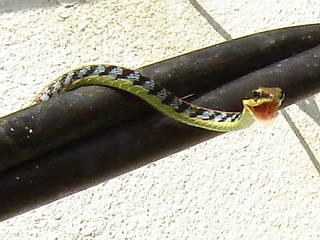
Notes on diet and reproduction #
Diet is heavily lizard — geckos, skinks, agamids — taken in fast active pursuit through the canopy. We have watched a Striped Bronzeback chase a flying lizard (Draco) along a horizontal branch for nearly two metres before the Draco escaped by gliding to a different tree. The species also takes the occasional small bird, roosting frog, or bird egg. Reproduction is oviparous, clutches of 5–7 eggs laid in tree hollows or fruit-tree leaf litter, hatching in 60–70 days.
Where to look #
Productive sites in southern Thailand:
- Mature rubber estates with old fruit trees mixed in. The bronzeback uses fruit-tree canopy more than the rubber itself.
- Coconut plantations behind the beach, especially in early morning when sun first hits the canopy.
- Forest edges of small reserves — the snake basks on outer branches catching the first heat of the day.
- Old fruit-orchard gardens around long-established Thai homes. Bronzebacks tolerate this habitat well as long as the canopy is reasonably continuous.
Less productive: oil palm (canopy too low and too uniform), heavily cleared agricultural land, very dry deciduous forest. The species needs reliable lizard prey and overhead cover.
If you find one #
Watch and walk past — they are harmless. Striped Bronzebacks photograph beautifully in morning sun (the metallic sheen really shows), and the inflate-and-expose-blue display is worth a careful slow approach to capture. Do not try to handle. The species’ fragility in heat is real; an animal kept in a warm bag for an hour can deteriorate quickly.
For comparison with the other two Thai bronzeback species, see our profiles of the Common Painted Bronzeback and the Wall’s Blue Bronzeback. For the wider catalogue of harmless Thai garden snakes, see common non-venomous Thailand snakes.
External references: the Reptile Database entry for Dendrelaphis caudolineatus for taxonomy and the iNaturalist record for the global distribution.

Quick reference card #
- Where most often encountered: See the range and habitat section above. Encounter rates rise sharply during the species’ active season — for most Thai snakes, this is the wet season (May–November) with a smaller secondary peak around the end of the cool months.
- Activity period: Whether the snake is diurnal, nocturnal or crepuscular shapes the practical encounter risk. Nocturnal species are more often missed in the dark; diurnal species are more often photographed clearly.
- Bite risk to humans: Determined by whether the species is venomous, how readily it bites when disturbed, how often it is encountered in human-modified landscape, and how potent its venom is. The combination matters more than any single factor.
- Best behaviour on encounter: Stand back, photograph from a respectful distance (two metres or more), do not handle, and let the snake leave under its own power. The great majority of Thai snake encounters resolve themselves without intervention if the human steps back.
Frequently asked questions #
Is this species protected under Thai law?
Many Thai snakes are protected under the Wild Animal Reservation and Protection Act. King Cobras, Burmese Pythons, Reticulated Pythons and several smaller species are explicitly listed; killing or trading these species is technically a criminal offence even when enforcement is uneven. For other species the legal status is more permissive, but local rules vary by province and protected-area designation. When in doubt, do not kill — call the volunteer fire-brigade rescue team for free relocation.
What should I do if my pet was bitten?
Take the pet to a veterinarian immediately. Veterinarians in Thailand have access to the same antivenoms used for humans, and treatment success in dogs and cats is reasonable when the bite is recognised quickly. Do not waste time on folk remedies. Photograph the snake from a safe distance if you can — the species ID will help the vet pick the correct antivenom.
How can I keep this species out of my garden?
Three things reduce snake encounters in a garden setting: cut grass and dense ground cover short, store firewood and outdoor materials elevated rather than ground-piled, and reduce rodent populations (snakes follow rats). Lighting walking paths after dark also helps prevent foot-on-snake encounters. None of these are perfect — wild snakes will still pass through — but together they substantially reduce the chance of an encounter.
Are juveniles as dangerous as adults?
For venomous species, yes — juveniles are venomous from birth and the venom is the same potent toxin as in adults. The dose per bite is smaller, but small doses of potent venom can still be life-threatening. There is also a folk-belief that juveniles “cannot control” their venom delivery and inject more per bite than an adult; the evidence for this is mixed but the practical lesson is to treat juveniles with the same caution as adults.
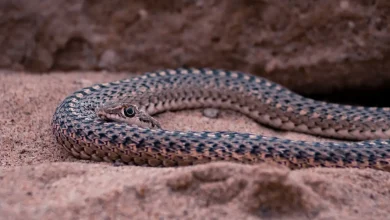
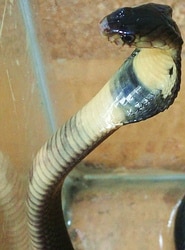
I have been in Thailand for about two months now and have seen this snake over a dozen times in my garden and around ponds. Is it safe to hold?
A striped bronzeback is safe to hold. If you’re 100% sure of that ID, then you shouldn’t have any problems.