Javan File Snake (Acrochordus javanicus) — The Wrinkly Aquatic Constrictor

The Javan File Snake looks like nothing else in Thai waters. Acrochordus javanicus is a heavy-bodied, fully aquatic, non-venomous constrictor with a saggy loose skin covered in tiny granular scales. Run a finger along the body and the texture is unmistakable — like sandpaper. The skin is so loose that the snake almost looks deflated when out of water. We meet them rarely, almost always after they have been pulled up in fish nets, and they are one of the most distinctive Thai snakes once you have seen one.
Identification #
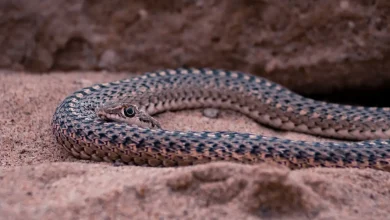
Adults reach 1.5–2.0 m, with the largest females recorded at 2.4 m and remarkable for sheer mass — a 2-metre Javan File Snake can weigh 5 kg. Body cylindrical to slightly laterally compressed. Head small relative to body, slightly pointed. Eye small, round pupil, set high on the head — adapted for an underwater lifestyle. The skin is the key feature: matte grey-brown to olive, sometimes with a few faint paler spots, very loose and thrown into wrinkles. Body scales are tiny, granular and rough — the species is named for that texture.
Adults are unmistakable; juveniles can occasionally be confused with one of the freshwater Cerberus water snakes, but Cerberus are much more slender and have ordinary smooth scales rather than the file-snake granular texture.
Range and habitat #

The species ranges from southern Thailand south through Malaysia and Indonesia, with strong populations in the lowland rivers of southern Thailand, southern Myanmar and into Sumatra and Java. Records in Thailand are concentrated in the south — Surat Thani, Phang Nga, Krabi, Trang, Songkhla and Pattani — with isolated records up the central plains. The species lives in freshwater and brackish water: rivers, slow lowland streams, mangrove channels, estuaries and large reservoirs. Salinity tolerance is wide.
Activity is largely nocturnal but the species’ time on the surface is brief — Javan File Snakes can stay underwater for an hour or more, and most of the diving life happens in shallow muddy water. They almost never come ashore voluntarily.
Diet and behaviour #
Diet is fish, taken by ambush in muddy water. The rough granular skin works as friction against the wet, slimy bodies of fish — the snake wraps around a fish and the rough skin gives the constriction grip that ordinary smooth scales would lose. It is one of the more elegant evolutionary adaptations in any Asian snake. Hunting is slow and deliberate; the snake wraps a fish without much fight and waits for it to suffocate before swallowing.
Defensive behaviour is essentially nil. Out of water the species is sluggish and almost incapable of fast movement. It will not bite even when handled. The bite, if it ever happens, is harmless — small recurved teeth, no venom, no medical concern.
Reproduction and conservation #
The species is fully viviparous; pups are born in the water. Litters are 6–17 with very large females reaching the upper end. Newborns are about 30 cm. Pups are immediately aquatic — like the adults, they almost never come ashore.
Conservation status is currently Least Concern (IUCN), but local populations are under pressure from habitat loss (mangrove conversion to shrimp farms, river channelisation), bycatch in fishing nets, and a steady international demand for the skin — Javan File Snake leather has historically been used for small leather goods, and Thailand and Indonesia have been net exporters in past decades. The species’ slow life-history and concentration in lowland rivers make it sensitive to development pressure.
If you find one #
Hands-down the snake is harmless. If it is in a fish net, the kindest thing is to release it back into the river — even net-stranded animals usually recover well after a few hours back in water. Do not handle for long; the species’ loose skin is a poor support for body weight out of water and prolonged handling can damage internal organs. If you photograph one, do it quickly and put it back.
For our wider catalogue of Thai water snakes (most of which are far more slender and active than the file snake), see our common non-venomous Thailand snakes reference and the related notes on how to identify snakes in Thailand.
External references: the Reptile Database entry for Acrochordus javanicus covers taxonomy, and the IUCN Red List assessment records the species as Least Concern. The Wikipedia article is a clean lay introduction.
Quick reference card #
- Where most often encountered: See the range and habitat section above. Encounter rates rise sharply during the species’ active season — for most Thai snakes, this is the wet season (May–November) with a smaller secondary peak around the end of the cool months.
- Activity period: Whether the snake is diurnal, nocturnal or crepuscular shapes the practical encounter risk. Nocturnal species are more often missed in the dark; diurnal species are more often photographed clearly.
- Bite risk to humans: Determined by whether the species is venomous, how readily it bites when disturbed, how often it is encountered in human-modified landscape, and how potent its venom is. The combination matters more than any single factor.
- Best behaviour on encounter: Stand back, photograph from a respectful distance (two metres or more), do not handle, and let the snake leave under its own power. The great majority of Thai snake encounters resolve themselves without intervention if the human steps back.
Frequently asked questions #
Is this species protected under Thai law?
Many Thai snakes are protected under the Wild Animal Reservation and Protection Act. King Cobras, Burmese Pythons, Reticulated Pythons and several smaller species are explicitly listed; killing or trading these species is technically a criminal offence even when enforcement is uneven. For other species the legal status is more permissive, but local rules vary by province and protected-area designation. When in doubt, do not kill — call the volunteer fire-brigade rescue team for free relocation.
What should I do if my pet was bitten?
Take the pet to a veterinarian immediately. Veterinarians in Thailand have access to the same antivenoms used for humans, and treatment success in dogs and cats is reasonable when the bite is recognised quickly. Do not waste time on folk remedies. Photograph the snake from a safe distance if you can — the species ID will help the vet pick the correct antivenom.
How can I keep this species out of my garden?
Three things reduce snake encounters in a garden setting: cut grass and dense ground cover short, store firewood and outdoor materials elevated rather than ground-piled, and reduce rodent populations (snakes follow rats). Lighting walking paths after dark also helps prevent foot-on-snake encounters. None of these are perfect — wild snakes will still pass through — but together they substantially reduce the chance of an encounter.
Are juveniles as dangerous as adults?
For venomous species, yes — juveniles are venomous from birth and the venom is the same potent toxin as in adults. The dose per bite is smaller, but small doses of potent venom can still be life-threatening. There is also a folk-belief that juveniles “cannot control” their venom delivery and inject more per bite than an adult; the evidence for this is mixed but the practical lesson is to treat juveniles with the same caution as adults.
Related on Thailand Snakes: snake identification decision tree, avoiding snakebites in Thailand, Thailand snakebite first-aid guide.