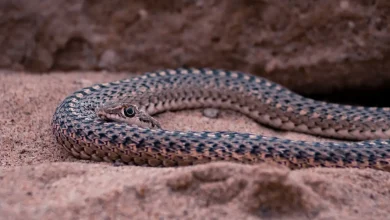
Snake Identification in Thailand — A Practical Decision Tree
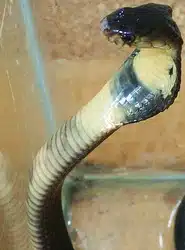
Identifying a snake quickly in Thailand is a skill, not a guess. The decision-tree approach works far better than flipping through pages of a field guide. We use the four-question filter every time we see an unfamiliar snake: colour pattern, head shape, eye/pupil, behaviour. Run the answers through and you usually narrow a Thai snake to a small group of candidates inside a minute.
Question 1 — colour and pattern #
Start with the dominant ground colour and the largest pattern feature.
- Bright green: One of the green pit vipers (most likely White-Lipped or Large-Eyed) or one of the green colubrids (Golden Tree Snake, Oriental Whip Snake). The pit-viper-versus-colubrid call comes from question 2.
- Bronze-brown with metallic sheen: One of the three Bronzeback species — see Common Painted Bronzeback.
- Black with bold yellow or white bands: Banded Krait, juvenile King Cobra, or Banded Mangrove Snake — see Banded Krait.
- Olive-green with red neck: almost certainly the dangerous Red-Necked Keelback.
- Tan with dark blotches: Pythons (Burmese, Reticulated) or the Malayan Pit Viper.
- Uniform grey or olive: One of several water snakes (Enhydris group) or a juvenile rat snake.
- Bright black with yellow snout, banded: Yellow-Lipped Sea Krait if on a beach.
Question 2 — head shape and neck #
Look at the head from the side and from above:
- Triangular head, head clearly distinct from neck: Pit viper. Vertical pupil confirms.
- Long oval head, head only slightly distinct from neck: Colubrid (rat snake, whip snake, bronzeback, cat snake). Most are non-venomous or mildly rear-fanged.
- Cylindrical head, head almost continuous with body: Krait, blind snake, or one of the small water snakes.
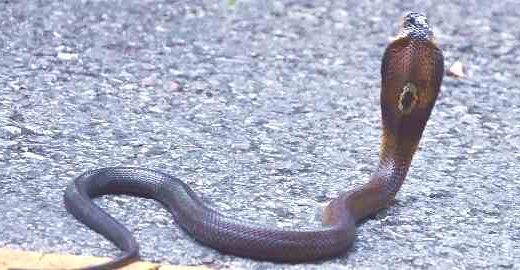
- Spread hood when rearing: Cobra. Hood pattern then identifies the species — see spitting cobras and Monocled Cobra.
Question 3 — pupil and eye #
From a safe distance and a photo:
- Vertical (cat-like) pupil: Pit viper, cat snake, or python. Most cat-pupil snakes are nocturnal.
- Round pupil: Cobra, krait, rat snake, bronzeback, most colubrids. Most round-pupil snakes are diurnal.
- Horizontal pupil: Whip snakes (Ahaetulla). Distinctive and diagnostic.
Question 4 — behaviour #
Watch what the snake does — defensive behaviour is often diagnostic:
- Rears, spreads hood, stays in place: Cobra.
- Coils tight, opens mouth, lunges feebly: Cat snake (Boiga).
- Inflates front of body, flashes blue interstitial skin: Bronzeback. Bluff display, not bite.
- Holds position on a branch, does not flee: Pit viper.
- Flees fast through grass or canopy: Whip snake, rat snake, racer.
- Flattens body and freezes on the ground: Banded Krait or Malayan Pit Viper.
The four-question worked example #
You see a snake in your Bangkok garden. Bright green dorsum, rusty brown tail, sitting still on a low branch.
- Q1 — Bright green. Likely pit viper or whip snake.
- Q2 — Triangular head clearly wider than neck. Pit viper.
- Q3 — Vertical pupil (binoculars). Confirmed pit viper.
- Q4 — Sitting still, holding position. Yes, pit viper.
Conclusion: White-Lipped Pit Viper or Large-Eyed Pit Viper. The pale upper lip would push toward White-Lipped; an unusually large eye toward Large-Eyed. In central Bangkok, both species are likely; the bite picture and treatment are essentially identical, so a precise species ID is academic from the medical standpoint.
What if I cannot ID it? #
Photograph from a distance and post it to our reader-submission queue or to iNaturalist. Default to “treat as venomous and dangerous” if you have any doubt, and stay back at least two metres. The cost of being wrong about ID is small if you treat every unknown snake as if it could bite; the cost of being wrong while handling the wrong snake is enormous.
For the wider field guide see our how to identify snakes in Thailand reference, the common venomous Thailand snakes overview, and the matching non-venomous reference.
External references: the Reptile Database for taxonomy and species records, and the iNaturalist citizen-science platform for crowd-sourced ID help.

Key takeaways #
- Context matters more than rules of thumb. Thailand’s snake fauna varies meaningfully by region, by season, and by habitat. Advice that holds in southern wet forest does not always hold in northern hill country or in the central agricultural plains.
- Prevention is high-leverage. Most serious snake-related incidents in Thailand are downstream of three preventable behaviours — reaching where you cannot see, walking forest paths at night without a torch, and attempting to handle or kill snakes rather than call professional removal.
- Hospital access is the real safety net. Thai provincial hospitals stock the standard polyvalent antivenoms. The single biggest predictor of bad outcome from a serious bite is delay in reaching one of those hospitals.
- Citizen-science records help. Even casual photographs with location data, posted to platforms like iNaturalist, contribute to the regional knowledge base. Most Thai snake species have surprisingly thin distribution data; one well-documented sighting can fill a real gap.
Common questions #
How likely am I to see a snake on a casual visit to Thailand?
Lower than you probably expect. A casual three-hour daytime forest hike in southern Thailand has roughly a 5–10% chance of producing any snake encounter at all, and roughly a 0.5–1% chance of producing a venomous-species sighting. Visitors who deliberately go looking — at night, in good habitat — see far more, but the casual exposure is genuinely low.
What time of year has the most snake activity?
The wet season (May through October) produces by far the most snake encounters across most of Thailand. Within that, two peaks: the start of the rains (April–June) when males are moving for breeding, and late wet season (September–November) when juvenile cohorts disperse from nest sites. The dry season (December–March) is genuinely quieter for snake-watching, particularly in the north and northeast.
Are Thai snakebite outcomes really that good?
For patients who reach a hospital within an hour or two of a venomous bite, yes — Thai outcomes are excellent by international standards. Mortality with appropriate antivenom and supportive care runs under 1% for most species. The deaths that do happen are concentrated in cases of significant pre-hospital delay, mis-identification of species, or in patients with serious co-morbidities. The Thai system is robust; the failure modes are mostly upstream of the hospital.
What is the single best preventive measure?
A torch at night. The single biggest reducer of Thai snakebite risk is consistent, eyes-down torch use on every walking path after dark. Most preventable bites in southern Thailand are foot-on-snake events on the ground at night, and a torch beam on the trail at metre-down angle prevents the great majority of them. Closed footwear is the second-biggest improvement; long trousers in dense vegetation is third.