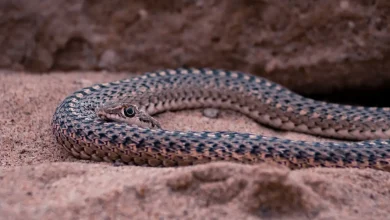
Jagor’s Water Snake — Field Notes from Lowland Pond Surveys

This is a working notebook of our field encounters with Jagor’s Water Snake. The full species profile lives on our main Jagor’s Water Snake page. This piece is the field-notes companion — when, where, how often, and what we have observed across years of dip-net surveys in lowland Thai ponds.
What our records show #
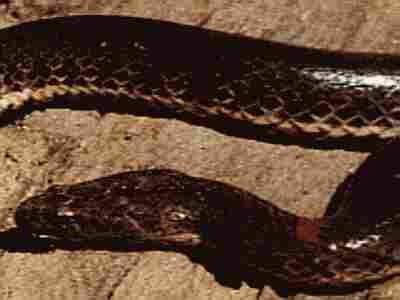
Across roughly fifteen years of casual lowland snake records in central and southern Thailand, Jagor’s Water Snake has been one of the most consistent species in our pond and reservoir surveys. Activity peaks in the mid-rainy season — June through August — when newborn fish provide an easy food source and when reservoirs are at their highest level with the most marginal vegetation. Activity drops to near zero during the late dry season; we have caught fewer than three individuals in any March or April across all years combined.
Most encounters are at dusk and through the first two hours of darkness. Daylight records are rare and almost always involve heavily overcast conditions or shaded ponds. Body size in our records ranges from 25 cm hatchlings up to one female near Phitsanulok measuring 84 cm, the largest we have personally measured.
Where we look #

Productive sites for the species:
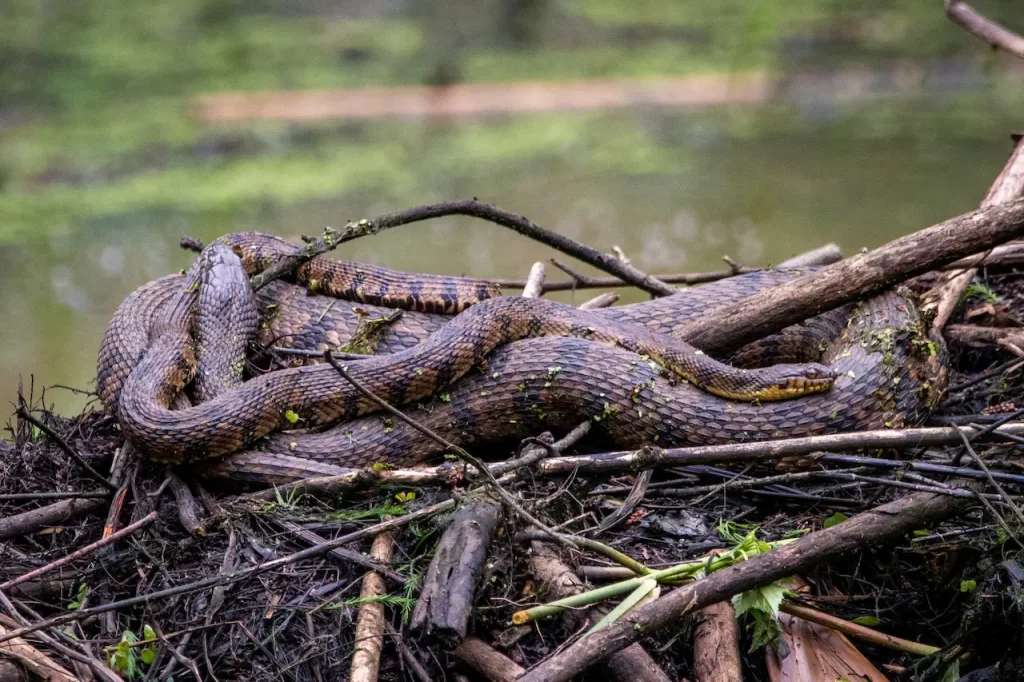
- Edges of large lowland reservoirs with grass and emergent vegetation. Especially anywhere there is a clear shallow zone with rooted aquatic plants.
- Older fish farm ponds with semi-natural margins. New, lined ponds rarely hold the species.
- Slow irrigation canals with bank vegetation. We pull more from canals after a quiet stretch of weather than from canals after recent flooding.
- Backwater pools off slow rivers. These are particularly good after the first rains break the dry season — fish move into the warm shallow water and the snakes follow.
Less productive: heavily shaded forest pools, fast-flowing streams, very polluted urban canals. The species needs sunlight on water to support the small-fish populations it eats.
Notes on temperament #
Jagor’s are calmer in the hand than most other Enhydris. Once stabilised in a wet bag, they rarely strike or musk. Out of water for more than a few minutes they become lethargic; we always work them quickly and return to water as soon as photographs and measurements are done. Some specimens — usually large, gravid females — produce a noticeable musk if handled roughly. We see no point in stressing the snake to that degree.
The species’ small size and uniform colouration do not photograph well in poor light. We have learned to use a soft daylight LED panel above a clear holding tank rather than a direct flash — the slight olive cast of the dorsum vanishes under flash and the resulting photo looks like a generic black snake. For our wider gallery of Thai water snakes, see Thailand snake photos.
Wider take-aways #
Jagor’s Water Snake is one of the species most likely to vanish quietly from a region without anyone noticing. The species is small, mostly nocturnal, harmless and unobtrusive — the kind of snake that does not show up in casual records. Citizen-science records (iNaturalist, GBIF) for the species are sparse compared to its actual abundance. If you photograph one, please consider posting the record to iNaturalist with location data.
For the species’ formal range, biology and bite picture, see our main Jagor’s Water Snake profile. For the wider Thai water-snake community, the common non-venomous Thai snakes reference covers the related species. The Reptile Database entry is the cleanest external taxonomy reference.
Key takeaways #
- Context matters more than rules of thumb. Thailand’s snake fauna varies meaningfully by region, by season, and by habitat. Advice that holds in southern wet forest does not always hold in northern hill country or in the central agricultural plains.
- Prevention is high-leverage. Most serious snake-related incidents in Thailand are downstream of three preventable behaviours — reaching where you cannot see, walking forest paths at night without a torch, and attempting to handle or kill snakes rather than call professional removal.
- Hospital access is the real safety net. Thai provincial hospitals stock the standard polyvalent antivenoms. The single biggest predictor of bad outcome from a serious bite is delay in reaching one of those hospitals.
- Citizen-science records help. Even casual photographs with location data, posted to platforms like iNaturalist, contribute to the regional knowledge base. Most Thai snake species have surprisingly thin distribution data; one well-documented sighting can fill a real gap.
Common questions #
How likely am I to see a snake on a casual visit to Thailand?
Lower than you probably expect. A casual three-hour daytime forest hike in southern Thailand has roughly a 5–10% chance of producing any snake encounter at all, and roughly a 0.5–1% chance of producing a venomous-species sighting. Visitors who deliberately go looking — at night, in good habitat — see far more, but the casual exposure is genuinely low.
What time of year has the most snake activity?
The wet season (May through October) produces by far the most snake encounters across most of Thailand. Within that, two peaks: the start of the rains (April–June) when males are moving for breeding, and late wet season (September–November) when juvenile cohorts disperse from nest sites. The dry season (December–March) is genuinely quieter for snake-watching, particularly in the north and northeast.
Are Thai snakebite outcomes really that good?
For patients who reach a hospital within an hour or two of a venomous bite, yes — Thai outcomes are excellent by international standards. Mortality with appropriate antivenom and supportive care runs under 1% for most species. The deaths that do happen are concentrated in cases of significant pre-hospital delay, mis-identification of species, or in patients with serious co-morbidities. The Thai system is robust; the failure modes are mostly upstream of the hospital.
What is the single best preventive measure?
A torch at night. The single biggest reducer of Thai snakebite risk is consistent, eyes-down torch use on every walking path after dark. Most preventable bites in southern Thailand are foot-on-snake events on the ground at night, and a torch beam on the trail at metre-down angle prevents the great majority of them. Closed footwear is the second-biggest improvement; long trousers in dense vegetation is third.