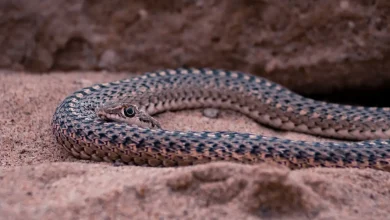
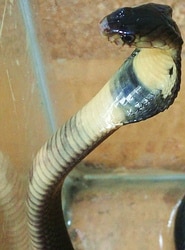
Helfenberg’s Racer (Orthriophis taeniurus helfenbergeri) — A Krabi Forest Specialist

Helfenberg’s Racer is a name most Thai snake-watchers have never heard. Orthriophis taeniurus helfenbergeri is one of the southern subspecies of the widespread Beauty Rat Snake, described from a single specimen collected in the limestone karst country around Krabi province in southern Thailand. It is a beautiful snake — an athletic, harmless, fast-moving rat snake — and we have caught fewer than ten in twenty years of southern herping. It is the kind of species you go out specifically hoping to see and rarely do.
Identification #
Adults reach 1.5–2.0 m, with the largest record from Krabi pushing 2.4 m. The snake is slender, fast, and proportionately long-tailed. Colour pattern shifts dramatically along the length of the body — head and front third are clean grass-green or yellow-green, the middle third has paler dorsum with a series of dark blotches, and the rear third is patterned with a bold black-and-yellow longitudinal stripe leading to the tail. Belly is pale yellow. The head is ovoid with a noticeable dark eye-stripe. Eyes are golden, pupils round.
The Helfenberg subspecies is separated from other Beauty Rat Snake forms by the precise pattern of the black tail-stripes (which converge differently in nominate taeniurus) and by mid-body scale counts. Practical hint: a Beauty Rat Snake from Krabi or southern Surat Thani is almost certainly the Helfenberg form. The species is occasionally confused with the Indo-Chinese Rat Snake (Ptyas korros), but Beauty Rat Snakes are larger, more colourful and have a different head shape.
Range and habitat #

The Helfenberg subspecies is restricted to limestone karst landscape in southern Thailand, with the strongest populations in Krabi, Phang Nga and Surat Thani provinces. Records also exist from southern Myanmar and a handful of sites in northern Malaysia. Inside Thailand, the species favours the bases of karst towers, cave entrances, and forest along limestone cliffs. They are also reasonably common in fruit orchards and rubber stands at the foot of karst formations.
Activity is largely crepuscular and diurnal. They climb readily and hunt at every level — leaf litter, low understory and high into the canopy. Cave entrances are productive search sites; the snake hunts roosting bats and swiftlets at known cave systems and we have photographed them coming out of caves at dusk.
Behaviour and diet #
Diet is dominated by birds and bats — Beauty Rat Snakes are one of the few Asian snakes that habitually take roosting bats, and the Helfenberg form does this in cave systems across the Krabi karst. Smaller mammals, lizards and bird eggs make up the rest. The hunting strategy is active pursuit; this is one of the fastest snakes you will see in southern Thailand, and adults can move surprisingly long horizontal distances in seconds when they are spooked.
Defensive behaviour is mostly flight. Cornered animals will rear and hiss, sometimes biting if grabbed, but they have no medically significant venom and the bite is just a row of small teeth marks. Reproduction is oviparous; clutches of 7–14 elongate eggs are laid in tree hollows or rotting logs, hatching in roughly 65 days.
Conservation and where this fits #
Restricted-range subspecies like this one are at the mercy of habitat loss. The Krabi karst country has been developed heavily for tourism, quarried for cement and limestone, and converted in places to short-rotation crops. Helfenberg’s Racer appears to need mature forest connectivity around the karst formations to thrive; it adapts somewhat to fruit orchards and rubber but is much less common in oil palm or in cleared agricultural landscape. The species is also collected for the international pet trade, where Beauty Rat Snakes generally are popular.
If you photograph one in southern Thailand, please consider posting the record to iNaturalist — it will substantially improve the very limited known distribution map. For our broader catalogue of southern non-venomous species, see our common non-venomous Thai snakes reference and the related notes on how to identify snakes in Thailand.
If you find one #
Watch and photograph — do not catch. Helfenberg’s Racers are fast and stressful to handle, and they are uncommon enough that every catch is a small loss to a small population. Keep your distance, get a clear photo of the body pattern (especially the rear third with the longitudinal stripe), and write down the GPS coordinates. If the snake is in a cave or near tourist infrastructure, the right thing is usually to walk past — they will move on as soon as the disturbance ends.
External references: the Reptile Database entry for the species covers the subspecies-level taxonomy, and the Wikipedia article on the Beauty Rat Snake is a reasonable lay introduction to the species’ impressive range and the various subspecies.
Key takeaways #
- Context matters more than rules of thumb. Thailand’s snake fauna varies meaningfully by region, by season, and by habitat. Advice that holds in southern wet forest does not always hold in northern hill country or in the central agricultural plains.
- Prevention is high-leverage. Most serious snake-related incidents in Thailand are downstream of three preventable behaviours — reaching where you cannot see, walking forest paths at night without a torch, and attempting to handle or kill snakes rather than call professional removal.
- Hospital access is the real safety net. Thai provincial hospitals stock the standard polyvalent antivenoms. The single biggest predictor of bad outcome from a serious bite is delay in reaching one of those hospitals.
- Citizen-science records help. Even casual photographs with location data, posted to platforms like iNaturalist, contribute to the regional knowledge base. Most Thai snake species have surprisingly thin distribution data; one well-documented sighting can fill a real gap.
Common questions #
How likely am I to see a snake on a casual visit to Thailand?
Lower than you probably expect. A casual three-hour daytime forest hike in southern Thailand has roughly a 5–10% chance of producing any snake encounter at all, and roughly a 0.5–1% chance of producing a venomous-species sighting. Visitors who deliberately go looking — at night, in good habitat — see far more, but the casual exposure is genuinely low.
What time of year has the most snake activity?
The wet season (May through October) produces by far the most snake encounters across most of Thailand. Within that, two peaks: the start of the rains (April–June) when males are moving for breeding, and late wet season (September–November) when juvenile cohorts disperse from nest sites. The dry season (December–March) is genuinely quieter for snake-watching, particularly in the north and northeast.
Are Thai snakebite outcomes really that good?
For patients who reach a hospital within an hour or two of a venomous bite, yes — Thai outcomes are excellent by international standards. Mortality with appropriate antivenom and supportive care runs under 1% for most species. The deaths that do happen are concentrated in cases of significant pre-hospital delay, mis-identification of species, or in patients with serious co-morbidities. The Thai system is robust; the failure modes are mostly upstream of the hospital.
What is the single best preventive measure?
A torch at night. The single biggest reducer of Thai snakebite risk is consistent, eyes-down torch use on every walking path after dark. Most preventable bites in southern Thailand are foot-on-snake events on the ground at night, and a torch beam on the trail at metre-down angle prevents the great majority of them. Closed footwear is the second-biggest improvement; long trousers in dense vegetation is third.
Related on Thailand Snakes: are Thailand snakes aggressive?, Thailand snake books and shirts, common Thailand venomous snakes overview.