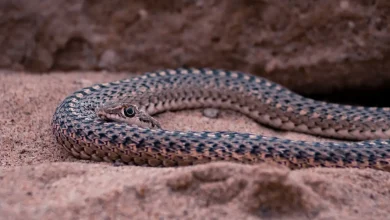
Blood Python (Python brongersmai) — Southern Thailand’s Short, Stout, Heavy Python

Blood Pythons are short, thick, and surprisingly strong. Python brongersmai is one of the smaller members of the python family — adults rarely exceed 1.8 m — but they are heavy-bodied and built for ambush in flooded peat-swamp and rice-paddy edges in southern Thailand and Sumatra. The English name comes from the rich brick-red ground colour many adults show. The species has been heavily harvested for the international skin trade over the past five decades, and Thailand has been one of the main source countries.
Identification #
Adults reach 1.2–1.8 m, occasionally 2.0 m, but the species is unusually heavy for its length — a 1.5 m Blood Python can weigh 8 kg, easily double a same-length reticulated python. The body is short, deep, and almost neckless; the head is broad and flat, distinct from the body but barely. Ground colour ranges from brick red through reddish-brown to ochre with darker brown blotches; some individuals have a clear mid-dorsal pale band. The tail is short and tapers abruptly. Belly is whitish or pale yellow.
The closest look-alike is the much smaller and slimmer Borneo Short-tailed Python (P. breitensteini), which does not occur in Thailand. The Burmese Python is much larger, more elongate and has a different blotch pattern. Once you have seen a Blood Python, the short heavy build is unmistakable.
Range and habitat #

The species is restricted to the southern Thai peninsula, the Malay peninsula, Sumatra and small adjacent islands. In Thailand the range is essentially everywhere south of about Surat Thani, with the strongest populations in the peat-swamp forest and rice-paddy landscape of the deep south (Yala, Pattani, Narathiwat, Songkhla). Habitat is wet, flat, often half-flooded — peat swamps, rice paddies, drainage ditches, fish farms and the edges of slow lowland rivers. They are decidedly not forest snakes.
Activity is largely nocturnal and crepuscular. Daytime is spent submerged with just the eyes above water, or coiled in dense floating vegetation. Hot dry weather pushes them into burrows; we see numbers come out at the start of the rains.
Behaviour, diet and reproduction #
Diet is dominated by small mammals — rats, voles, occasional small birds. The hunting strategy is ambush from shallow water or floating vegetation. Strike, coil, drown. The species is faster than its short build suggests; an adult Blood Python can pivot 180° in less than a second from a coiled rest. Defensive behaviour is remarkably bold for a python — they hold position, hiss loudly, strike repeatedly, and bite hard. Pet keepers know the species as one of the most defensive of the “small” python species; wild adults in southern Thailand have the same temperament.
Reproduction is oviparous. Females lay 12–30 eggs, coil around them and incubate by muscle contraction (raising body temperature 1–2 °C above ambient), and stay with the clutch until hatching. Hatchlings are about 30 cm. Hatching season is April–June.
Conservation pressure #
Blood Pythons have been the target species of one of the largest reptile-skin export industries in Asia. Indonesian harvest figures alone have run into the hundreds of thousands of skins per year over much of the past two decades; Thai harvest has been smaller but still meaningful. The species is listed on CITES Appendix II and Thai exports are regulated, but illegal harvest in the deep south continues. Habitat loss to oil-palm conversion is the other major pressure. Local populations in Yala and Narathiwat appear thinner than they did twenty years ago.
Bites: the species is non-venomous but the bite from an adult is severe — large recurved teeth, strong jaw musculature and willingness to hold. We treat handling adult Blood Pythons as needing two people the same way as Burmese Python. The bite itself does not kill (unless secondary infection sets in), but it does the kind of soft-tissue damage that needs hospital cleaning. Our piece on the Burmese Python danger profile covers the wider context of “non-venomous but dangerous”.
If you find one #
Do not handle. Call a professional snake-rescue team. Blood Pythons are heavy and bold and require experienced handling. The local fire brigade in southern Thailand handles snake removal — see our snake removal phone numbers list for contacts. If you photograph one, the brick-red colour photographs well in mid-morning light; the species’ short build looks almost cartoonish in good photos.
External references: the Reptile Database entry for Python brongersmai for taxonomy, and the IUCN Red List assessment — currently Least Concern globally but with documented harvest pressure across the species range.
Quick reference card #
- Where most often encountered: See the range and habitat section above. Encounter rates rise sharply during the species’ active season — for most Thai snakes, this is the wet season (May–November) with a smaller secondary peak around the end of the cool months.
- Activity period: Whether the snake is diurnal, nocturnal or crepuscular shapes the practical encounter risk. Nocturnal species are more often missed in the dark; diurnal species are more often photographed clearly.
- Bite risk to humans: Determined by whether the species is venomous, how readily it bites when disturbed, how often it is encountered in human-modified landscape, and how potent its venom is. The combination matters more than any single factor.
- Best behaviour on encounter: Stand back, photograph from a respectful distance (two metres or more), do not handle, and let the snake leave under its own power. The great majority of Thai snake encounters resolve themselves without intervention if the human steps back.
Frequently asked questions #
Is this species protected under Thai law?
Many Thai snakes are protected under the Wild Animal Reservation and Protection Act. King Cobras, Burmese Pythons, Reticulated Pythons and several smaller species are explicitly listed; killing or trading these species is technically a criminal offence even when enforcement is uneven. For other species the legal status is more permissive, but local rules vary by province and protected-area designation. When in doubt, do not kill — call the volunteer fire-brigade rescue team for free relocation.
What should I do if my pet was bitten?
Take the pet to a veterinarian immediately. Veterinarians in Thailand have access to the same antivenoms used for humans, and treatment success in dogs and cats is reasonable when the bite is recognised quickly. Do not waste time on folk remedies. Photograph the snake from a safe distance if you can — the species ID will help the vet pick the correct antivenom.
How can I keep this species out of my garden?
Three things reduce snake encounters in a garden setting: cut grass and dense ground cover short, store firewood and outdoor materials elevated rather than ground-piled, and reduce rodent populations (snakes follow rats). Lighting walking paths after dark also helps prevent foot-on-snake encounters. None of these are perfect — wild snakes will still pass through — but together they substantially reduce the chance of an encounter.
Are juveniles as dangerous as adults?
For venomous species, yes — juveniles are venomous from birth and the venom is the same potent toxin as in adults. The dose per bite is smaller, but small doses of potent venom can still be life-threatening. There is also a folk-belief that juveniles “cannot control” their venom delivery and inject more per bite than an adult; the evidence for this is mixed but the practical lesson is to treat juveniles with the same caution as adults.
Related on Thailand Snakes: Thailand snake books and shirts, common Thailand venomous snakes overview, common non-venomous Thailand snakes reference.