Keeled Slug Snake (Pareas carinatus) — The Snake That Eats Snails

The Keeled Slug Snake is one of the most genuinely strange snakes in Thailand. Pareas carinatus belongs to a small Asian family of snakes that have specialised to eat snails and slugs almost exclusively, and their anatomy reflects the diet — most famously, the lower jaw is asymmetric, with more teeth on the right side than the left because the snake mostly extracts dextrally-coiled snails. Once you have watched a Keeled Slug Snake delicately winkle a snail out of its shell, you understand why an entire family evolved around this one ecological niche.
Identification #
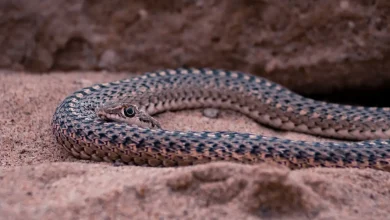
Adults are 50–75 cm. The body is moderately slender, more or less laterally compressed, with strongly keeled body scales that give the snake a textured, almost chiselled look. Ground colour ranges through brown, tan, reddish-brown and grey, usually with a series of darker dorsal blotches or a pair of darker lateral lines. The head is large relative to the slender neck — a striking ratio that reminds people of an arboreal pit viper, except the head is rounded and not triangular. The eye is large with a vertical pupil. Belly is pale tan, often with darker speckling along the edges of the ventrals.
The closest look-alikes are the other Thai Pareas species (Hampton’s Slug Snake and the White-Spotted Slug Snake). Pareas are recognisable as a group by the combination of vertical pupil, oversized head, keeled scales and rounded body — once you know the genus, individual species ID is mostly about colour pattern. None of the slug snakes are venomous, so getting the genus right is the practical part.
Range and habitat #

Keeled Slug Snakes are widespread across Southeast Asia. The Thai range covers the entire mainland, from the deep south through the central plains and into the north. They are most common in evergreen and semi-deciduous forest, but also occur in fruit orchards, rubber plantations and well-vegetated gardens — anywhere snails and slugs are abundant. After heavy rain, the species concentrates on damp leaf litter, mossy rocks and the bases of fallen logs.
Activity is strictly nocturnal. Daytime is spent coiled in leaf litter, under bark or in small crevices. They climb low foliage and saplings to hunt arboreal snails. Wet warm nights from May to October are when most encounters happen.
How they eat snails #
This is what makes the species worth a special trip. Pareas snakes have evolved a feeding mechanism specific to dextrally-coiled snails — the right side of the lower jaw has more teeth than the left, and the jaw twists during a feeding bout. The snake bites a snail, hooks its lower jaw inside the shell, and extracts the soft body in a sequence of careful jaw movements that take 30–90 seconds. Watching it happen with a torch is one of the better small wildlife experiences in southeast-Asian herping.
Slugs are taken whole. Diet is exclusively molluscan in adults; juveniles will occasionally take small earthworms. The species has no need for the kind of fast strike that other snakes use; movement is slow and deliberate, and the snake spends a meaningful share of every active night testing leaves and bark for slime trails to follow.
Behaviour and reproduction #
Defensive behaviour is mild — the snake coils, hisses softly, and may attempt a small open-mouth bluff. They will rarely actually bite, and the small teeth and lack of any meaningful venom make a Pareas bite a non-event. We have caught dozens for photography over the years and never had a defensive strike that drew blood.
Reproduction is oviparous. Clutches of 4–8 elongate eggs are laid in damp leaf litter or rotting wood, hatching in 50–60 days. Newborns are about 12 cm and start hunting the smallest snails immediately.
If you find one #
Photograph from a distance. Slug snakes are easy to handle but they are also stress-sensitive — their slow metabolism and slug-only diet means a stressed individual can take days to recover. If the animal is on a path where it might be stepped on, gently encourage it off with a stick; if it is in a place where it can be left alone, just admire and walk past. The species is one of the most beneficial snakes in any Thai garden, eating the snails that demolish leafy crops.
For wider context on the harmless small snakes you will run into in a Thai garden, see our reference on common non-venomous Thailand snakes and the related how to identify snakes in Thailand guide. Photography of the species is a good way to spend an evening; we keep a wider gallery on our Thailand snake photos page.
External references: the Reptile Database entry for Pareas carinatus for taxonomy and the Wikipedia article for a clean introduction to the species and the family’s strange jaw asymmetry.

Quick reference card #
- Where most often encountered: See the range and habitat section above. Encounter rates rise sharply during the species’ active season — for most Thai snakes, this is the wet season (May–November) with a smaller secondary peak around the end of the cool months.
- Activity period: Whether the snake is diurnal, nocturnal or crepuscular shapes the practical encounter risk. Nocturnal species are more often missed in the dark; diurnal species are more often photographed clearly.
- Bite risk to humans: Determined by whether the species is venomous, how readily it bites when disturbed, how often it is encountered in human-modified landscape, and how potent its venom is. The combination matters more than any single factor.
- Best behaviour on encounter: Stand back, photograph from a respectful distance (two metres or more), do not handle, and let the snake leave under its own power. The great majority of Thai snake encounters resolve themselves without intervention if the human steps back.
Frequently asked questions #
Is this species protected under Thai law?
Many Thai snakes are protected under the Wild Animal Reservation and Protection Act. King Cobras, Burmese Pythons, Reticulated Pythons and several smaller species are explicitly listed; killing or trading these species is technically a criminal offence even when enforcement is uneven. For other species the legal status is more permissive, but local rules vary by province and protected-area designation. When in doubt, do not kill — call the volunteer fire-brigade rescue team for free relocation.
What should I do if my pet was bitten?
Take the pet to a veterinarian immediately. Veterinarians in Thailand have access to the same antivenoms used for humans, and treatment success in dogs and cats is reasonable when the bite is recognised quickly. Do not waste time on folk remedies. Photograph the snake from a safe distance if you can — the species ID will help the vet pick the correct antivenom.
How can I keep this species out of my garden?
Three things reduce snake encounters in a garden setting: cut grass and dense ground cover short, store firewood and outdoor materials elevated rather than ground-piled, and reduce rodent populations (snakes follow rats). Lighting walking paths after dark also helps prevent foot-on-snake encounters. None of these are perfect — wild snakes will still pass through — but together they substantially reduce the chance of an encounter.
Are juveniles as dangerous as adults?
For venomous species, yes — juveniles are venomous from birth and the venom is the same potent toxin as in adults. The dose per bite is smaller, but small doses of potent venom can still be life-threatening. There is also a folk-belief that juveniles “cannot control” their venom delivery and inject more per bite than an adult; the evidence for this is mixed but the practical lesson is to treat juveniles with the same caution as adults.