Wall’s Bronzeback / Blue Bronzeback (Dendrelaphis cyanochloris) — The Flash of Blue

Wall’s Bronzeback is the bronze-and-blue tree snake people remember after they have seen one inflate. Dendrelaphis cyanochloris is one of three Bronzeback species in Thailand and the only one that, when threatened, exposes electric-blue interstitial skin between its body scales as a warning flash. The English name “Blue Bronzeback” comes from that flash; the formal name “Wall’s” honours Frank Wall, the early 20th-century British army surgeon turned herpetologist who described several Asian snakes from Burma.
Identification #
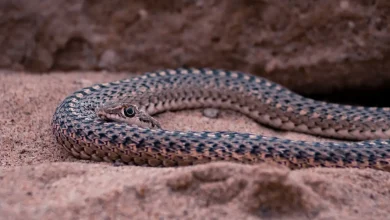
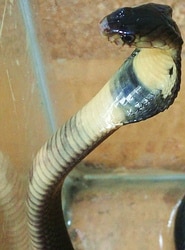
Adults are 90–130 cm. The body is slender and laterally compressed, the head is a long oval, and the eye is large with a round pupil. Dorsal colour at rest is bronze-brown to copper-brown, often with a subtle metallic sheen. The lateral stripe (where it exists) is faint and not as pronounced as in the Common Painted Bronzeback. The diagnostic feature is the brilliant turquoise-blue interstitial skin between body scales — invisible at rest, but flashed when the snake inflates the front third of its body in a defensive display. We have not seen another Thai snake do this so dramatically.
Common Painted Bronzeback (D. pictus) is the closest look-alike but has a more prominent yellow-and-black lateral stripe and the interstitial flash is more white-blue than the rich turquoise of cyanochloris. Striped Bronzeback (D. caudolineatus) has prominent dark dorsal striping. Mid-body scale rows in cyanochloris: 15.
Range and habitat #

The species occurs across Southeast Asia: Thailand, Myanmar, Laos, Vietnam, parts of southern China, Malaysia and parts of Indonesia. In Thailand it is widespread but more reliant on closed forest than the Common Painted Bronzeback — we have most records from mature forest and large forest fragments rather than suburban gardens. Both lowland and mid-elevation forest hold populations. They climb readily and are usually found 1–4 m off the ground in foliage.
Activity is strictly diurnal. They roost overnight in dense leaf cover and start moving with full sun. Cool overcast days produce few encounters. Hot bright mornings after rain are when most are seen.
Behaviour, diet and reproduction #
Diet is dominated by lizards and small frogs, taken in fast active pursuit. Small mammals and bird eggs make up a smaller share. Caught in the open, the snake’s first response is flight — Wall’s Bronzeback is one of the fastest tree snakes in Thai forest. Cornered, the defensive display is the famous one: rear up the front third, inflate the body to expose the blue interstitial skin, hold the position and look as big as possible. They rarely actually bite even when this fails; most opt for one final flight attempt.
Reproduction is oviparous. Clutches of 5–7 elongate eggs are laid in tree hollows or leaf litter, hatching in 60–70 days. Newborns are about 22 cm and immediately arboreal.
Are they dangerous? #
No. Wall’s Bronzeback has no medically significant venom. The bite is small puncture marks, light bleeding, and a snake that wants to be released. In several thousand documented Asian Bronzeback bites there are zero recorded fatalities and zero serious envenomation cases. Clean any bite, watch for infection, and let the snake go on its way.
Like other Bronzebacks, this species is occasionally killed because villagers mistake the inflated blue display for a “venomous snake about to attack”. The display is purely a bluff. The best defence is information; for the wider picture see our common non-venomous Thailand snakes reference and the related are Thailand snakes aggressive? page.
If you find one #
Get your camera ready and take photos at rest, then back away — the blue flash only appears when the animal feels threatened, and provoking it just to see the display is unkind. If the snake is in a tree near your house, leave it alone; it will move on by the next day. If you must move it, use a long stick from a metre back to encourage it to climb to a different perch. We have moved Wall’s Bronzebacks dozens of times without bag or hook simply by standing on the wrong side of the snake and asking it politely to move.
External references: the Reptile Database entry for Dendrelaphis cyanochloris covers taxonomy, and the iNaturalist record shows the global distribution from citizen-science observations.
 keelback-snake1.jpg" alt="Red-necked Keelback in defensive pose" class="wp-image-5" srcset="https://thailandsnakes.com/wp-content/uploads/2010/02/red-necked-keelback-snake1.jpg 500w, https://thailandsnakes.com/wp-content/uploads/2010/02/red-necked-keelback-snake1-300x88.jpg 300w, https://thailandsnakes.com/wp-content/uploads/2010/02/red-necked-keelback-snake1-150x44.jpg 150w" sizes="(max-width: 500px) 100vw, 500px" />
Quick reference card #
- Where most often encountered: See the range and habitat section above. Encounter rates rise sharply during the species’ active season — for most Thai snakes, this is the wet season (May–November) with a smaller secondary peak around the end of the cool months.
- Activity period: Whether the snake is diurnal, nocturnal or crepuscular shapes the practical encounter risk. Nocturnal species are more often missed in the dark; diurnal species are more often photographed clearly.
- Bite risk to humans: Determined by whether the species is venomous, how readily it bites when disturbed, how often it is encountered in human-modified landscape, and how potent its venom is. The combination matters more than any single factor.
- Best behaviour on encounter: Stand back, photograph from a respectful distance (two metres or more), do not handle, and let the snake leave under its own power. The great majority of Thai snake encounters resolve themselves without intervention if the human steps back.
Frequently asked questions #
Is this species protected under Thai law?
Many Thai snakes are protected under the Wild Animal Reservation and Protection Act. King Cobras, Burmese Pythons, Reticulated Pythons and several smaller species are explicitly listed; killing or trading these species is technically a criminal offence even when enforcement is uneven. For other species the legal status is more permissive, but local rules vary by province and protected-area designation. When in doubt, do not kill — call the volunteer fire-brigade rescue team for free relocation.
What should I do if my pet was bitten?
Take the pet to a veterinarian immediately. Veterinarians in Thailand have access to the same antivenoms used for humans, and treatment success in dogs and cats is reasonable when the bite is recognised quickly. Do not waste time on folk remedies. Photograph the snake from a safe distance if you can — the species ID will help the vet pick the correct antivenom.
How can I keep this species out of my garden?
Three things reduce snake encounters in a garden setting: cut grass and dense ground cover short, store firewood and outdoor materials elevated rather than ground-piled, and reduce rodent populations (snakes follow rats). Lighting walking paths after dark also helps prevent foot-on-snake encounters. None of these are perfect — wild snakes will still pass through — but together they substantially reduce the chance of an encounter.
Are juveniles as dangerous as adults?
For venomous species, yes — juveniles are venomous from birth and the venom is the same potent toxin as in adults. The dose per bite is smaller, but small doses of potent venom can still be life-threatening. There is also a folk-belief that juveniles “cannot control” their venom delivery and inject more per bite than an adult; the evidence for this is mixed but the practical lesson is to treat juveniles with the same caution as adults.
Related on Thailand Snakes: where the snakes are in Thailand, Thailand snake mating season, most common Thailand snake reader poll.