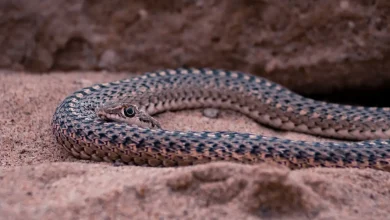
What Snake Kills You the Fastest? — The King Cobra Argument
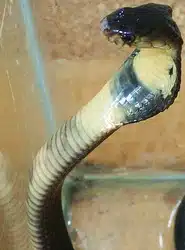
Some snakes kill slowly. The Many-Banded Krait (Bungarus multicinctus) bite can take 30 hours to produce respiratory failure even untreated. The pit vipers can take days, with bleeding and tissue damage building over a slow window. The King Cobra is at the other extreme. With a full envenomation from a large adult, “10 minutes to dead” is not hyperbole — it has happened. We are going to make the case here for Ophiophagus hannah as the fastest killer in the world, then look at why other commonly-cited “fast killers” actually take longer.
Why the King Cobra wins on speed #
Three numbers do most of the work. First, venom yield: a 4 m King Cobra can deliver up to 400–500 mg of venom in a single bite under ideal lab conditions. The lethal human dose is around 12 mg. The species is delivering 30 to 40 times the lethal dose in one bite. Second, the venom is predominantly post-synaptic neurotoxin — it blocks the neuromuscular junction directly, with no slow build-up. Third, the bite mechanics: King Cobra fangs are 8–10 mm long, fixed, and engage tissue deeply. The venom goes in fast.
Combined: a fully envenomating bite from a large adult can produce respiratory paralysis within 10–30 minutes, and death within 30 minutes to a few hours without intervention. The often-cited “elephant killed in three hours” reports from Indian forestry records are real and happen because elephants can take a fully envenomating bite in soft tissue near a major vessel. For human bite victims with prompt antivenom, mortality drops dramatically — but the unmodified speed of the natural bite is the ceiling.
Why other “fastest” candidates are actually slower #
Inland Taipan (Australia): Holds the record for highest venom toxicity by LD50 weight-for-weight. Often called “the world’s most venomous”. But the species delivers a much smaller venom volume per bite (around 110 mg max), is only intermittently aggressive, and the actual time-to-death in documented bites is in the 6-to-24-hour range. Faster than most snakes; slower than a fully envenomating King Cobra bite.
Black Mamba (Africa): Famous for “the kiss of death” reputation. Time to death in documented untreated cases is 7–15 hours, occasionally faster. Venom yield is 100–400 mg, but it is delivered through shorter fangs in a shallower bite. The mamba is undeniably fast and dangerous, but per-bite speed is comparable to or slower than the King Cobra.
Many-Banded Krait: One of the deadliest in terms of medical impact (high mortality without antivenom), but slow. Bites are often painless at first, and respiratory failure builds over 8–30 hours. Many fatalities are people who went to sleep “feeling fine” and never woke up.
Russell’s Viper: The biggest killer of humans in South Asia by total deaths. Mortality from bleeding-and-shock pattern, but the time-to-death is typically 24–96 hours, not minutes.
Speed is not the same as deadliness #
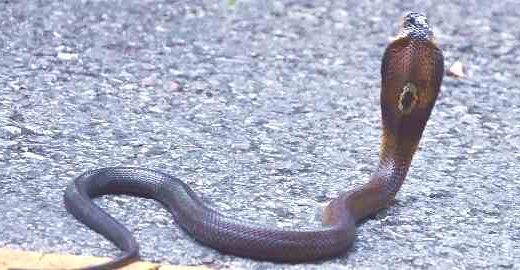
It is worth noting that “fastest to kill” and “deadliest in real terms” are not the same statistic. The King Cobra is the fastest acting per-bite, but the species kills very few people in Thailand — perhaps one or two confirmed deaths a year nationally — because the species is rare, lives in forest, and rarely encounters people. The Russell’s Viper, the Malayan Krait and the Monocled Cobra together kill far more Thais each year than the King Cobra does, even though each individual bite from those species takes longer to be lethal.
For a wider look at the deadly Thai snake community see our reference on common venomous Thailand snakes, the King Cobra stories from Thailand, and our piece on the largest venomous snake in the world. For the bite first-aid picture, our avoiding snakebites in Thailand guide is the practical reference.
What this means for risk #
If you live or work in King Cobra habitat — particularly mature southern Thai forest or northern hill forest with intact canopy — the practical implication is that any King Cobra bite is a serious medical emergency. Prompt antivenom and respiratory support save lives, but the window is shorter than for almost any other Thai snake. Carry a phone, know the route to the nearest hospital, and do not delay even if the bite “feels okay” — King Cobra envenomation can develop very quickly.
For most Thai residents, this is academic — King Cobras are uncommon enough in human-altered landscape that a bite is unlikely. The realistic Thai snakebite emergencies are pit-viper bites in gardens and rice paddies, and Russell’s Viper bites in fields. Knowing what kills fastest matters less than knowing what is actually likely to bite you.
External references: the WHO snakebite envenoming hub for global treatment guidelines, and the Reptile Database entry for Ophiophagus hannah for taxonomy and species records.

Key takeaways #
- Context matters more than rules of thumb. Thailand’s snake fauna varies meaningfully by region, by season, and by habitat. Advice that holds in southern wet forest does not always hold in northern hill country or in the central agricultural plains.
- Prevention is high-leverage. Most serious snake-related incidents in Thailand are downstream of three preventable behaviours — reaching where you cannot see, walking forest paths at night without a torch, and attempting to handle or kill snakes rather than call professional removal.
- Hospital access is the real safety net. Thai provincial hospitals stock the standard polyvalent antivenoms. The single biggest predictor of bad outcome from a serious bite is delay in reaching one of those hospitals.
- Citizen-science records help. Even casual photographs with location data, posted to platforms like iNaturalist, contribute to the regional knowledge base. Most Thai snake species have surprisingly thin distribution data; one well-documented sighting can fill a real gap.
Common questions #
How likely am I to see a snake on a casual visit to Thailand?
Lower than you probably expect. A casual three-hour daytime forest hike in southern Thailand has roughly a 5–10% chance of producing any snake encounter at all, and roughly a 0.5–1% chance of producing a venomous-species sighting. Visitors who deliberately go looking — at night, in good habitat — see far more, but the casual exposure is genuinely low.
What time of year has the most snake activity?
The wet season (May through October) produces by far the most snake encounters across most of Thailand. Within that, two peaks: the start of the rains (April–June) when males are moving for breeding, and late wet season (September–November) when juvenile cohorts disperse from nest sites. The dry season (December–March) is genuinely quieter for snake-watching, particularly in the north and northeast.
Are Thai snakebite outcomes really that good?
For patients who reach a hospital within an hour or two of a venomous bite, yes — Thai outcomes are excellent by international standards. Mortality with appropriate antivenom and supportive care runs under 1% for most species. The deaths that do happen are concentrated in cases of significant pre-hospital delay, mis-identification of species, or in patients with serious co-morbidities. The Thai system is robust; the failure modes are mostly upstream of the hospital.
What is the single best preventive measure?
A torch at night. The single biggest reducer of Thai snakebite risk is consistent, eyes-down torch use on every walking path after dark. Most preventable bites in southern Thailand are foot-on-snake events on the ground at night, and a torch beam on the trail at metre-down angle prevents the great majority of them. Closed footwear is the second-biggest improvement; long trousers in dense vegetation is third.