Golden Tree Snake in a Bangkok Garden — Reader Photo and Notes
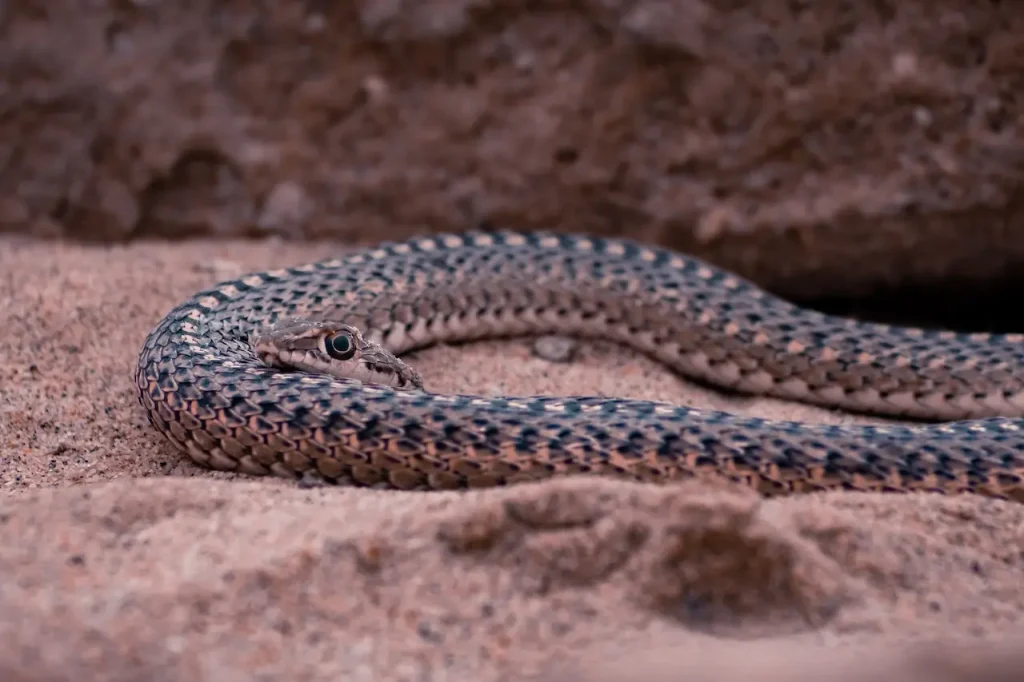
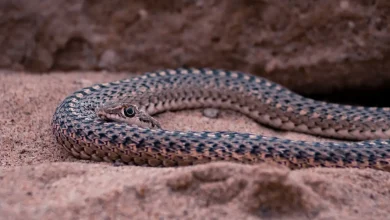
The Golden Tree Snake is the snake most Bangkok residents will see in their lifetime. Chrysopelea ornata is widespread, conspicuous, harmless, and one of the most beautiful snakes in Thailand. Reader Khun Suphat sent in a recent photo of one in his Sukhumvit garden, draped along a hibiscus stem in morning sun. The snake is a perfect example of why we tell new Bangkok residents: don’t kill the green-and-yellow snake — it eats the lizards that eat your beneficial garden insects, and it is harmless.

Why Golden Tree Snakes do well in Bangkok #
Bangkok has more Golden Tree Snakes than people realise. The species’ tolerance of disturbed habitat is unusual among Thai snakes. Hedge-and-tree garden environments suit them perfectly: house geckos, skinks and small lizards (their main prey) are abundant in city green space, and the network of fences, garden walls and hedges gives them safe corridors to move through without dropping to ground level. The species is one of the few Thai snakes that has likely become more numerous in Bangkok over the last few decades.
For the full species profile see our main Golden Tree Snake page. The short version: bright greenish-yellow body with bold black crossbars and red flowery markings, slender, fast, diurnal, and capable of gliding short distances between trees the same way as the related Paradise Tree Snake.
What to do if one is in your garden #
Leave it alone. Photograph it from a respectful distance. Move on. Golden Tree Snakes will not enter houses unless they are chasing prey through an open door, and even then they leave under their own power once disturbed. Do not block the snake’s escape routes. If you absolutely cannot tolerate the snake, gentle encouragement with a long broom from a metre away usually moves it onto the next bush.
The species has no medically significant venom. Bites are uncommon, and the snake will almost always flee rather than fight. Children should be told the species is harmless and beautiful — killing it is unhelpful and would be a small ecological loss. For the wider catalogue of harmless Bangkok garden snakes see common non-venomous Thailand snakes.
Common ID confusion #
The species most often confused with the Golden Tree Snake is the harmless Oriental Whip Snake (uniform green with horizontal pupil) or the green pit vipers (much heavier-bodied with vertical pupils). The Golden Tree Snake’s bold black-and-yellow pattern with red highlights is unmistakable once seen properly. See our snake identification decision tree for the practical separation.
How to send us your own ID request #
Photo from at least 1.5 m showing head and body, location (province), approximate size, behaviour. Email and we will reply with an ID. The reader-submission archive is at snake ID reader submissions.
External references: the Reptile Database entry for Chrysopelea ornata for taxonomy, and iNaturalist for citizen-science distribution.
Key takeaways #
- Context matters more than rules of thumb. Thailand’s snake fauna varies meaningfully by region, by season, and by habitat. Advice that holds in southern wet forest does not always hold in northern hill country or in the central agricultural plains.
- Prevention is high-leverage. Most serious snake-related incidents in Thailand are downstream of three preventable behaviours — reaching where you cannot see, walking forest paths at night without a torch, and attempting to handle or kill snakes rather than call professional removal.
- Hospital access is the real safety net. Thai provincial hospitals stock the standard polyvalent antivenoms. The single biggest predictor of bad outcome from a serious bite is delay in reaching one of those hospitals.
- Citizen-science records help. Even casual photographs with location data, posted to platforms like iNaturalist, contribute to the regional knowledge base. Most Thai snake species have surprisingly thin distribution data; one well-documented sighting can fill a real gap.
Common questions #
How likely am I to see a snake on a casual visit to Thailand?
Lower than you probably expect. A casual three-hour daytime forest hike in southern Thailand has roughly a 5–10% chance of producing any snake encounter at all, and roughly a 0.5–1% chance of producing a venomous-species sighting. Visitors who deliberately go looking — at night, in good habitat — see far more, but the casual exposure is genuinely low.
What time of year has the most snake activity?
The wet season (May through October) produces by far the most snake encounters across most of Thailand. Within that, two peaks: the start of the rains (April–June) when males are moving for breeding, and late wet season (September–November) when juvenile cohorts disperse from nest sites. The dry season (December–March) is genuinely quieter for snake-watching, particularly in the north and northeast.
Are Thai snakebite outcomes really that good?
For patients who reach a hospital within an hour or two of a venomous bite, yes — Thai outcomes are excellent by international standards. Mortality with appropriate antivenom and supportive care runs under 1% for most species. The deaths that do happen are concentrated in cases of significant pre-hospital delay, mis-identification of species, or in patients with serious co-morbidities. The Thai system is robust; the failure modes are mostly upstream of the hospital.
What is the single best preventive measure?
A torch at night. The single biggest reducer of Thai snakebite risk is consistent, eyes-down torch use on every walking path after dark. Most preventable bites in southern Thailand are foot-on-snake events on the ground at night, and a torch beam on the trail at metre-down angle prevents the great majority of them. Closed footwear is the second-biggest improvement; long trousers in dense vegetation is third.
Further reading and related references #
If you found this article useful, our wider catalogue covers most of the related topics in similar depth. We keep regional reference pages for each major Thai habitat, species pages for the country’s medically important snakes, and field-notes write-ups from each of our regular sites. The site is built as a connected network of references — most articles link out to two or three closely-related pieces, and you can navigate by following the in-text links to species or topics that catch your attention.
For the broader catalogue see our best-of-articles index, the common venomous Thailand snakes reference, and the matching non-venomous overview. For first-aid see our snakebite first-aid page. For the regional snake distribution see where the snakes are in Thailand and the related Thailand snake mating season piece.
Reader contributions are how the site grows. If you have a Thai snake encounter worth sharing — a clear photograph, a well-documented sighting, a question we have not covered — please email or submit through our reader-submission queue at snake ID reader submissions. The accumulated reader records have substantially improved our regional knowledge over the years, and citizen-science records remain one of the most under-utilised tools in Thai herpetology.
For the global research context that supports this work, three external resources are worth bookmarking: the Reptile Database for canonical species taxonomy, the IUCN Red List for conservation status assessments, and iNaturalist for the citizen-science observation platform that aggregates Thai records alongside global ones. The WHO snakebite envenoming hub is the international reference for clinical management.