Thailand Snake Mating Season — When and Why You See More Snakes
Thai snake encounters peak twice a year — once at the start of the rainy season (April-June) and again in late wet season into early dry (September-November). Both peaks are tied to breeding, and once you know the calendar you can predict which species you are most likely to see when. This piece covers the breeding seasons of the major Thai snake groups and what that means for “more snakes than usual” in your garden.
The pit vipers #
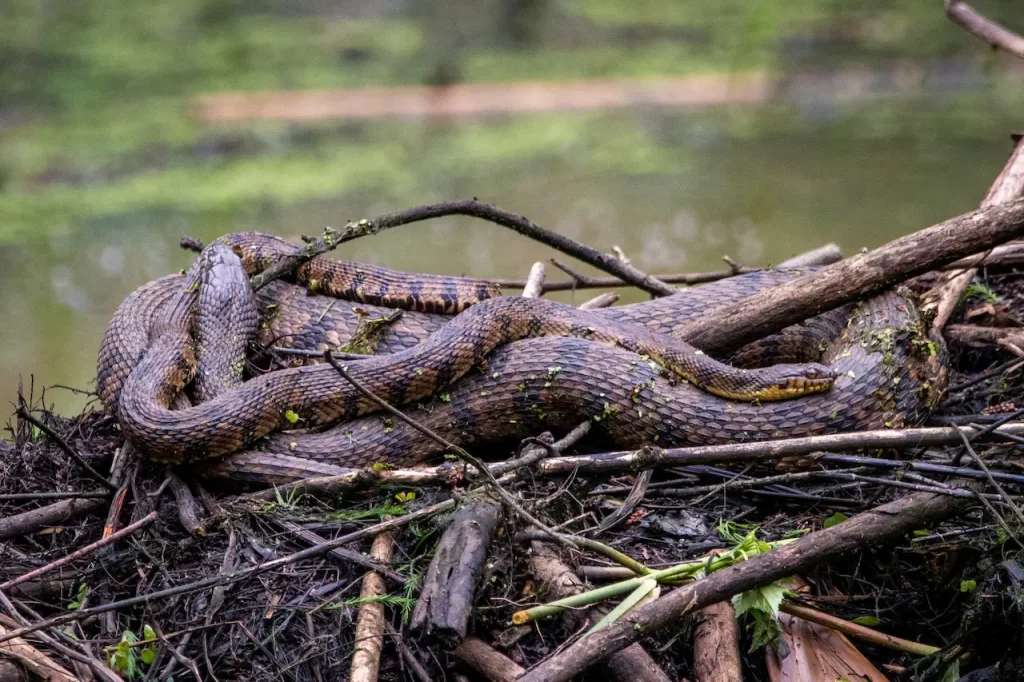
Most Thai pit vipers (the green Trimeresurus complex, the Malayan Pit Viper) breed in late dry season into early wet season — roughly February through May depending on latitude. Females give birth to live young from August through December, with peak juvenile encounters in October–November. If your garden suddenly seems full of small green pit vipers in late October, this is normal — the new birth cohort is dispersing.
For species detail see White-Lipped Pit Viper, Large-Eyed Pit Viper, and Malayan Pit Viper.
The cobras #
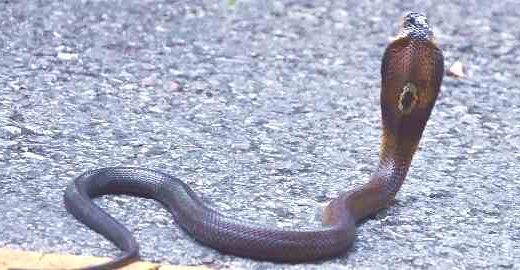
Monocled Cobras and Indochinese Spitting Cobras both mate in March–April. Females lay eggs in May–June. Eggs hatch in late July through early September. The peak in cobra encounters around villages happens twice — once when males are roaming for mates in March-April, and again when juvenile cobras disperse from nest sites in August-September.
The King Cobra is on a different schedule. Mating December–April, eggs laid March–June, hatching May–July. Female King Cobras guard their nests through the incubation period — the only Thai snake to do this — making them more visible (and more defensive) than usual through that window.
The kraits #
The Banded Krait, Malayan Krait and Red-Headed Krait all mate in mid-rainy season (June-August). Eggs (the kraits are oviparous) are laid in August-September, hatching in October-November. The window of new juvenile krait encounters in central and southern Thailand is reliably November.
Adult kraits also become more active and visible during the breeding season — one reason warm wet July nights can produce more krait encounters than the rest of the year combined. See our krait identification guide for species details.
The pythons #
Burmese Pythons and Reticulated Pythons mate in November-February (cool season courtship), eggs laid March-May, hatching May-July. Hatching pythons disperse quickly and are rarely seen by people — most are eaten by predators in the first few months of life. The famous Lumphini Park python rescues happen most often in March-April when adult females leave nest sites looking for the next meal after a long fast.
Blood Pythons are different — mating is in the wet season (June-August), eggs in late wet season, hatching April-June.
The rat snakes and tree snakes #
Most Thai colubrids — rat snakes, bronzebacks, whip snakes, golden tree snakes — breed in late dry season to early wet season (March-May), with eggs laid in April-June and hatching June-August. Juvenile encounters peak in July-September. Garden populations of Golden Tree Snakes, Common Painted Bronzebacks and similar species are typically highest in late wet season.
What this means for you #
If you suddenly notice “more snakes than usual” in your garden, check the calendar. April-June is breeding-male movement season. October-November is juvenile dispersal season. Both are normal patterns and require no special intervention beyond ordinary good housekeeping (cut grass, light paths, raised storage).
For region-by-region patterns see where the snakes are in Thailand. For practical prevention see avoiding snakebites in Thailand.
External references: the iNaturalist citizen-science platform shows seasonal observation patterns by species, and the Wikipedia article on snake reproduction covers the biology of egg-laying versus live-bearing species.
Key takeaways #
- Context matters more than rules of thumb. Thailand’s snake fauna varies meaningfully by region, by season, and by habitat. Advice that holds in southern wet forest does not always hold in northern hill country or in the central agricultural plains.
- Prevention is high-leverage. Most serious snake-related incidents in Thailand are downstream of three preventable behaviours — reaching where you cannot see, walking forest paths at night without a torch, and attempting to handle or kill snakes rather than call professional removal.
- Hospital access is the real safety net. Thai provincial hospitals stock the standard polyvalent antivenoms. The single biggest predictor of bad outcome from a serious bite is delay in reaching one of those hospitals.
- Citizen-science records help. Even casual photographs with location data, posted to platforms like iNaturalist, contribute to the regional knowledge base. Most Thai snake species have surprisingly thin distribution data; one well-documented sighting can fill a real gap.
Common questions #
How likely am I to see a snake on a casual visit to Thailand?
Lower than you probably expect. A casual three-hour daytime forest hike in southern Thailand has roughly a 5–10% chance of producing any snake encounter at all, and roughly a 0.5–1% chance of producing a venomous-species sighting. Visitors who deliberately go looking — at night, in good habitat — see far more, but the casual exposure is genuinely low.
What time of year has the most snake activity?
The wet season (May through October) produces by far the most snake encounters across most of Thailand. Within that, two peaks: the start of the rains (April–June) when males are moving for breeding, and late wet season (September–November) when juvenile cohorts disperse from nest sites. The dry season (December–March) is genuinely quieter for snake-watching, particularly in the north and northeast.
Are Thai snakebite outcomes really that good?
For patients who reach a hospital within an hour or two of a venomous bite, yes — Thai outcomes are excellent by international standards. Mortality with appropriate antivenom and supportive care runs under 1% for most species. The deaths that do happen are concentrated in cases of significant pre-hospital delay, mis-identification of species, or in patients with serious co-morbidities. The Thai system is robust; the failure modes are mostly upstream of the hospital.
What is the single best preventive measure?
A torch at night. The single biggest reducer of Thai snakebite risk is consistent, eyes-down torch use on every walking path after dark. Most preventable bites in southern Thailand are foot-on-snake events on the ground at night, and a torch beam on the trail at metre-down angle prevents the great majority of them. Closed footwear is the second-biggest improvement; long trousers in dense vegetation is third.