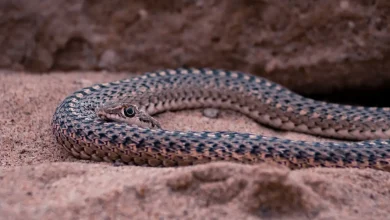
Reader Poll Results — What Is Thailand’s Most Common Snake?
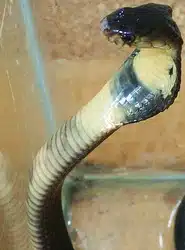
We ran a reader poll for over a year asking the simple question: “What is Thailand’s most common snake?” 182 readers voted, mostly long-time residents and herping enthusiasts based in Thailand or with serious country experience. The results are an interesting window into perception versus actual abundance — what people see most often is not necessarily the most numerous species, and the gap between the two tells you something about how Thai snakes use the human-altered landscape.
Reader poll results #
- Golden Tree Snake (Chrysopelea ornata): 35% — 63 votes
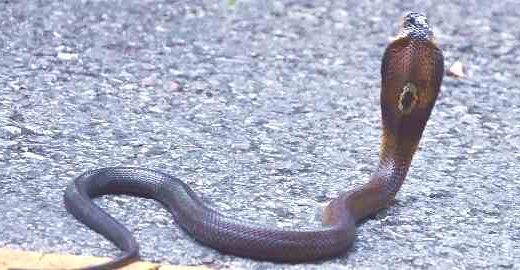
- Monocled Cobra (Naja kaouthia): 16% — 30 votes
- Malayan Pit Viper (Calloselasma rhodostoma): 12% — 21 votes
- Common Painted Bronzeback (Dendrelaphis pictus): 9% — 17 votes
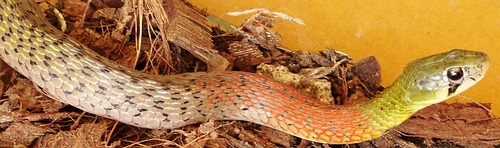
- Oriental Whip Snake (Ahaetulla prasina): 8% — 15 votes
- Red-Necked Keelback (Rhabdophis subminiatus): 8% — 15 votes
- Copperheaded Racer (Coelognathus radiatus): 7% — 12 votes
- Other species: 5% combined — 9 votes spread across 6 different species.
The Golden Tree Snake won decisively. This is consistent with our own field observations — across the entire mainland of Thailand, in suburban gardens and rural settings alike, Golden Tree Snakes are the green-and-yellow snake people most often see flicking through hedges in the morning. For the species profile see our Golden Tree Snake species page.
What the poll actually measures #
Reader polls measure visibility, not abundance. The species at the top of the list are the ones that are diurnal, active, and large enough to register — Golden Tree Snake, Monocled Cobra, Malayan Pit Viper, Bronzebacks, Whip Snakes. The species missing from the top of the list are arguably more numerous in Thailand by raw count. The Plumbeous Water Snake, the Brahminy Blind Snake (probably the single most numerous snake in Thailand by individual count), the various small Enhydris water snakes — none of these registered. They are nocturnal, small, and aquatic; they vanish from the average person’s perception even if they outnumber the top species by an order of magnitude.
This matters for how we think about Thai snake biology. The “common snakes” are not the abundant snakes; they are the visible snakes. Most of the country’s snake biomass lives in rice paddies and irrigation canals at night, and never makes it into a daytime garden encounter.
Regional differences worth noting #
Several voters in the comments noted regional differences. The Monocled Cobra is genuinely the most-seen large snake in many central-plains villages, where the open agricultural landscape suits it well. The Malayan Pit Viper is over-represented in the south; the Banded Krait registered higher than expected in northeastern records. Read the comments thread back through the poll and the regional pattern is clear — perception of “most common” is heavily filtered by local habitat.
For the broader picture of which species you are most likely to encounter as a visitor, see our reference on how common snakes are in Thailand. The are Thailand snakes dangerous to visitors companion piece covers the venomous-versus-non-venomous breakdown.
What we will do next #
We are running a follow-up survey this year asking specifically by region and by season. Initial results suggest the Northern provinces give a different top-three than the South, and that wet-season encounter rates run roughly twice the dry-season equivalent for almost every species. We will publish the results when we have a similar 150-plus vote sample.
If you have a Thai-snake observation worth sharing, post it to our Thailand snake photos collection or to the citizen-science platform iNaturalist — both are useful inputs for the next round of analysis.
External references: the GBIF page for Chrysopelea ornata shows the global occurrence record for the Golden Tree Snake — useful for comparing reader perception to actual scientific records.
Key takeaways #
- Context matters more than rules of thumb. Thailand’s snake fauna varies meaningfully by region, by season, and by habitat. Advice that holds in southern wet forest does not always hold in northern hill country or in the central agricultural plains.
- Prevention is high-leverage. Most serious snake-related incidents in Thailand are downstream of three preventable behaviours — reaching where you cannot see, walking forest paths at night without a torch, and attempting to handle or kill snakes rather than call professional removal.
- Hospital access is the real safety net. Thai provincial hospitals stock the standard polyvalent antivenoms. The single biggest predictor of bad outcome from a serious bite is delay in reaching one of those hospitals.
- Citizen-science records help. Even casual photographs with location data, posted to platforms like iNaturalist, contribute to the regional knowledge base. Most Thai snake species have surprisingly thin distribution data; one well-documented sighting can fill a real gap.
Common questions #
How likely am I to see a snake on a casual visit to Thailand?
Lower than you probably expect. A casual three-hour daytime forest hike in southern Thailand has roughly a 5–10% chance of producing any snake encounter at all, and roughly a 0.5–1% chance of producing a venomous-species sighting. Visitors who deliberately go looking — at night, in good habitat — see far more, but the casual exposure is genuinely low.
What time of year has the most snake activity?
The wet season (May through October) produces by far the most snake encounters across most of Thailand. Within that, two peaks: the start of the rains (April–June) when males are moving for breeding, and late wet season (September–November) when juvenile cohorts disperse from nest sites. The dry season (December–March) is genuinely quieter for snake-watching, particularly in the north and northeast.
Are Thai snakebite outcomes really that good?
For patients who reach a hospital within an hour or two of a venomous bite, yes — Thai outcomes are excellent by international standards. Mortality with appropriate antivenom and supportive care runs under 1% for most species. The deaths that do happen are concentrated in cases of significant pre-hospital delay, mis-identification of species, or in patients with serious co-morbidities. The Thai system is robust; the failure modes are mostly upstream of the hospital.
What is the single best preventive measure?
A torch at night. The single biggest reducer of Thai snakebite risk is consistent, eyes-down torch use on every walking path after dark. Most preventable bites in southern Thailand are foot-on-snake events on the ground at night, and a torch beam on the trail at metre-down angle prevents the great majority of them. Closed footwear is the second-biggest improvement; long trousers in dense vegetation is third.