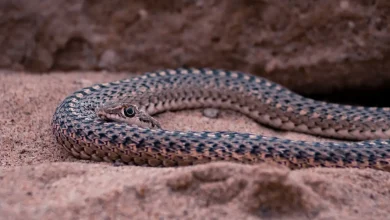
Burmese Python — Why a Non-Venomous Snake Can Still Be Dangerous

“Non-venomous” does not mean “safe to handle”. The Burmese Python is the textbook example. Python bivittatus is the largest non-venomous snake in Thailand, and the second-largest snake in the country after the Reticulated Python. Adults reach 5 m and weigh in excess of 50 kg. They have no venom and they will not chase a person, but they have inflicted real injuries — bite punctures from very large adults, broken bones from constriction, and at least one credible Thai fatality involving a captive specimen. This page is the safety angle. For the species profile and basic biology, our main Burmese Python species page is the canonical reference.
What “dangerous” actually means with a python #
Pythons are ambush hunters. They strike fast — within a metre or two from a coil — and immediately throw two or three coils around the prey. The bite of a 3 m python is a row of recurved teeth that hook into flesh; pulling away tears the flesh worse than the original puncture. The coil is what kills. A 4 m Burmese Python generates roughly 300 mmHg of constriction pressure on its prey — easily enough to stop venous return, then arterial flow, in a human limb. Death (in prey) is typically from cardiac arrest within 60 seconds, not asphyxiation as old textbooks claimed.
Adult Burmese Pythons in Thailand have killed dogs, goats, monkeys and at least one documented human in the past forty years. The human case involved a captive 4 m specimen and a single keeper handling alone. Wild adults in Thailand will eat dogs and very small children if the opportunity is right; we have removed two adults from village outskirts after pet predation incidents. The species is not aggressive but a cornered or disturbed adult is genuinely dangerous in a way no Thai venomous snake is.
Where the danger actually shows up #

Most python-related injuries in Thailand happen in three contexts. First: pet pythons handled by inexperienced owners, particularly the standard error of feeding and handling on the same day — the snake associates the keeper with food and strikes. Second: villagers attempting to capture a wild python for the meat or skin trade with no equipment. Third: small-child pet predation events when an outdoor pet python escapes a substandard enclosure. Wild encounter without provocation almost never produces an injury — Burmese Pythons in Thailand will hold position, hiss, and try to leave.
The Bangkok metro has a healthy wild Burmese Python population in the canals and the Chao Phraya floodplain. Lumphini Park alone produces several adult-python rescues every wet season. None of these have produced a serious injury in living memory; the Bangkok fire brigade’s snake-rescue teams are excellent and the public is generally good at calling for help rather than handling.
What to do if you find one #

The right answer is almost always: do not handle. Call the local fire brigade snake-rescue line. Most provinces in Thailand have a free volunteer snake-removal team — see our list of snake removal phone numbers across Thailand. Bangkok specifically has one of the best teams in the country; they will arrive within an hour and remove an adult python with hooks, bags and three or four people.
If you must contain a python until rescue arrives — for example, the snake is in a doorway or near a child — the practical move is to keep eyes on it from at least three metres back. The snake will not strike unless cornered. If it tries to leave through a window or pipe and you cannot stop it, do not block its escape route; pythons that feel cornered are vastly more dangerous than pythons that have an escape. Never attempt to grab the head: the bite is bad, but the worse outcome is the body coil that follows the bite.
Pet python safety #
For pet keepers: the rule that has saved more lives than any other is the simple one — do not handle a python over 3 m alone. Two adults in the room, one always with a free hand to manage the head, is the bare minimum for an adult Burmese. Feed in a separate enclosure to break the food-association response. Never handle a snake within 24–48 hours of feeding. Always wash off any rodent or rabbit smell before approaching the snake.
The Reticulated Python is in some senses more dangerous because of its larger size at maturity, but the Burmese is more frequently kept and more frequently produces accidents. Both species are protected under Thai wildlife law and require permits for keeping; for the legal context, the how dangerous are Thai snakes reference is a starting point.
External references: the Reptile Database entry for Python bivittatus for taxonomy, and the IUCN Red List assessment — currently Vulnerable globally, with Thai populations under significant pressure from skin trade and habitat fragmentation.
Key takeaways #
- Context matters more than rules of thumb. Thailand’s snake fauna varies meaningfully by region, by season, and by habitat. Advice that holds in southern wet forest does not always hold in northern hill country or in the central agricultural plains.
- Prevention is high-leverage. Most serious snake-related incidents in Thailand are downstream of three preventable behaviours — reaching where you cannot see, walking forest paths at night without a torch, and attempting to handle or kill snakes rather than call professional removal.
- Hospital access is the real safety net. Thai provincial hospitals stock the standard polyvalent antivenoms. The single biggest predictor of bad outcome from a serious bite is delay in reaching one of those hospitals.
- Citizen-science records help. Even casual photographs with location data, posted to platforms like iNaturalist, contribute to the regional knowledge base. Most Thai snake species have surprisingly thin distribution data; one well-documented sighting can fill a real gap.
Common questions #
How likely am I to see a snake on a casual visit to Thailand?
Lower than you probably expect. A casual three-hour daytime forest hike in southern Thailand has roughly a 5–10% chance of producing any snake encounter at all, and roughly a 0.5–1% chance of producing a venomous-species sighting. Visitors who deliberately go looking — at night, in good habitat — see far more, but the casual exposure is genuinely low.
What time of year has the most snake activity?
The wet season (May through October) produces by far the most snake encounters across most of Thailand. Within that, two peaks: the start of the rains (April–June) when males are moving for breeding, and late wet season (September–November) when juvenile cohorts disperse from nest sites. The dry season (December–March) is genuinely quieter for snake-watching, particularly in the north and northeast.
Are Thai snakebite outcomes really that good?
For patients who reach a hospital within an hour or two of a venomous bite, yes — Thai outcomes are excellent by international standards. Mortality with appropriate antivenom and supportive care runs under 1% for most species. The deaths that do happen are concentrated in cases of significant pre-hospital delay, mis-identification of species, or in patients with serious co-morbidities. The Thai system is robust; the failure modes are mostly upstream of the hospital.
What is the single best preventive measure?
A torch at night. The single biggest reducer of Thai snakebite risk is consistent, eyes-down torch use on every walking path after dark. Most preventable bites in southern Thailand are foot-on-snake events on the ground at night, and a torch beam on the trail at metre-down angle prevents the great majority of them. Closed footwear is the second-biggest improvement; long trousers in dense vegetation is third.