Night Herping in Sisaket — Far Northeast Thailand Field Notes
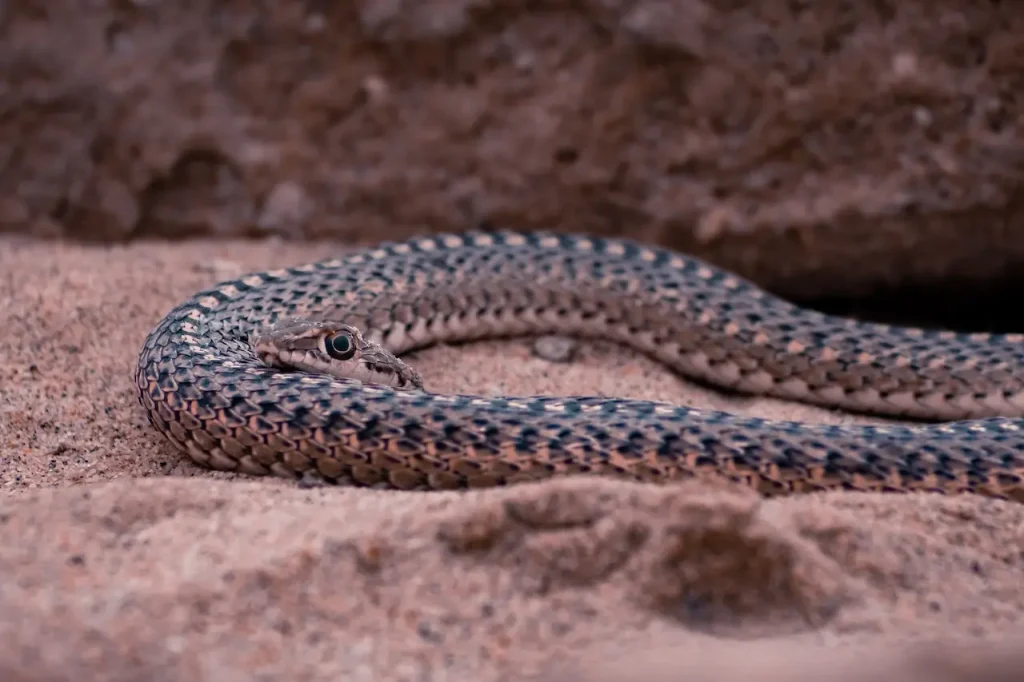
Sisaket sits in the far southeast corner of Isan, butting up against the Cambodian border. The province is mostly agricultural — rice in the lowlands, sugarcane and cassava on the slightly higher ground — but pockets of dry-evergreen forest survive in the hills near the border, and a few protected areas hold the kind of habitat that produces interesting snakes. We did three nights of herping in this landscape and have written up the results.

Why Sisaket forest matters #
The dry-evergreen forest pockets near the Cambodian border preserve some of the best surviving snake habitat in Isan. The substrate is largely sandy with scattered laterite outcrops, and the canopy is mostly intact. This habitat supports a slightly different snake fauna than the wetter southern regions — drought-tolerant species like the Indochinese Spitting Cobra, the Banded Krait, the Indo-Chinese Rat Snake and the dry-forest pit vipers are core. Wet-forest specialists drop out.
Cross-border movement is also a factor. Several species we have caught in this region are more characteristic of Cambodian forests — for example a single putative Indo-Chinese Forest Cobra (now called the Andaman Cobra in some lists, but the genus and ID are still being argued over) was caught here a decade ago and represented a significant range extension at the time.
The three nights #
Night 1: Started at 19:00 on a warm dry night, no rain in 5 days. Three hours of walking the forest edge produced one Banded Krait on a sandy track, one juvenile Indochinese Spitting Cobra (small but already capable of spitting — we maintained 3 m), and one Common Wolf Snake. The krait was on a slow forage and gave us 30 seconds of unhurried photography from 2 m before sliding into thick grass.
Night 2: Same circuit, slightly cooler night with light wind. Activity dropped — one Indo-Chinese Rat Snake on a track moving fast, two house geckos, three frogs. No surprises. We added a road-cruising leg by car after midnight and picked up two more rat snakes and a juvenile Russell’s Viper crossing a sandy road. The Russell’s was a small one — perhaps 50 cm — and gave the standard loud hiss when our headlamp tracked across it.
Night 3: Heavy rain in the afternoon, evening still wet. Productive — we found three small snake species in two hours, all leaf-litter dwellers (one Brahminy Blind Snake, one Common Wolf Snake juvenile, one Many-Spotted Cat Snake). The wet substrate seemed to bring everything to the surface.
What this region rewards #
Three lessons from these nights:
- Road-cruising works. Sisaket has the kind of lightly-used rural roads that make road-cruising productive. Slow speed, headlamps, eyes on the surface — Russell’s Vipers and rat snakes regularly cross.
- Wet substrate trumps moonlight. The third night was bright but had wet substrate from afternoon rain; that was the most productive night.
- The dry-forest species are different. If you only herp the south, you should add at least one northeast trip per year. The Isan species are worth seeing on their own and the comparison sharpens your sense of what each habitat does.
Caution about the border #
Some of the best forest in this region is right against the Cambodian border, and access requires care — the border zone has a complex history, parts of it have unmapped landmines, and crossing the border line by accident is genuinely possible. Stick to known trails, check with local rangers before night work, and do not herp areas marked as restricted. The risk is real and not theoretical. Safer alternatives are the protected reserves slightly north of the border zone (Khao Phra Wihan National Park area, with the appropriate permits and ranger contact).
For the broader Isan picture see our Roi Et and Sisaket trip notes and the region-wide where Thai snakes live reference. For practical first-aid see avoiding snakebites in Thailand.
External references: the Thai National Parks website covers Khao Phra Wihan and other Sisaket reserves, and iNaturalist hosts citizen-science observations across the Isan region.
 keelback-snake1.jpg" alt="Red-necked Keelback in defensive pose" class="wp-image-5" srcset="https://thailandsnakes.com/wp-content/uploads/2010/02/red-necked-keelback-snake1.jpg 500w, https://thailandsnakes.com/wp-content/uploads/2010/02/red-necked-keelback-snake1-300x88.jpg 300w, https://thailandsnakes.com/wp-content/uploads/2010/02/red-necked-keelback-snake1-150x44.jpg 150w" sizes="(max-width: 500px) 100vw, 500px" />
Key takeaways #
- Context matters more than rules of thumb. Thailand’s snake fauna varies meaningfully by region, by season, and by habitat. Advice that holds in southern wet forest does not always hold in northern hill country or in the central agricultural plains.
- Prevention is high-leverage. Most serious snake-related incidents in Thailand are downstream of three preventable behaviours — reaching where you cannot see, walking forest paths at night without a torch, and attempting to handle or kill snakes rather than call professional removal.
- Hospital access is the real safety net. Thai provincial hospitals stock the standard polyvalent antivenoms. The single biggest predictor of bad outcome from a serious bite is delay in reaching one of those hospitals.
- Citizen-science records help. Even casual photographs with location data, posted to platforms like iNaturalist, contribute to the regional knowledge base. Most Thai snake species have surprisingly thin distribution data; one well-documented sighting can fill a real gap.
Common questions #
How likely am I to see a snake on a casual visit to Thailand?
Lower than you probably expect. A casual three-hour daytime forest hike in southern Thailand has roughly a 5–10% chance of producing any snake encounter at all, and roughly a 0.5–1% chance of producing a venomous-species sighting. Visitors who deliberately go looking — at night, in good habitat — see far more, but the casual exposure is genuinely low.
What time of year has the most snake activity?
The wet season (May through October) produces by far the most snake encounters across most of Thailand. Within that, two peaks: the start of the rains (April–June) when males are moving for breeding, and late wet season (September–November) when juvenile cohorts disperse from nest sites. The dry season (December–March) is genuinely quieter for snake-watching, particularly in the north and northeast.
Are Thai snakebite outcomes really that good?
For patients who reach a hospital within an hour or two of a venomous bite, yes — Thai outcomes are excellent by international standards. Mortality with appropriate antivenom and supportive care runs under 1% for most species. The deaths that do happen are concentrated in cases of significant pre-hospital delay, mis-identification of species, or in patients with serious co-morbidities. The Thai system is robust; the failure modes are mostly upstream of the hospital.
What is the single best preventive measure?
A torch at night. The single biggest reducer of Thai snakebite risk is consistent, eyes-down torch use on every walking path after dark. Most preventable bites in southern Thailand are foot-on-snake events on the ground at night, and a torch beam on the trail at metre-down angle prevents the great majority of them. Closed footwear is the second-biggest improvement; long trousers in dense vegetation is third.