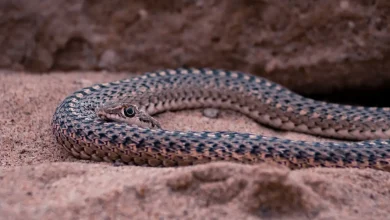
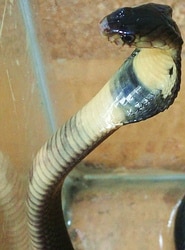
Rare Gold Python Bred in Captivity in Nakhon Si Thammarat

A rare gold-coloured Burmese Python was successfully bred in captivity by a Thai keeper in Nakhon Si Thammarat — a result that made local Thai news in late 2016 and is worth a longer look. Python bivittatus normally appears in the typical brown-and-tan blotched pattern; “gold” specimens are leucistic or hypomelanistic morphs where the dark pigment is reduced, leaving a pale yellow body with the underlying pattern still visible in cream tones. This particular animal was reported to be a clean rich gold-yellow, very photogenic, and had been bred from two parents both showing the same morph.
How a “gold” python happens #
Most “gold” python morphs in the global captive trade are one of two genetic backgrounds. Hypomelanistic morphs reduce dark pigment in the pattern, leaving a softer pale-yellow ground with brown or cream highlights. Albino morphs are full melanin loss — pure yellow ground with red or pink eyes. The Nakhon specimen appears to be hypomelanistic rather than full albino: the pattern is still visible in soft cream-yellow against the gold ground, and the eyes are normal-coloured. Hypomelanism is recessive, so for a clutch of hypomelanistic babies both parents must carry the gene.
The morph occurs sporadically in wild Thai Burmese Pythons — we have anecdotal reports of one or two over the years from southern Thailand and one from Bangkok. None made it into formal published records, but the genes for the morph are clearly present in the wild population. Captive breeding selects and stabilises the morph, which is why most of the gold pythons you see are captive-bred.
Why it matters beyond the looks #
Three things this story tells us. First, there is enough genetic diversity in Thai Burmese Python populations to support visible colour morphs. Second, captive breeding of the species is now an established small industry inside Thailand — fifteen years ago, most colour-morph Thai pythons would have been sold abroad and bred outside the country. Third, leucistic and hypomelanistic morphs in any wild snake species are at a meaningful disadvantage in their natural habitat — they do not blend in, they do not survive predation as well, and the gene typically stays at very low frequency in the wild. Captive populations are now the main reservoir for the morph.
For the species background see our Burmese Python species page and the related notes on the why Burmese Python is dangerous companion piece. For Thai pythons more generally see the Reticulated Python profile.
Captive Burmese Python keeping in Thailand #
Burmese Pythons are protected under Thai wildlife law (CITES Appendix II), but captive-bred animals can be kept legally with the right permit. The species is one of the most popular large pet snakes globally, and Thai breeders have grown into the trade slowly over the past decade. The Nakhon specimen would have been a meaningful asset to the breeder — typical pricing for hypomelanistic Burmese Pythons in the international trade has been in the hundreds to low thousands of US dollars depending on quality and lineage.
The reality of keeping a 5 m python in any climate is the same: substantial enclosure space, careful feeding, two-person handling for adults, and reasonable insurance against the (very rare) escape. We have written about why Burmese Pythons need careful handling in detail; the safety advice applies regardless of whether the snake is normal-coloured or a gold morph.
If you see a wild gold python #
Photograph it from a distance, log GPS coordinates, and consider posting the record to iNaturalist. Wild gold-morph Burmese Pythons in Thailand are rare enough that even one record adds meaningfully to what is known about the morph’s frequency in the wild. Do not handle. The species is dangerous in the same way every adult Burmese Python is.
External references: the Reptile Database entry for Python bivittatus for taxonomy, and the IUCN Red List assessment — currently Vulnerable globally with declining wild population trends.
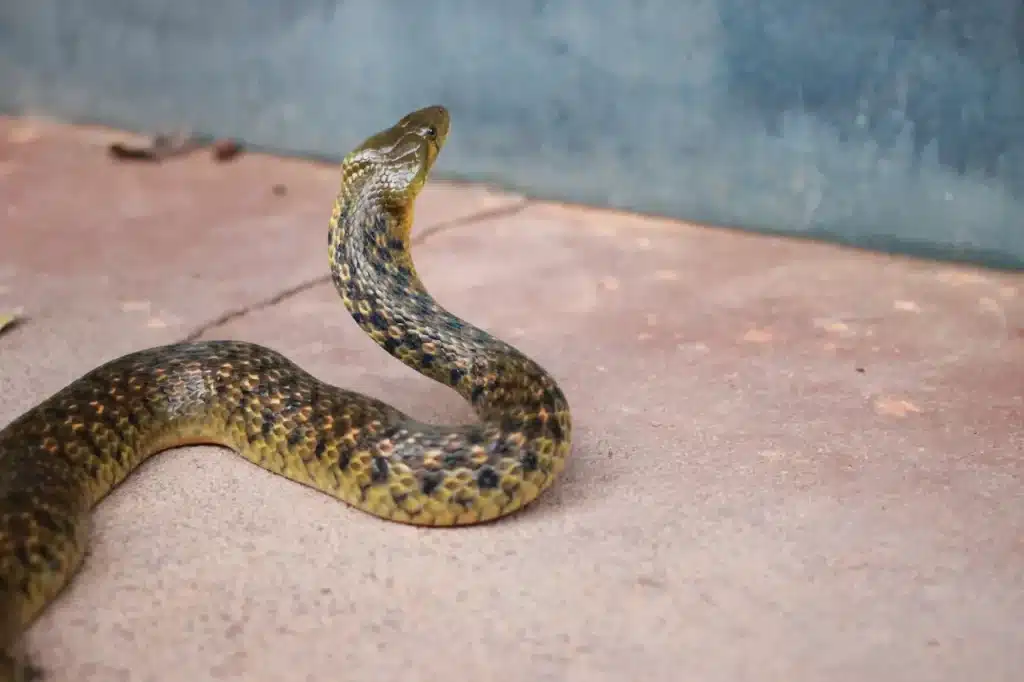 Banded Krait — black and yellow banded body" class="wp-image-69" />
Key takeaways #
- Context matters more than rules of thumb. Thailand’s snake fauna varies meaningfully by region, by season, and by habitat. Advice that holds in southern wet forest does not always hold in northern hill country or in the central agricultural plains.
- Prevention is high-leverage. Most serious snake-related incidents in Thailand are downstream of three preventable behaviours — reaching where you cannot see, walking forest paths at night without a torch, and attempting to handle or kill snakes rather than call professional removal.
- Hospital access is the real safety net. Thai provincial hospitals stock the standard polyvalent antivenoms. The single biggest predictor of bad outcome from a serious bite is delay in reaching one of those hospitals.
- Citizen-science records help. Even casual photographs with location data, posted to platforms like iNaturalist, contribute to the regional knowledge base. Most Thai snake species have surprisingly thin distribution data; one well-documented sighting can fill a real gap.
Common questions #
How likely am I to see a snake on a casual visit to Thailand?
Lower than you probably expect. A casual three-hour daytime forest hike in southern Thailand has roughly a 5–10% chance of producing any snake encounter at all, and roughly a 0.5–1% chance of producing a venomous-species sighting. Visitors who deliberately go looking — at night, in good habitat — see far more, but the casual exposure is genuinely low.
What time of year has the most snake activity?
The wet season (May through October) produces by far the most snake encounters across most of Thailand. Within that, two peaks: the start of the rains (April–June) when males are moving for breeding, and late wet season (September–November) when juvenile cohorts disperse from nest sites. The dry season (December–March) is genuinely quieter for snake-watching, particularly in the north and northeast.
Are Thai snakebite outcomes really that good?
For patients who reach a hospital within an hour or two of a venomous bite, yes — Thai outcomes are excellent by international standards. Mortality with appropriate antivenom and supportive care runs under 1% for most species. The deaths that do happen are concentrated in cases of significant pre-hospital delay, mis-identification of species, or in patients with serious co-morbidities. The Thai system is robust; the failure modes are mostly upstream of the hospital.
What is the single best preventive measure?
A torch at night. The single biggest reducer of Thai snakebite risk is consistent, eyes-down torch use on every walking path after dark. Most preventable bites in southern Thailand are foot-on-snake events on the ground at night, and a torch beam on the trail at metre-down angle prevents the great majority of them. Closed footwear is the second-biggest improvement; long trousers in dense vegetation is third.