Paradise Tree Snake — The Flying Snake of Khao Lak

The Paradise Tree Snake is one of the most peculiar snakes on the planet — and one of Thailand’s most overlooked. Chrysopelea paradisi is a member of the small family of Asian “flying snakes” that have evolved the ability to flatten the body and glide considerable distances between trees. We meet them most often in coconut plantations and the secondary forest behind beachfront resorts in southern Thailand. The species is mildly rear-fanged but functionally harmless to humans. The full species profile lives at our main Paradise Tree Snake page; this piece focuses on the southern Thailand encounters and the gliding behaviour itself.
Identifying a Paradise Tree Snake #
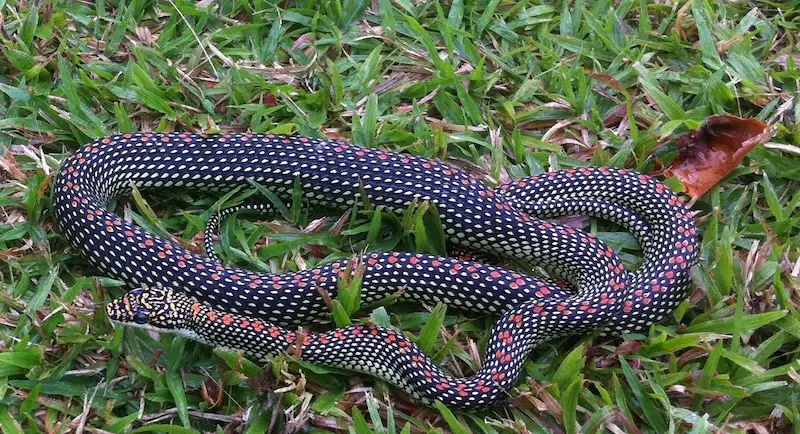
Adults are 80–115 cm. The body is slender, laterally compressed and slightly keeled below the spine — a body shape with hints of an aerofoil even at rest. Ground colour is a leaf-green to green-yellow base, overlaid with rows of small dark transverse markings that often have rusty-red or orange centres. The pattern looks almost embroidered. The head is a long oval with large eyes (round pupils) and the species has a noticeably “alert” face. Belly is pale yellow, often with a fine dark line down the centre.
Look-alikes: the related Golden Tree Snake (C. ornata) is much more common, larger and has a different colour pattern (greenish-yellow with bold black crossbars and yellow flowery markings). Once you have seen both side-by-side they are not confused. The harmless Bronzebacks (Dendrelaphis) lack the red-orange flecking and the head is differently shaped.
How a flying snake actually flies #
Flying snakes do not flap. The species launches from a high perch by leaping outward and upward, then immediately flattens the body — drawing the ribs forward and downward to expand the cross-section into a slight concave aerofoil. Once airborne, the snake undulates side to side as if swimming through the air. The body shape acts like a wing and the lateral undulation maintains directional stability. A glide of 10–25 m horizontally between trees is typical, with vertical drops of 2–10 m. The species is genuinely capable of choosing a landing target and adjusting trajectory in flight.
Why fly? Predator escape, and energy efficiency moving between widely-spaced canopy trees in coconut plantation. The species is one of the few Asian snakes that genuinely benefits from the regular tree spacing of coconut and oil palm — the gaps between trees are roughly the right distance for a one-glide hop, much faster and safer than descending and crossing the ground.
Range, habitat and behaviour #
The species ranges across Southeast Asia. In Thailand it occurs through the south, with reasonable numbers across into the central plains and isolated records as far north as Phetchaburi and the upper gulf. Habitat is broad — secondary forest, coconut plantations, oil palm, mature rubber, suburban gardens with old trees. Activity is strictly diurnal. Hot bright mornings after rain are when most encounters happen.
Diet is dominated by lizards (geckos especially) and small frogs, with the occasional bat or roosting bird. Hunting is active pursuit through the canopy. Reproduction is oviparous; clutches of 6–12 elongate eggs are laid in tree hollows, hatching in roughly 70 days.
If you find one #
Photograph and stand still. The species is harmless and the gliding behaviour is one of the best snake-watching experiences in southeast-Asian wildlife. If a Paradise Tree Snake launches from one tree and lands in another, you have witnessed something less than a quarter of one percent of biologists have seen in person.
For comparisons with the related Golden Tree Snake, see our Golden Tree Snake species page. For the broader catalogue of Thai tree snakes, see common non-venomous Thailand snakes.
External references: the Reptile Database entry for Chrysopelea paradisi for taxonomy, and the Wikipedia article for an introduction including the biomechanics research on flying-snake aerodynamics.
 Banded Krait — black and yellow banded body" class="wp-image-69" />
Key takeaways #
- Context matters more than rules of thumb. Thailand’s snake fauna varies meaningfully by region, by season, and by habitat. Advice that holds in southern wet forest does not always hold in northern hill country or in the central agricultural plains.
- Prevention is high-leverage. Most serious snake-related incidents in Thailand are downstream of three preventable behaviours — reaching where you cannot see, walking forest paths at night without a torch, and attempting to handle or kill snakes rather than call professional removal.
- Hospital access is the real safety net. Thai provincial hospitals stock the standard polyvalent antivenoms. The single biggest predictor of bad outcome from a serious bite is delay in reaching one of those hospitals.
- Citizen-science records help. Even casual photographs with location data, posted to platforms like iNaturalist, contribute to the regional knowledge base. Most Thai snake species have surprisingly thin distribution data; one well-documented sighting can fill a real gap.
Common questions #
How likely am I to see a snake on a casual visit to Thailand?
Lower than you probably expect. A casual three-hour daytime forest hike in southern Thailand has roughly a 5–10% chance of producing any snake encounter at all, and roughly a 0.5–1% chance of producing a venomous-species sighting. Visitors who deliberately go looking — at night, in good habitat — see far more, but the casual exposure is genuinely low.
What time of year has the most snake activity?
The wet season (May through October) produces by far the most snake encounters across most of Thailand. Within that, two peaks: the start of the rains (April–June) when males are moving for breeding, and late wet season (September–November) when juvenile cohorts disperse from nest sites. The dry season (December–March) is genuinely quieter for snake-watching, particularly in the north and northeast.
Are Thai snakebite outcomes really that good?
For patients who reach a hospital within an hour or two of a venomous bite, yes — Thai outcomes are excellent by international standards. Mortality with appropriate antivenom and supportive care runs under 1% for most species. The deaths that do happen are concentrated in cases of significant pre-hospital delay, mis-identification of species, or in patients with serious co-morbidities. The Thai system is robust; the failure modes are mostly upstream of the hospital.
What is the single best preventive measure?
A torch at night. The single biggest reducer of Thai snakebite risk is consistent, eyes-down torch use on every walking path after dark. Most preventable bites in southern Thailand are foot-on-snake events on the ground at night, and a torch beam on the trail at metre-down angle prevents the great majority of them. Closed footwear is the second-biggest improvement; long trousers in dense vegetation is third.