Northeast Thailand (Isan) Snake Trip — What We Found in Roi Et and Sisaket
Northeastern Thailand (Isan) is the toughest of the five Thai regions for casual herping, but it has its own rewards. The dry-deciduous forest, the floodplain edges, the Mekong tributaries — none of these match southern wet forest for snake density, but each produces species you do not see in the south. We did a five-day trip across Roi Et and Sisaket provinces in early wet season and came back with a small but interesting list of species, plus a clearer sense of how to herp the northeast effectively.
How Isan differs from the south #
The big difference is moisture. Southern Thailand has a long wet season and high year-round humidity. Isan has a short, intense wet season (May-October) and a long dry stretch (November-April) when much of the landscape becomes parched. This matters for snake density: wet-forest specialists drop out, and the species you find tend to be dry-tolerant — the Indo-Chinese Rat Snake, the Indochinese Spitting Cobra, the Banded Krait, the Russell’s Viper, the Reticulated Python.
The other difference is that Isan has more open agricultural land and less mature forest. Most Thai national parks in the northeast are smaller and more fragmented than in the south. Productive snake habitat is concentrated in dry-evergreen patches, river floodplains, and the few large reserves like Phu Khieo and Phu Pha Man.
The trip #
We crossed into Roi Et on a Friday afternoon, fresh thunderstorms across the floodplain. Five nights of herping followed. Day-by-day:
- Night 1 (Roi Et floodplain edge): 1 Indo-Chinese Rat Snake on a track, 1 small water snake (Plumbeous, in a flooded ditch), and a startled monitor lizard.
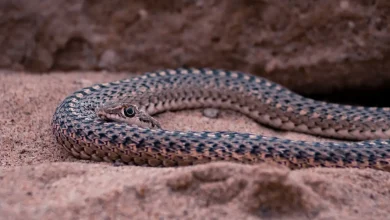
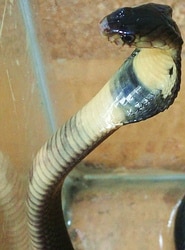
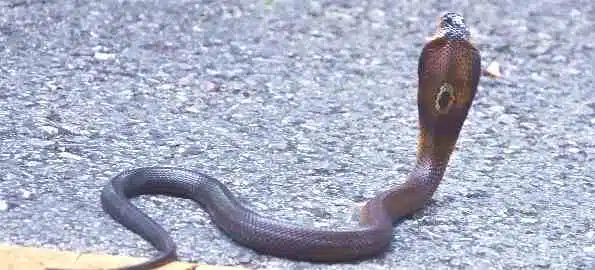
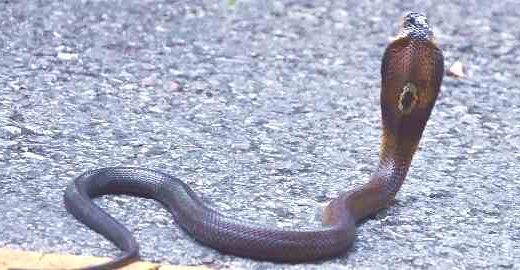
- Night 2 (small reserve north of Roi Et): 1 Indochinese Spitting Cobra crossing a road, 1 Banded Krait near a forest stream, 2 Banded Wolf Snakes in leaf litter.
- Night 3 (Sisaket dry-evergreen edge): Skunked. Heavy rain canceled the night.
- Night 4 (back to Sisaket forest): 1 large Reticulated Python on a road (very large — probably 4 m), 1 Common Wolf Snake under a log.
- Night 5 (river floodplain edge, Sisaket): 1 small Russell’s Viper in a clearing, 2 frogs of two interesting species.
Total: 9 snakes of 7 species over 5 nights. Lower than a comparable southern trip but the species mix was different — Russell’s Viper especially is one we rarely see in the south, and the trip-defining encounter was the big Reticulated Python on the road.
Russell’s Viper notes #
The Russell’s was a juvenile of perhaps 60 cm, in defensive coil on the edge of a track. We photographed from 1.5 m, did not handle. Russell’s are responsible for more Thai bite deaths per year than any other species, almost entirely from the central plains and Isan agricultural landscape — exactly where this snake was. The bite picture is severe coagulopathy and acute kidney failure; mortality without antivenom is high. See our broader reference on common venomous Thailand snakes.
The species pattern is unmistakable — chain of dark brown ovoid blotches with pale yellow halos on a tan ground colour, very stocky body, broad triangular head. Once seen, never confused. The defensive hiss is also famously loud — a Russell’s hiss is closer to a steam-kettle than to other Thai snake hisses.
What we’d do differently #
Two things: more time at the floodplain edges (we found the most diversity there but spent only one night), and more time after sunset on dry forest roads (Reticulated Pythons specifically are road-active in this landscape). We would also bring better mosquito protection — the floodplain at dusk in early wet season is an unkind environment for the unprepared. For the broader practice see our avoiding snakebites reference.
Field summary #
- Region: Roi Et and Sisaket, northeast Thailand.
- Period: Early wet season, 5 days/nights.
- Snakes found: Indo-Chinese Rat Snake, Plumbeous Water Snake, Indochinese Spitting Cobra, Banded Krait, Banded Wolf Snake, Common Wolf Snake, Reticulated Python, Russell’s Viper.
- Highlights: Russell’s Viper at floodplain edge; large Reticulated Python on road.
- Misses: No king cobras, no rare endemics. Both are scarce in this region anyway.
For the broader region-by-region snake distribution see our where the snakes are in Thailand reference. For our notes on identifying the species we found, see the snake identification decision tree.
External references: the Thai National Parks website covers the major Isan reserves, and iNaturalist hosts the citizen-science records that show seasonal patterns by region.

Quick reference card #
- Where most often encountered: See the range and habitat section above. Encounter rates rise sharply during the species’ active season — for most Thai snakes, this is the wet season (May–November) with a smaller secondary peak around the end of the cool months.
- Activity period: Whether the snake is diurnal, nocturnal or crepuscular shapes the practical encounter risk. Nocturnal species are more often missed in the dark; diurnal species are more often photographed clearly.
- Bite risk to humans: Determined by whether the species is venomous, how readily it bites when disturbed, how often it is encountered in human-modified landscape, and how potent its venom is. The combination matters more than any single factor.
- Best behaviour on encounter: Stand back, photograph from a respectful distance (two metres or more), do not handle, and let the snake leave under its own power. The great majority of Thai snake encounters resolve themselves without intervention if the human steps back.
Frequently asked questions #
Is this species protected under Thai law?
Many Thai snakes are protected under the Wild Animal Reservation and Protection Act. King Cobras, Burmese Pythons, Reticulated Pythons and several smaller species are explicitly listed; killing or trading these species is technically a criminal offence even when enforcement is uneven. For other species the legal status is more permissive, but local rules vary by province and protected-area designation. When in doubt, do not kill — call the volunteer fire-brigade rescue team for free relocation.
What should I do if my pet was bitten?
Take the pet to a veterinarian immediately. Veterinarians in Thailand have access to the same antivenoms used for humans, and treatment success in dogs and cats is reasonable when the bite is recognised quickly. Do not waste time on folk remedies. Photograph the snake from a safe distance if you can — the species ID will help the vet pick the correct antivenom.
How can I keep this species out of my garden?
Three things reduce snake encounters in a garden setting: cut grass and dense ground cover short, store firewood and outdoor materials elevated rather than ground-piled, and reduce rodent populations (snakes follow rats). Lighting walking paths after dark also helps prevent foot-on-snake encounters. None of these are perfect — wild snakes will still pass through — but together they substantially reduce the chance of an encounter.
Are juveniles as dangerous as adults?
For venomous species, yes — juveniles are venomous from birth and the venom is the same potent toxin as in adults. The dose per bite is smaller, but small doses of potent venom can still be life-threatening. There is also a folk-belief that juveniles “cannot control” their venom delivery and inject more per bite than an adult; the evidence for this is mixed but the practical lesson is to treat juveniles with the same caution as adults.