
Worst Snake to be Bitten By in Thailand? — The King Cobra Argument
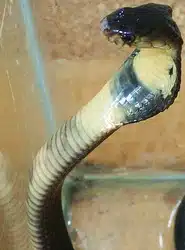
Of all the snakes in Thailand, which is the worst to be bitten by? The honest answer depends on what we mean by “worst” — fastest-acting? Highest dose? Hardest to treat? The King Cobra is the answer to most of those questions, even though it is not the species responsible for most Thai snakebite deaths. This piece is the practical comparison of the species that punch hardest per bite, and what makes a King Cobra bite the one we would least like to receive.
What “worst” actually means #
Three different things can mean “worst”:
- Per-bite severity — how bad is one envenomating bite, on average. Big venom, fast onset, hard to treat = bad. Winner: King Cobra.
- Total deaths per year — which species kills the most people in Thailand annually. Winner: Russell’s Viper, followed by Malayan Pit Viper and Malayan Krait. King Cobra kills very few people because it is rare.
- Aftermath / disability — which bites leave the worst lasting damage. Winner: Malayan Pit Viper, which causes the most documented amputations and tissue loss in Thai bite series.
Different definitions, different answers. This piece focuses on the first one: per-bite severity. For the second see our common venomous Thailand snakes overview.
Why King Cobra wins on per-bite severity #
An adult King Cobra can deliver 400–500 mg of venom in a single bite. The lethal dose is around 12 mg. The species is delivering 30–40 times the lethal dose per bite. The venom is potent neurotoxin — it blocks the neuromuscular junction directly, and the onset of paralysis can be in minutes. Fangs are 8–10 mm long and engage tissue deeply. Add the size advantage — adults reach 5 m and can rear over 1.5 m — and the King Cobra has the worst-case-scenario package of any Thai snake.
For the deeper venom-mechanics analysis see our what snake kills fastest piece. The TL;DR is: time-to-respiratory-failure for a fully envenomating King Cobra bite can be 30 minutes or less, faster than any other Thai snake.
Other contenders #
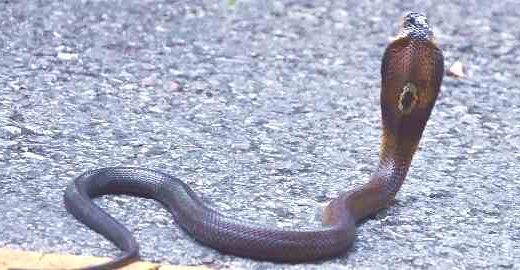
Russell’s Viper: Bigger killer of humans in Thailand than the King Cobra by total deaths, because it lives in agricultural land where people work. Bite causes severe coagulopathy, kidney failure, and death over 24–96 hours.
Malayan Pit Viper: The most numerous serious bite in southern Thailand. Heavy local tissue damage, occasional amputations, but mortality with treatment is under 1%.
Malayan Krait: The painless-bite-while-sleeping killer. Bite mortality without antivenom is over 50%; with antivenom and ventilation, survival is good.
Monocled Cobra: The most-bites-from-cobras Thai species. Severe local damage and neurotoxic envenomation; mortality with antivenom around 1–2%.
What this means for risk-by-region #
If you live in central plains agricultural Thailand, the species most likely to harm you is the Monocled Cobra or the Russell’s Viper. If you live or work in southern Thai forest, the Malayan Pit Viper is the highest-frequency dangerous bite, with the King Cobra a low-frequency but high-severity outlier. If you sleep on a floor in rural central Thailand, the Malayan Krait is the species that has killed people in their sleep.
The King Cobra wins the “worst per bite” trophy but is not the species you statistically need to plan for. For the practical “what bites people” picture see are Thailand snakes dangerous to visitors and avoiding snakebites in Thailand.
The honest takeaway #
King Cobra bites are extremely dangerous when they happen, but they happen rarely. The species you should be most concerned about depends on where you live and what you do. If you work outdoors in rural Thailand at night, the krait is the species most likely to kill you. If you work in rice paddies in the central plains, the Russell’s Viper is the species you should know cold. If you live in a Bangkok suburb with green space, the green pit vipers are the species you will actually meet — uncomfortable, occasionally painful, but rarely fatal.
External references: the WHO snakebite envenoming hub for international guidelines, and the Reptile Database entry for Ophiophagus hannah for taxonomy and species records.
Key takeaways #
- Context matters more than rules of thumb. Thailand’s snake fauna varies meaningfully by region, by season, and by habitat. Advice that holds in southern wet forest does not always hold in northern hill country or in the central agricultural plains.
- Prevention is high-leverage. Most serious snake-related incidents in Thailand are downstream of three preventable behaviours — reaching where you cannot see, walking forest paths at night without a torch, and attempting to handle or kill snakes rather than call professional removal.
- Hospital access is the real safety net. Thai provincial hospitals stock the standard polyvalent antivenoms. The single biggest predictor of bad outcome from a serious bite is delay in reaching one of those hospitals.
- Citizen-science records help. Even casual photographs with location data, posted to platforms like iNaturalist, contribute to the regional knowledge base. Most Thai snake species have surprisingly thin distribution data; one well-documented sighting can fill a real gap.
Common questions #
How likely am I to see a snake on a casual visit to Thailand?
Lower than you probably expect. A casual three-hour daytime forest hike in southern Thailand has roughly a 5–10% chance of producing any snake encounter at all, and roughly a 0.5–1% chance of producing a venomous-species sighting. Visitors who deliberately go looking — at night, in good habitat — see far more, but the casual exposure is genuinely low.
What time of year has the most snake activity?
The wet season (May through October) produces by far the most snake encounters across most of Thailand. Within that, two peaks: the start of the rains (April–June) when males are moving for breeding, and late wet season (September–November) when juvenile cohorts disperse from nest sites. The dry season (December–March) is genuinely quieter for snake-watching, particularly in the north and northeast.
Are Thai snakebite outcomes really that good?
For patients who reach a hospital within an hour or two of a venomous bite, yes — Thai outcomes are excellent by international standards. Mortality with appropriate antivenom and supportive care runs under 1% for most species. The deaths that do happen are concentrated in cases of significant pre-hospital delay, mis-identification of species, or in patients with serious co-morbidities. The Thai system is robust; the failure modes are mostly upstream of the hospital.
What is the single best preventive measure?
A torch at night. The single biggest reducer of Thai snakebite risk is consistent, eyes-down torch use on every walking path after dark. Most preventable bites in southern Thailand are foot-on-snake events on the ground at night, and a torch beam on the trail at metre-down angle prevents the great majority of them. Closed footwear is the second-biggest improvement; long trousers in dense vegetation is third.
Hi,
It’s been interesting reading on your site trying to find out what the snakes were i cycled past on a recent trip, maybe you can help.
I was cycling back from Si Sawat to Kanchanaburi last week, and almost cycled over maybe a 7 foot snake.
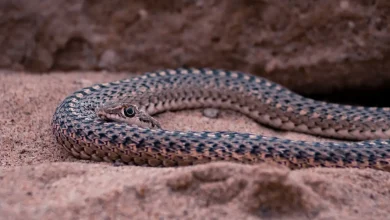
It was pretty stunning looking, i think a kind of triangular shape throughout and it was striped along its body. The stripes were a dark orange and a dark grey.
It freaked me out a bit but sped off as I noticed it about a few feet in front. I was going uphill and was acknowledging some motocyclists saying hi and then looked down and spotted it at last minute.
Saw a few others but this one struck me.
Any ideas i’d be keen to know,
cheers.
Hi Rob, thanks for writing.
It sounds like you ran across a rare mix of two different snakes – the Reticulated Python has what might be considered a triangle pattern, and is stunning. The other snake is the copperheaded racer – a rat snake, that has stripes like you describe. I’m joking of course – there is no mixed snake like this, but I can’t for the life of me guess which one you saw based on your descript. Can you answer a couple more Q’s?
Overall color? Thickness? The python would be about as big as your forearm. The rat snake as big as 4 fingers together. Was it moving fast or slow?
Hi there, sorry for such a late reply, must have hit my spam box or something if answered comments get sent to recipient.
Anyway, yes, it was thicker than my forearm, if not thicker. Definitely triangular, flat at the bottom, triangulating at the top. Yes, it moved super fast as did a back turn in the cycle lane which you get in Thailand.
I’d say maybe 5ft but it was in an S formation so difficult to tell.
Something similar but the lines were more equal:
http://farm3.static.flickr.com/2617/4048820024_e65d9f9f5d.jpg
And definitely thicker.
Sounds like a banded Krait” Nguu pok oy”
Had a similar experience near Boploi
I was pressure washing the stone wall in my garden and decided to clean the PVC pipes that allow the excess water to seep out when the soil is heavy with rain. After taking a break I went back to admire my work and seen what I thought was a large crack in the wall. On closer inspection it turned out to be a metre long snake. I decided to take a closer look as I was fascinated by it but my wife kept calling me away. I got the normal hose out to wash it off the wall and was surprised to see it fall to the ground and then rear up…..it was a king cobra!!!! Amazing and awesome sight to see but now I make sure to wear my wellies in the garden.
Photos! Would be great to find one in my own garden… get some photos next time, video even better! Cheers
I live behind a nature reserve in Ranong. My back garden adjoins it with a large lake. Snakes are every where but this was literally my first face to face encounter. I was so fascinated that I got close up and personal just to get a good look at it, not realising that it was a king cobra. Next time I will grab my camera and record it along with any other snakes I encounter.