Plumbeous Water Snake (Hypsiscopus plumbea) — Tiny, Mild-Venom Rice-Paddy Snake

The Plumbeous Water Snake is the small, dark, easily-missed water snake we pull up in dip nets in flooded rice paddies and farm ponds. Hypsiscopus plumbea (older name Enhydris plumbea) is one of the smallest water snakes in Thailand and the most numerous — by sheer head count it is one of the most common snakes in the country. The species is mildly venomous (rear-fanged) but not a meaningful health threat to people. The “plumbeous” in the name means lead-coloured, and the dark grey-blue body matches that name.
Identification #
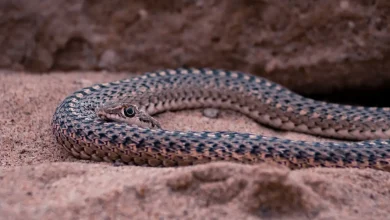
Adults are 30–50 cm — small. The body is short and stout for the length. Ground colour is a uniform dark slate-grey to lead-blue, sometimes with a slightly olive cast in good light. The belly is white or pale yellow, often with a row of small dark spots along the centre. Head is moderately broad, slightly distinct from the neck, with eyes set high (a water-snake adaptation). Mid-body scale rows: 17.
Look-alikes are other small Enhydris and related water snakes. Practical differences: H. plumbea is smaller than the Rainbow Water Snake (Enhydris enhydris) and lacks the iridescent purplish sheen of the latter; it is more uniformly coloured than Bocourt’s Water Snake (E. bocourti). The species is often confused at a glance with juvenile Checkered Keelbacks but lacks the chequered pattern.
Range and habitat #

The Plumbeous Water Snake is widespread across Southeast Asia and across the entire Thai mainland from the south through the north. Habitat is freshwater, shallow, slow-moving — rice paddies, irrigation ditches, fish ponds, drainage canals, the margins of slow rivers. The species tolerates polluted and turbid water remarkably well, and is one of the few Thai snakes you can find in numbers in heavily disturbed agricultural landscape.
Activity is largely nocturnal but they will hunt at dusk and on overcast days. Hot days are spent coiled in submerged vegetation or in burrows in the bank. We have caught adults in dip nets aimed at fish — a cm net pulled across rice-paddy water frequently brings up a Plumbeous along with the prey it was hunting.
Diet, behaviour and reproduction #
Diet is dominated by small fish (about 70% of stomach contents in published Thai studies), with frogs, tadpoles and small amphibians making up the rest. Hunting is ambush in shallow water — the snake floats with eyes above the surface and strikes downward at fish. The species is sluggish on land and will not voluntarily move overland in daylight.
Reproduction is viviparous — pups born live in the water. Litters are 4–10 (with very large females reaching slightly more), born in the wet season. Newborns are about 12 cm — among the smallest neonate snakes in Thailand.
Bite #
The species is rear-fanged with mild venom but the venom is so weak in human terms that documented bite cases produce essentially no clinical effect — at most a small puncture, mild irritation and a few hours of localised redness. There are no documented systemic envenomations or fatalities. The species is best treated as harmless. Wound infection is the realistic concern; the muddy water it lives in carries a meaningful bacterial load.
If you handle one for any reason — typically when sorting fish or pulling weeds in a rice paddy — wash hands afterward and watch the puncture for infection. Our broader piece on avoiding snakebites in Thailand applies; for the wider Thai water-snake community see the non-venomous overview.
If you find one #
Leave it alone. Plumbeous Water Snakes are useful predators in rice paddies — they take small fish, prawns and tadpoles in numbers that help keep mosquito-larvae populations balanced. Killing them is a net loss to the local pest-control balance. If a snake ends up out of water, gentle return to the nearest pond or paddy is the kindest move; do not handle for long, the species’ small body dehydrates quickly out of water.
External references: the Reptile Database entry for Hypsiscopus plumbea for the current taxonomic placement (the species was moved out of Enhydris in recent revisions), and the IUCN Red List assessment — Least Concern, with the species being one of the few Asian snakes that has likely benefited from extensive paddy agriculture.

Quick reference card #
- Where most often encountered: See the range and habitat section above. Encounter rates rise sharply during the species’ active season — for most Thai snakes, this is the wet season (May–November) with a smaller secondary peak around the end of the cool months.
- Activity period: Whether the snake is diurnal, nocturnal or crepuscular shapes the practical encounter risk. Nocturnal species are more often missed in the dark; diurnal species are more often photographed clearly.
- Bite risk to humans: Determined by whether the species is venomous, how readily it bites when disturbed, how often it is encountered in human-modified landscape, and how potent its venom is. The combination matters more than any single factor.
- Best behaviour on encounter: Stand back, photograph from a respectful distance (two metres or more), do not handle, and let the snake leave under its own power. The great majority of Thai snake encounters resolve themselves without intervention if the human steps back.
Frequently asked questions #
Is this species protected under Thai law?
Many Thai snakes are protected under the Wild Animal Reservation and Protection Act. King Cobras, Burmese Pythons, Reticulated Pythons and several smaller species are explicitly listed; killing or trading these species is technically a criminal offence even when enforcement is uneven. For other species the legal status is more permissive, but local rules vary by province and protected-area designation. When in doubt, do not kill — call the volunteer fire-brigade rescue team for free relocation.
What should I do if my pet was bitten?
Take the pet to a veterinarian immediately. Veterinarians in Thailand have access to the same antivenoms used for humans, and treatment success in dogs and cats is reasonable when the bite is recognised quickly. Do not waste time on folk remedies. Photograph the snake from a safe distance if you can — the species ID will help the vet pick the correct antivenom.
How can I keep this species out of my garden?
Three things reduce snake encounters in a garden setting: cut grass and dense ground cover short, store firewood and outdoor materials elevated rather than ground-piled, and reduce rodent populations (snakes follow rats). Lighting walking paths after dark also helps prevent foot-on-snake encounters. None of these are perfect — wild snakes will still pass through — but together they substantially reduce the chance of an encounter.
Are juveniles as dangerous as adults?
For venomous species, yes — juveniles are venomous from birth and the venom is the same potent toxin as in adults. The dose per bite is smaller, but small doses of potent venom can still be life-threatening. There is also a folk-belief that juveniles “cannot control” their venom delivery and inject more per bite than an adult; the evidence for this is mixed but the practical lesson is to treat juveniles with the same caution as adults.
Related on Thailand Snakes: Thailand snakebite first-aid guide, where the snakes are in Thailand, Thailand snake mating season.