
Small-Spotted Coral Snake — Field Photos and Notes from Southern Thailand
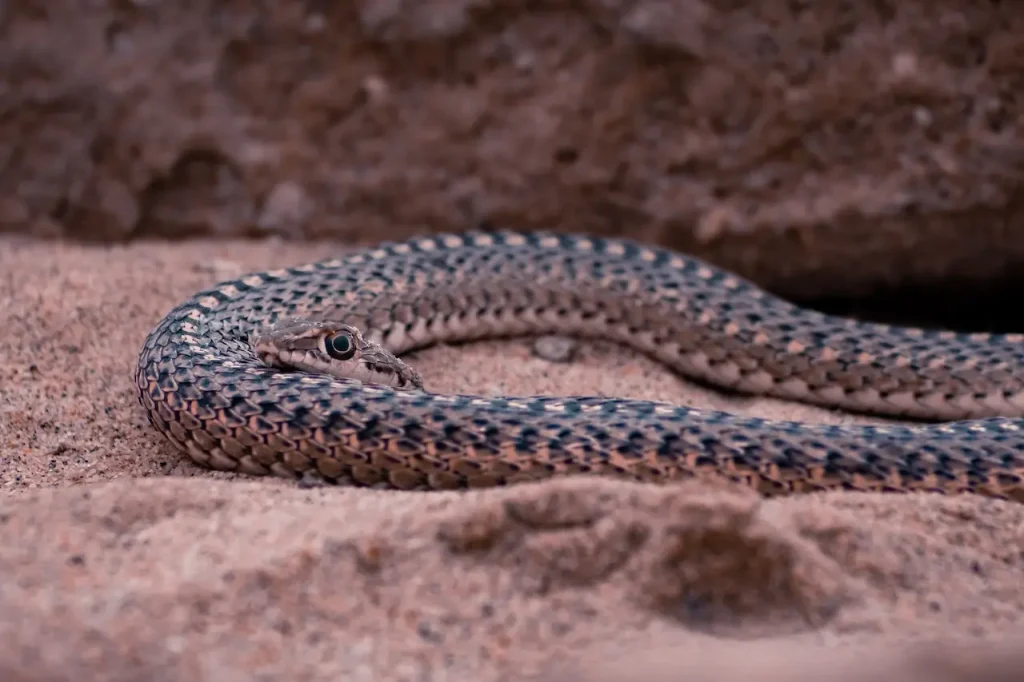
Coral snakes are the small, brightly coloured, highly venomous elapids that most people in Thailand never see. Calliophis maculiceps — the Small-Spotted Coral Snake — is one of three Thai species in the genus, all of them slender, all secretive, all packing a surprisingly potent neurotoxic venom for their size. We have caught a handful of them in southern Thailand over the years; this is the field write-up of one we found in damp leaf litter near a forest stream.

Identification #
Adults are 30–50 cm — small, even by coral snake standards. The body is unusually slender, almost worm-like in proportions. Ground colour is a deep glossy black with two thin pale longitudinal stripes (one each side of the dorsum), and a series of small white or yellow dorsal spots along the back. The belly is bright red or orange. The head is small, only barely distinct from the neck, with a dark cap and pale or yellow markings on the lower head and chin.
The species is sometimes confused with juvenile kraits — the colour scheme has surface similarities — but kraits have alternating broad bands rather than longitudinal stripes and dots, and kraits are heavier-bodied with the characteristic triangular cross-section. Coral snakes are uniformly cylindrical and much more slender. The bright red belly is also unusual; few other Thai snakes have this feature.
Range, habitat, and our find #
The species is widespread across mainland Southeast Asia. In Thailand it occurs across the south, central plains, and into parts of the north, with the strongest populations in damp forest and forest-edge habitat where loose leaf litter is abundant. Activity is strictly nocturnal and largely subterranean — they spend most of their time in leaf litter, under fallen logs, or in shallow burrows. Surface encounters are rare.
Our find: 22:00, southern Thai forest near a small permanent stream, after light rain. Substrate damp, leaf litter abundant. The snake was 35 cm long, on the surface, moving slowly in a leaf-litter pocket. We photographed from 50 cm with a hook and bag ready, did not handle, and the snake disappeared back under leaf cover within two minutes. The whole encounter was less than five minutes.
Behaviour and venom #
Diet is almost entirely other small snakes — particularly blind snakes and the smaller worm snakes — and occasionally small lizards. Coral snakes are dedicated snake-eaters in the same way as the king cobra, just at a much smaller scale. Defensive behaviour is to coil tightly and hide the head under the body, with the tail (often as boldly coloured as the head) flicked up as a decoy. The strike is fast and accurate at close range but the species rarely lunges.
The venom is a potent neurotoxin in the family of elapid venoms, comparable in toxicity to cobra venom in laboratory tests. Documented bite cases are rare because the species is rare in human-occupied landscape, but the few published Thai cases describe rapid onset of neurological signs (drooping eyelids, swallowing difficulty) within an hour of the bite. The species’ small mouth and short fangs limit the dose delivered; nevertheless, any coral snake bite should be treated as serious and transported immediately to a hospital with appropriate polyvalent antivenom.
What to do if you find one #
Photograph from a comfortable distance — one metre is fine since the species rarely strikes proactively — and leave it alone. Coral snakes are uncommon enough that every encounter is a small contribution to known distribution data; consider posting the record to iNaturalist with location. Do not handle. The bite is medically serious and the species is small enough that a hand-grab is genuinely possible.
For the wider Thai venomous snake community see common venomous Thailand snakes; for first-aid see Thailand snakebite first-aid.
External references: the Reptile Database entry for Calliophis maculiceps for taxonomy, and the IUCN Red List assessment.
 Banded Krait — black and yellow banded body" class="wp-image-69" />
Key takeaways #
- Context matters more than rules of thumb. Thailand’s snake fauna varies meaningfully by region, by season, and by habitat. Advice that holds in southern wet forest does not always hold in northern hill country or in the central agricultural plains.
- Prevention is high-leverage. Most serious snake-related incidents in Thailand are downstream of three preventable behaviours — reaching where you cannot see, walking forest paths at night without a torch, and attempting to handle or kill snakes rather than call professional removal.
- Hospital access is the real safety net. Thai provincial hospitals stock the standard polyvalent antivenoms. The single biggest predictor of bad outcome from a serious bite is delay in reaching one of those hospitals.
- Citizen-science records help. Even casual photographs with location data, posted to platforms like iNaturalist, contribute to the regional knowledge base. Most Thai snake species have surprisingly thin distribution data; one well-documented sighting can fill a real gap.
Common questions #
How likely am I to see a snake on a casual visit to Thailand?
Lower than you probably expect. A casual three-hour daytime forest hike in southern Thailand has roughly a 5–10% chance of producing any snake encounter at all, and roughly a 0.5–1% chance of producing a venomous-species sighting. Visitors who deliberately go looking — at night, in good habitat — see far more, but the casual exposure is genuinely low.
What time of year has the most snake activity?
The wet season (May through October) produces by far the most snake encounters across most of Thailand. Within that, two peaks: the start of the rains (April–June) when males are moving for breeding, and late wet season (September–November) when juvenile cohorts disperse from nest sites. The dry season (December–March) is genuinely quieter for snake-watching, particularly in the north and northeast.
Are Thai snakebite outcomes really that good?
For patients who reach a hospital within an hour or two of a venomous bite, yes — Thai outcomes are excellent by international standards. Mortality with appropriate antivenom and supportive care runs under 1% for most species. The deaths that do happen are concentrated in cases of significant pre-hospital delay, mis-identification of species, or in patients with serious co-morbidities. The Thai system is robust; the failure modes are mostly upstream of the hospital.
What is the single best preventive measure?
A torch at night. The single biggest reducer of Thai snakebite risk is consistent, eyes-down torch use on every walking path after dark. Most preventable bites in southern Thailand are foot-on-snake events on the ground at night, and a torch beam on the trail at metre-down angle prevents the great majority of them. Closed footwear is the second-biggest improvement; long trousers in dense vegetation is third.
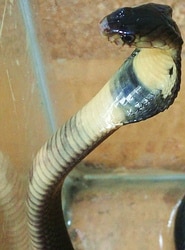
These are a fantastic little species, i found one at the resort in 2008, right by the restaurant heading down some concrete steps.
I found this small spotted snake slithering on our tiles after my dog started barking at something under the car. From your description, including the orange colouring underneath, it looks like a small spotted coral snake. This snake was found in a small town near Wang Saphung, Loei.
Yes, maybe the coral then. Whey didn’t you send the photo? Here’s our ID page – https://thailandsnakes.com/thailand-snake-id/