Pope’s Bamboo Pit Viper — Highland Form and Subspecies of Trimeresurus popeiorum

The taxonomy around Trimeresurus popeiorum has been argued over for nearly a century. The “Pope’s Bamboo Pit Viper” name has been applied at various times to highland populations from northern Thailand and adjacent Myanmar that show subtle differences from typical lowland Pope’s — slightly different scale counts, slightly more turquoise-tinted green, and a strong association with bamboo and giant fern habitat in cloud forest above 1,200 m. Whether these populations are a distinct subspecies, a regional colour form, or simply the upper end of the natural variation in popeiorum is still being worked out by herpetologists. This page is the local-population view: what the bamboo-zone Pope’s looks like, where to find one, and what is different in practice.
How the highland form differs #
Lowland and mid-elevation Pope’s Pit Vipers are bright leaf-green with a rusty red-brown tail. Highland bamboo-zone individuals tend to show a slightly cooler, more bluish-green tone, particularly in adult females, and the rusty tail is a deeper, darker brown. Some authors have referred to this as a separate subspecies (variously T. p. sabahi in older literature, with the picture complicated by descriptions of T. sabahi from Borneo as a distinct species in modern revisions). The pragmatic answer for a Thai field guide: it is still Trimeresurus popeiorum, the variation is real but on a continuum, and the snake bites the same and is the same species for medical purposes.
Adults of the highland form average a fraction smaller than lowland Pope’s — most we have measured fall between 65 and 80 cm. Mid-body scale rows are typically 21, ventrals 145–175, and males show the white-and-red ventrolateral stripe more prominently than females, as in the rest of the species.
Where to find them #
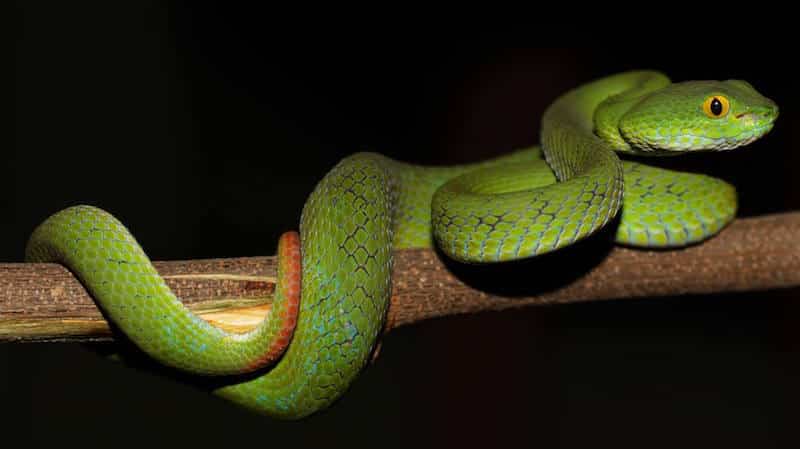
The bamboo-zone form is the green pit viper of the high north. Doi Inthanon, Doi Suthep-Pui above the temple, Doi Pha Hom Pok, Doi Phu Kha and the highest areas of Pha Daeng National Park all hold this form. Bamboo brakes between 1,200 and 2,000 m, especially where there is heavy moss cover and slow-flowing streams, are productive. We have caught more in late September after a stretch of rain than in any other month. Below about 800 m the highland form gives way to ordinary Pope’s; above about 2,000 m the species drops out and other elapids and colubrids take over.
Behaviour and bite — practical notes #
Behaviour matches the species: ambush hunter, mostly nocturnal, calm by viper standards but accurate on a strike. Diet is frogs, lizards and the occasional small mammal — caudal luring with the dark tail tip is common. Reproduction is ovoviviparous, with 4–8 live young born in October and November, slightly later than the lowland Pope’s birth window.
Bites are managed exactly as for the species generally — see our Pope’s Pit Viper main profile for the full medical picture. The Thai green pit viper antivenom (Queen Saovabha Memorial Institute Hemato Polyvalent) is effective, and bites at highland sites have the additional logistical concern of distance from a hospital. If you are camping in the bamboo zone, plan an evacuation route before the trip.
How to handle an encounter #
Walk past at a metre and a half, leave the snake where it is, and keep moving. Highland Pope’s hold their position and almost never strike unprovoked. If you absolutely must take a photograph, get low (the cool turquoise tone shows beautifully against bamboo) and do not touch the foliage the snake is sitting in. Our broader notes on avoiding snakebites in Thailand apply doubly when you are eight hours from a hospital.
For a side-by-side with the closely related Large-Eyed Pit Viper, which shares some highland habitat in northern Thailand, see the related profile we keep on green pit viper diversity in Thailand. For the canonical species page, follow our main Pope’s Pit Viper write-up; this page is the regional-form companion.
External references: the Reptile Database entry for T. popeiorum covers the synonymy and the subspecies-level argument better than any single paper, and the iNaturalist record map shows where the species has actually been observed across its range.
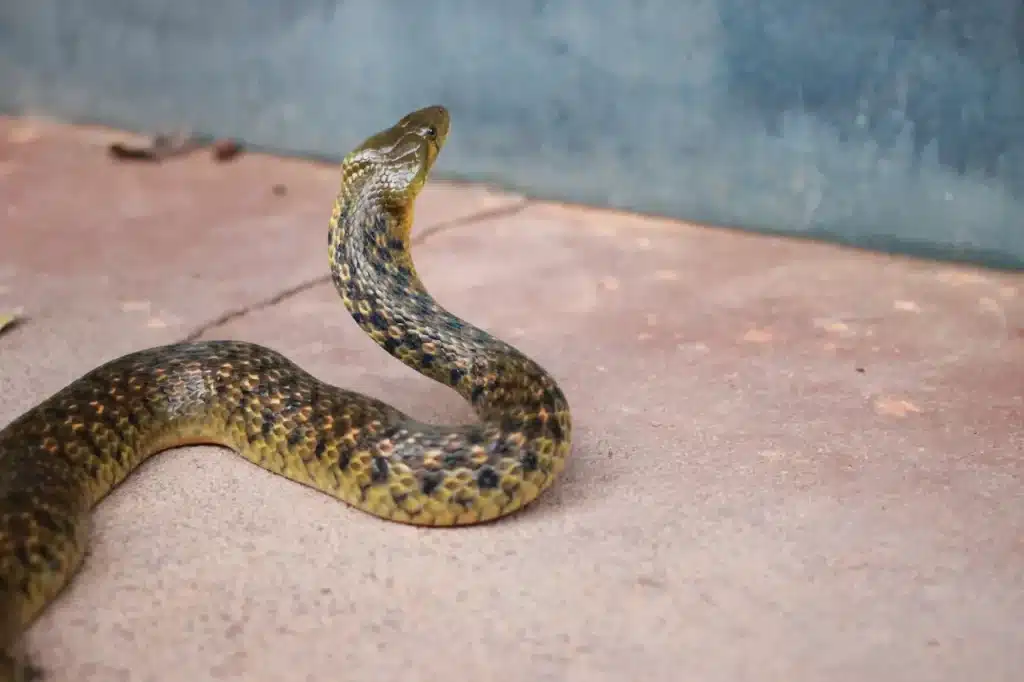 Banded Krait — black and yellow banded body" class="wp-image-69" />
Key takeaways #
- Context matters more than rules of thumb. Thailand’s snake fauna varies meaningfully by region, by season, and by habitat. Advice that holds in southern wet forest does not always hold in northern hill country or in the central agricultural plains.
- Prevention is high-leverage. Most serious snake-related incidents in Thailand are downstream of three preventable behaviours — reaching where you cannot see, walking forest paths at night without a torch, and attempting to handle or kill snakes rather than call professional removal.
- Hospital access is the real safety net. Thai provincial hospitals stock the standard polyvalent antivenoms. The single biggest predictor of bad outcome from a serious bite is delay in reaching one of those hospitals.
- Citizen-science records help. Even casual photographs with location data, posted to platforms like iNaturalist, contribute to the regional knowledge base. Most Thai snake species have surprisingly thin distribution data; one well-documented sighting can fill a real gap.
Common questions #
How likely am I to see a snake on a casual visit to Thailand?
Lower than you probably expect. A casual three-hour daytime forest hike in southern Thailand has roughly a 5–10% chance of producing any snake encounter at all, and roughly a 0.5–1% chance of producing a venomous-species sighting. Visitors who deliberately go looking — at night, in good habitat — see far more, but the casual exposure is genuinely low.
What time of year has the most snake activity?
The wet season (May through October) produces by far the most snake encounters across most of Thailand. Within that, two peaks: the start of the rains (April–June) when males are moving for breeding, and late wet season (September–November) when juvenile cohorts disperse from nest sites. The dry season (December–March) is genuinely quieter for snake-watching, particularly in the north and northeast.
Are Thai snakebite outcomes really that good?
For patients who reach a hospital within an hour or two of a venomous bite, yes — Thai outcomes are excellent by international standards. Mortality with appropriate antivenom and supportive care runs under 1% for most species. The deaths that do happen are concentrated in cases of significant pre-hospital delay, mis-identification of species, or in patients with serious co-morbidities. The Thai system is robust; the failure modes are mostly upstream of the hospital.
What is the single best preventive measure?
A torch at night. The single biggest reducer of Thai snakebite risk is consistent, eyes-down torch use on every walking path after dark. Most preventable bites in southern Thailand are foot-on-snake events on the ground at night, and a torch beam on the trail at metre-down angle prevents the great majority of them. Closed footwear is the second-biggest improvement; long trousers in dense vegetation is third.
Related on Thailand Snakes: common Thailand venomous snakes overview, common non-venomous Thailand snakes reference, snake identification decision tree.