Pope’s Pit Viper (Trimeresurus popeiorum) — Northern Thailand’s Highland Green Viper
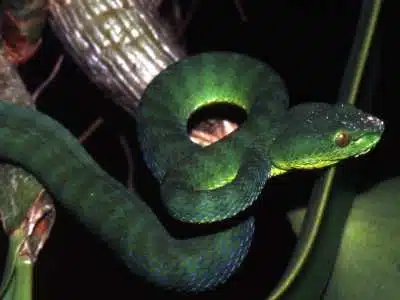
Pope’s Pit Viper is the green pit viper most people meet on a hike through the cool, misty hill forests of northern Thailand. Trimeresurus popeiorum is named for Clifford Pope, the American herpetologist who collected the type specimens in the 1930s. It is a close cousin of the much more familiar lowland White-Lipped Pit Viper but tends to live higher, deeper into forest, and is the green snake we expect on every Doi Suthep, Doi Inthanon or Doi Phu Kha night-walk we take above 800 metres.
Field identification #
Adults reach 70–95 cm with the largest females approaching 1.1 m. Body bright leaf-green above, pale yellow to whitish-green below. The tail is rusty red-brown. Like most Asian green pit vipers the head is broad, triangular and clearly distinct from the slender neck, with a heat-sensing pit between eye and nostril. Eye colour varies — most adults have a yellow-bronze iris with a vertical pupil. Males show a thin white-and-red ventrolateral stripe along the body that females lack or show only faintly.
The biggest ID challenge is separating Pope’s from the lowland White-Lipped Pit Viper (T. albolabris). Both are bright green snakes with a rusty tail. Three features help: Pope’s lacks the conspicuous pale upper-lip line that the White-Lipped wears; Pope’s has a slightly more bluish-green ground colour in good light; and elevation/forest condition is a strong tiebreaker — Pope’s is a higher-elevation, more closed-forest snake. If you have one in a Bangkok garden, it is almost certainly the White-Lipped. Our broader walk-through on how to identify snakes in Thailand covers the practical decision tree.
Range and habitat #

Pope’s Pit Viper is a hill-forest specialist. In Thailand it occurs across the entire northern region — Mae Hong Son, Chiang Mai, Chiang Rai, Lampang, Nan, Phitsanulok, Loei — typically above 600 m and into cloud-forest above 1,500 m. Records from south of the Chao Phraya basin are rare and disputed; most southern “popeiorum” turn out on close examination to be T. macrops or T. albolabris. Outside Thailand the species ranges into Myanmar, northern Laos, northern Vietnam and parts of southern China.
Habitat is closed-canopy evergreen forest with abundant epiphytes and a wet understory. They love mossy branches, fern thickets and the edges of small streams. Activity is essentially nocturnal but they will hunt at dusk on cool overcast days. We see the most encounters from May to October, peaking with the early rains.
Diet, behaviour and reproduction #
Diet is mostly frogs and lizards taken from the leaf litter or from low branches; small mammals and birds make up a smaller share. The hunting strategy is the genus-standard ambush — find a perch on a low branch over a known frog trail, freeze, and wait. The rusty tail is flicked tip-up to attract curious frogs and small lizards within striking range, a technique known as caudal luring. We have watched a Pope’s hold a single perch for over four hours.
Defensive behaviour is calm by viper standards: a cornered snake hisses and goes still, relying on its green camouflage. Push closer and the strike is fast. Compared to the White-Lipped, Pope’s tend to be a bit more nervous in bright light and more inclined to leave when given the chance.
The species is ovoviviparous. Females give birth to 4–10 live young in late rainy season, usually August through October. Newborns are about 18 cm and immediately venomous.
Venom and bite #
The bite picture matches the rest of the genus: severe local pain and swelling within thirty minutes, bruising and blistering at the bite site, occasional spread of swelling up the limb, and a procoagulant/anticoagulant venom that can produce a slow-developing coagulopathy over the first 24 hours. Spontaneous bleeding from gums or old wounds is a sign of the latter. Mortality is reported as low — under 1% in the published Thai hospital series — but morbidity is real, with a small fraction of cases needing fasciotomy or losing tissue from the bite area.
If bitten in the hill forest: stay calm, immobilise the limb at heart level, remove watches and rings, and head out to the nearest hospital. No tourniquet, no cutting, no ice. Photograph the snake from a safe distance only if it does not slow you down. The same Thai green pit viper antivenom (Queen Saovabha Memorial Institute) covers popeiorum. Our piece on avoiding snakebites in Thailand covers the day-to-day prevention; if you are heading into mountain forest, also see our notes on how dangerous Thai snakes really are to visitors.
Field tips for hill walkers #
Most bites in the north happen at night, on a wet evening, on a forest trail. The single best preventive measure is a torch. Pope’s Pit Vipers do not chase, do not stalk people, and do not climb above eye level on a trail. Almost every bite case we know of involved someone reaching with a hand into foliage they could not see — picking up a tarp, grabbing a tent guy, lifting a backpack off the ground. If you are camping in highland forest, store gear elevated and check before you handle anything in low light.
If you find one and want a photo, give it a metre and a half, get low, and leave the snake on the same branch you found it on. Pope’s are not aggressive, but they hold their position and will strike accurately within their reach if you crowd them. For a sense of how this species fits next to Thailand’s other vipers, see our common Thailand venomous snakes overview.
External references: the Reptile Database entry for Trimeresurus popeiorum for taxonomy and synonymy, and the IUCN Red List assessment for conservation status.
 keelback-snake1.jpg" alt="Red-necked Keelback in defensive pose" class="wp-image-5" srcset="https://thailandsnakes.com/wp-content/uploads/2010/02/red-necked-keelback-snake1.jpg 500w, https://thailandsnakes.com/wp-content/uploads/2010/02/red-necked-keelback-snake1-300x88.jpg 300w, https://thailandsnakes.com/wp-content/uploads/2010/02/red-necked-keelback-snake1-150x44.jpg 150w" sizes="(max-width: 500px) 100vw, 500px" />
Quick reference card #
- Where most often encountered: See the range and habitat section above. Encounter rates rise sharply during the species’ active season — for most Thai snakes, this is the wet season (May–November) with a smaller secondary peak around the end of the cool months.
- Activity period: Whether the snake is diurnal, nocturnal or crepuscular shapes the practical encounter risk. Nocturnal species are more often missed in the dark; diurnal species are more often photographed clearly.
- Bite risk to humans: Determined by whether the species is venomous, how readily it bites when disturbed, how often it is encountered in human-modified landscape, and how potent its venom is. The combination matters more than any single factor.
- Best behaviour on encounter: Stand back, photograph from a respectful distance (two metres or more), do not handle, and let the snake leave under its own power. The great majority of Thai snake encounters resolve themselves without intervention if the human steps back.
Frequently asked questions #
Is this species protected under Thai law?
Many Thai snakes are protected under the Wild Animal Reservation and Protection Act. King Cobras, Burmese Pythons, Reticulated Pythons and several smaller species are explicitly listed; killing or trading these species is technically a criminal offence even when enforcement is uneven. For other species the legal status is more permissive, but local rules vary by province and protected-area designation. When in doubt, do not kill — call the volunteer fire-brigade rescue team for free relocation.
What should I do if my pet was bitten?
Take the pet to a veterinarian immediately. Veterinarians in Thailand have access to the same antivenoms used for humans, and treatment success in dogs and cats is reasonable when the bite is recognised quickly. Do not waste time on folk remedies. Photograph the snake from a safe distance if you can — the species ID will help the vet pick the correct antivenom.
How can I keep this species out of my garden?
Three things reduce snake encounters in a garden setting: cut grass and dense ground cover short, store firewood and outdoor materials elevated rather than ground-piled, and reduce rodent populations (snakes follow rats). Lighting walking paths after dark also helps prevent foot-on-snake encounters. None of these are perfect — wild snakes will still pass through — but together they substantially reduce the chance of an encounter.
Are juveniles as dangerous as adults?
For venomous species, yes — juveniles are venomous from birth and the venom is the same potent toxin as in adults. The dose per bite is smaller, but small doses of potent venom can still be life-threatening. There is also a folk-belief that juveniles “cannot control” their venom delivery and inject more per bite than an adult; the evidence for this is mixed but the practical lesson is to treat juveniles with the same caution as adults.