
Red-Necked Keelback Caught on a Night Herping Trip — Field Notes
 keelback-snake1.jpg" class="thailandsnakes-featured-img" alt="Red Necked Keelback Snake, venomous, Thailand and southeast Asia." style="width:100%;height:auto;display:block;margin:0 0 1.6em 0;border-radius:4px;" loading="eager" fetchpriority="high" srcset="https://thailandsnakes.com/wp-content/uploads/2010/02/red-necked-keelback-snake1.jpg 500w, https://thailandsnakes.com/wp-content/uploads/2010/02/red-necked-keelback-snake1-300x88.jpg 300w, https://thailandsnakes.com/wp-content/uploads/2010/02/red-necked-keelback-snake1-150x44.jpg 150w" sizes="(max-width: 500px) 100vw, 500px" />
The Red-Necked Keelback is one of the snakes most frequently misjudged in Thailand. Rhabdophis subminiatus looks small and unimposing, has weak rear fangs, and bites that often “feel fine” for the first hour. The species is also genuinely deadly — a procoagulant venom that produces consumption coagulopathy 24-48 hours later, with documented fatalities in the medical literature. We caught one on a southern Thailand herping night last week. The catch is the field study; the bigger lesson is the species’ deceptive innocence.
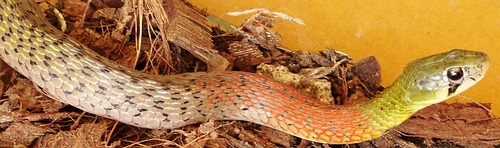
The catch #
21:00, warm wet evening, southern Thai forest near a small stream. We had been walking for ninety minutes with one earlier find (a Common Painted Bronzeback). The keelback was on the trail edge, about 70 cm long, slowly moving toward the stream. The red neck was conspicuous under the torch beam. We had the snake bagged with a hook in about two minutes — the species is calm to handle and rarely strikes during ordinary catch operations.
Body condition: good. Recent meal visible as a slight bulge mid-body, probably a frog. We photographed the snake in the bag, did not handle further, and released at the original site within an hour. No bite, no incident.
The deceptive innocence #
The Red-Necked Keelback’s most dangerous quality is how unimpressive it looks. The body is slender, the snake moves slowly, the defensive display is mild — at most a small open-mouth bluff. Compare this to a cobra (rear, hood, hiss) or a krait (slow but confident, the pattern alone tells you to back off). The Red-Necked Keelback presents as “harmless small water snake”. For decades the species was treated that way in field guides. Then the bite cases started accumulating.
The species’ venom is unusual. The procoagulant component activates clotting in the body, exhausting clotting factors over 12-48 hours. Once the factors are exhausted, the patient enters a consumption coagulopathy and bleeds spontaneously — gums, urine, old wounds, IV access sites. There is also evidence of bufotoxin sequestration from the snake’s toad diet, adding a cardiotoxic component to severe envenomations. Mortality without specific antivenom is meaningful; documented Thai fatalities exist.
Catch protocol for venomous-but-misjudged species #
Our practice for Red-Necked Keelbacks specifically:
- Treat as if it were a cobra. Long hook, controlled bag, no hand contact.
- Photograph through the bag mesh — do not remove the snake for staged photography.
- Note the bite marks of any prey item visible in the snake; if the snake has fed recently, releasing at the catch site within hours is preferable.
- Document any bite, no matter how trivial. The bite picture is silent for hours.
- Refer any keelback bite to a hospital with serial coagulation profile testing for at least 24 hours.
What we’d want every Thai medic to know #
The single most important point for clinical practice: a Red-Necked Keelback bite that “looks fine” at presentation can crash 24-48 hours later. Patients should not be discharged without serial coagulation profile testing. The 20-Minute Whole Blood Clotting Test should be repeated at 6, 12 and 24 hours. If the patient develops coagulopathy, manage as for a Russell’s Viper bite (specific antivenom from the Queen Saovabha Memorial Institute, fresh frozen plasma if needed, supportive care).
For the species profile see our main Red-Necked Keelback page and the related delayed coagulopathy notes. For the wider snakebite first-aid picture see Thailand snakebite first-aid.
External references: the Reptile Database entry for Rhabdophis subminiatus for taxonomy and the WHO snakebite envenoming hub for international treatment guidelines.
Key takeaways #
- Context matters more than rules of thumb. Thailand’s snake fauna varies meaningfully by region, by season, and by habitat. Advice that holds in southern wet forest does not always hold in northern hill country or in the central agricultural plains.
- Prevention is high-leverage. Most serious snake-related incidents in Thailand are downstream of three preventable behaviours — reaching where you cannot see, walking forest paths at night without a torch, and attempting to handle or kill snakes rather than call professional removal.
- Hospital access is the real safety net. Thai provincial hospitals stock the standard polyvalent antivenoms. The single biggest predictor of bad outcome from a serious bite is delay in reaching one of those hospitals.
- Citizen-science records help. Even casual photographs with location data, posted to platforms like iNaturalist, contribute to the regional knowledge base. Most Thai snake species have surprisingly thin distribution data; one well-documented sighting can fill a real gap.
Common questions #
How likely am I to see a snake on a casual visit to Thailand?
Lower than you probably expect. A casual three-hour daytime forest hike in southern Thailand has roughly a 5–10% chance of producing any snake encounter at all, and roughly a 0.5–1% chance of producing a venomous-species sighting. Visitors who deliberately go looking — at night, in good habitat — see far more, but the casual exposure is genuinely low.
What time of year has the most snake activity?
The wet season (May through October) produces by far the most snake encounters across most of Thailand. Within that, two peaks: the start of the rains (April–June) when males are moving for breeding, and late wet season (September–November) when juvenile cohorts disperse from nest sites. The dry season (December–March) is genuinely quieter for snake-watching, particularly in the north and northeast.
Are Thai snakebite outcomes really that good?
For patients who reach a hospital within an hour or two of a venomous bite, yes — Thai outcomes are excellent by international standards. Mortality with appropriate antivenom and supportive care runs under 1% for most species. The deaths that do happen are concentrated in cases of significant pre-hospital delay, mis-identification of species, or in patients with serious co-morbidities. The Thai system is robust; the failure modes are mostly upstream of the hospital.
What is the single best preventive measure?
A torch at night. The single biggest reducer of Thai snakebite risk is consistent, eyes-down torch use on every walking path after dark. Most preventable bites in southern Thailand are foot-on-snake events on the ground at night, and a torch beam on the trail at metre-down angle prevents the great majority of them. Closed footwear is the second-biggest improvement; long trousers in dense vegetation is third.
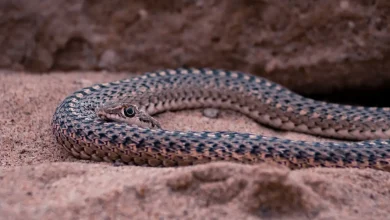
These used to be imported as pets years ago didn’t they? Before they realized they were as toxic as they are?
Yep, unfortunately. There are others in the same genus – Rhabdophis – that everyone should be careful of. Could be the same kidney destroying venom in those snakes as well.