Dog-Faced Water Snake (Cerberus rynchops) — The Mangrove Bicycle Snake

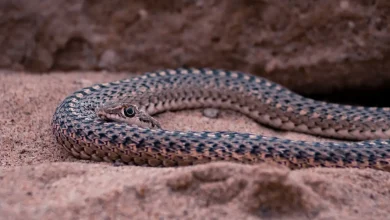
The Dog-Faced Water Snake is the mangrove specialist that fishermen on the Andaman coast pull out of their nets in surprising numbers. Cerberus rynchops is rear-fanged and mildly venomous, but the venom is weak and the species is essentially harmless to humans. The common name “dog-faced” comes from the slightly bulldog-shaped snout — the head looks short and wide, with the eyes positioned high. We have caught hundreds of these snakes over the years; they are one of the most numerous snakes of Thailand’s mangrove and brackish-water systems.
Identification #
Adults are 60–90 cm, occasionally 120 cm. Body moderately stout, head wide and slightly distinct from neck. Eyes are small and set high on the head — adapted for watching above the water surface while the body floats. The colour pattern varies a lot: most individuals show grey or brown ground colour with darker irregular crossbars, and a heavily speckled belly. A few individuals are almost uniformly olive. Scales smooth or weakly keeled, mid-body 21–25 rows.
The species is most often confused with juvenile Banded Mangrove Snakes (Boiga dendrophila) and with one of the freshwater Enhydris water snakes. Banded Mangrove juveniles have bright yellow bands on a black ground — opposite of the muted Dog-Faced pattern. Enhydris are typically more cylindrical, more uniformly pigmented and have an aspect of a “small smooth water snake” rather than the slightly bulky aspect of Cerberus.
Range and habitat #

The species is widespread across coastal Asia from India east through Indonesia and the Philippines. Thai records are concentrated along both coastlines — the Andaman side from Ranong south through the peninsula, and the Gulf side from the inner gulf round to the eastern provinces. Habitat is mangrove channels, mud-flats, estuaries, brackish-water lagoons and the lower reaches of coastal rivers. They tolerate a very wide salinity range. Inland, they will also use freshwater fish ponds with a tidal connection.
Activity is largely nocturnal but they will hunt at dawn and dusk and on overcast days. The species is amphibious to an unusual degree — they hunt in water, rest at the waterline, and move overland between channels at night. We have found them up to 200 m from the nearest standing water on a wet mangrove forest floor.
Behaviour, diet and reproduction #
Diet is fish (about 60% of stomach contents in published Thai studies), with crabs, prawns and the occasional frog making up the rest. The hunting strategy is ambush in shallow water. The snake floats with eyes and nostrils above the surface, body curled below, and strikes downward at fish that come within range. The famous “bicycle motion” of Cerberus on land — a sideways sidewinder-like loop — is unique among Thai snakes; the species locomotes well overland on slick mud where ordinary lateral undulation would slip.
Reproduction is viviparous; pups are born in the water. Litters are 6–26, born in late wet season. Newborns are about 18 cm.
Venom and bites #
The species is technically rear-fanged with mild venom, but the venom is so weak in human terms that documented bite cases produce little more than minor local swelling and irritation. There are no recorded systemic envenomations or fatalities from Cerberus rynchops. The species is best treated as “harmless” for practical purposes — a fisherman pulling one out of a net should certainly avoid the bite, but a clinical poisoning is not realistic.
If bitten, clean the wound and watch for infection. The mangrove environment carries a higher background load of bacteria than a forest setting, so wound infection is the more realistic concern than envenomation. Our broader piece on avoiding snakebites in Thailand still applies — most “snake-related” emergencies in coastal villages are actually wound infections, not venom.
If you find one #
Leave it alone. Dog-Faced Water Snakes do not attack swimmers, kayakers or fishermen unless directly handled. If one is in a fish trap or net, the kindest move is to release it — they are valuable mangrove predators that take large numbers of small fish in a way that does not conflict significantly with commercial fishing. If you photograph one, the wide head and the bulldog snout are the best angles to capture.
For more on the wider Thai water-snake community, see our common non-venomous Thailand snakes reference and the related how to identify snakes in Thailand guide. The mangrove environment also supports the much more dangerous Banded Mangrove Snake, so it is worth knowing both.
External references: the Reptile Database entry for Cerberus rynchops for taxonomy, and the IUCN Red List assessment — currently Least Concern, but mangrove conversion remains a meaningful regional pressure.
 Banded Krait — black and yellow banded body" class="wp-image-69" />
Quick reference card #
- Where most often encountered: See the range and habitat section above. Encounter rates rise sharply during the species’ active season — for most Thai snakes, this is the wet season (May–November) with a smaller secondary peak around the end of the cool months.
- Activity period: Whether the snake is diurnal, nocturnal or crepuscular shapes the practical encounter risk. Nocturnal species are more often missed in the dark; diurnal species are more often photographed clearly.
- Bite risk to humans: Determined by whether the species is venomous, how readily it bites when disturbed, how often it is encountered in human-modified landscape, and how potent its venom is. The combination matters more than any single factor.
- Best behaviour on encounter: Stand back, photograph from a respectful distance (two metres or more), do not handle, and let the snake leave under its own power. The great majority of Thai snake encounters resolve themselves without intervention if the human steps back.
Frequently asked questions #
Is this species protected under Thai law?
Many Thai snakes are protected under the Wild Animal Reservation and Protection Act. King Cobras, Burmese Pythons, Reticulated Pythons and several smaller species are explicitly listed; killing or trading these species is technically a criminal offence even when enforcement is uneven. For other species the legal status is more permissive, but local rules vary by province and protected-area designation. When in doubt, do not kill — call the volunteer fire-brigade rescue team for free relocation.
What should I do if my pet was bitten?
Take the pet to a veterinarian immediately. Veterinarians in Thailand have access to the same antivenoms used for humans, and treatment success in dogs and cats is reasonable when the bite is recognised quickly. Do not waste time on folk remedies. Photograph the snake from a safe distance if you can — the species ID will help the vet pick the correct antivenom.
How can I keep this species out of my garden?
Three things reduce snake encounters in a garden setting: cut grass and dense ground cover short, store firewood and outdoor materials elevated rather than ground-piled, and reduce rodent populations (snakes follow rats). Lighting walking paths after dark also helps prevent foot-on-snake encounters. None of these are perfect — wild snakes will still pass through — but together they substantially reduce the chance of an encounter.
Are juveniles as dangerous as adults?
For venomous species, yes — juveniles are venomous from birth and the venom is the same potent toxin as in adults. The dose per bite is smaller, but small doses of potent venom can still be life-threatening. There is also a folk-belief that juveniles “cannot control” their venom delivery and inject more per bite than an adult; the evidence for this is mixed but the practical lesson is to treat juveniles with the same caution as adults.