Red-Tailed Racer — A Beautiful Find in Southern Thai Forest
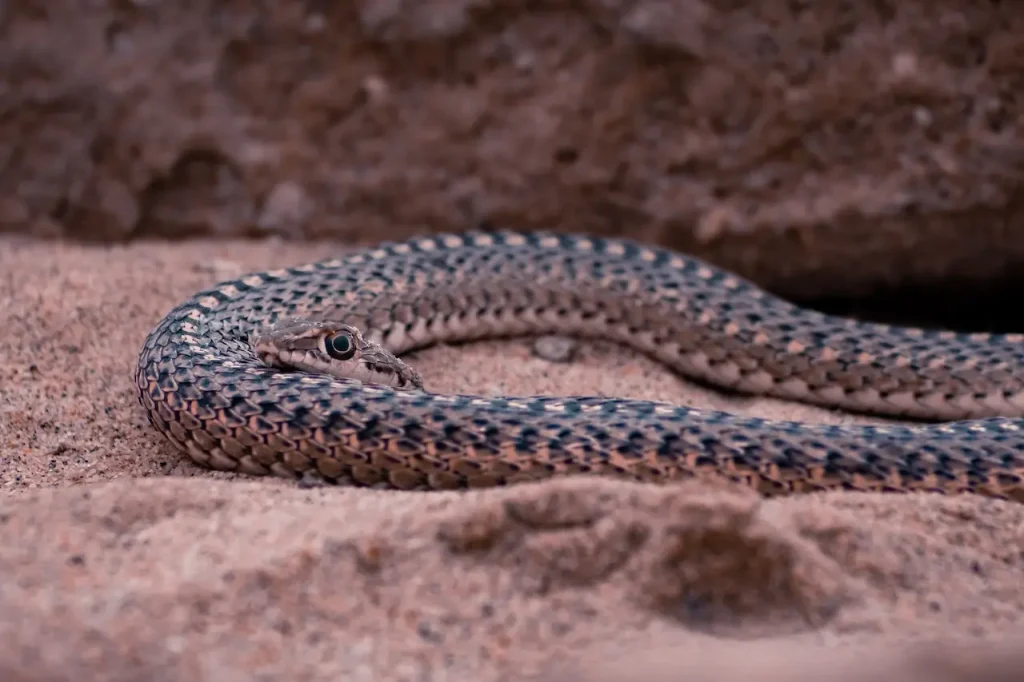
The Red-Tailed Racer is one of the most striking non-venomous snakes in Thailand. Gonyosoma oxycephalum (in some recent literature placed in Gonyosoma prasinum) is a long, slender, electric-green racer with a cinnamon-red tail and a strikingly long, pointed head. We caught one this past weekend in southern Thai forest — a 1.6 m adult female on a low branch — and the encounter is worth writing up because the species is one of the more spectacular sightings any Thai herper can hope for.

Identification #
Adults reach 1.5–2.0 m, occasionally 2.4 m. The body is long and slender, laterally compressed (deeper than wide), with the head a long pointed oval clearly distinct from the neck. Eyes are large with round pupils. The dorsum is bright leaf-green, often with a slight olive tint in mature animals. The tail is a striking cinnamon-red or rusty-orange — about the last 25-30% of the body. The belly is yellowish-green. There is no obvious lateral stripe.
The species is unmistakable once seen — the green body with red tail combination is unique among Thai snakes. Look-alikes are the various green pit vipers (heavier-bodied, triangular head, vertical pupil) and the harmless Bronzebacks (more bronze-brown, shorter tail).
Range and habitat #
The species is widespread across Southeast Asia. In Thailand, it occurs in mature forest across the south and parts of the central plains and east, with some records from the better-preserved patches in the north. It is more dependent on intact forest than the more flexible Bronzebacks; the species drops out of heavily disturbed agricultural landscape.
Activity is largely diurnal, with peak movement in mid-morning and late afternoon. The species is one of the most arboreal of Thai colubrids — adults spend most of their active life 2–8 m off the ground in canopy. Hunting is fast active pursuit of small mammals (especially nesting birds, occasionally bats) and the occasional larger lizard.
Our find #
10:30 in the morning, sunny day, mature forest in southern Thailand. The racer was on a low branch about 3 m off the ground, basking in a sunlit gap. We had about 20 seconds of unhurried photography from 4 m before the snake noticed us, lifted its head, and disappeared into the canopy at speed. Body length estimated at 1.6 m. No capture, no handling — the species photographs beautifully and there was no reason to disturb it further.
Defensive behaviour, when it does occur, is the standard “open mouth, flash of bright lining” bluff. The species rarely actually bites, and the bite is harmless — small teeth, no venom of medical concern.
Where to find one #
Productive habitat: mature secondary forest with a good tall canopy and reasonably continuous tree cover. The species needs vertical structure and a healthy bird and small-mammal prey base. Coconut and rubber plantations are too low-canopy for the species; oil palm is too uniform. The best Thai sites are inside national parks (Khao Sok, Khao Yai, Khao Sam Roi Yot, Khao Pra-Bang Khram) and large mature private forest fragments in the south.
For the wider Thai non-venomous snake catalogue see common non-venomous Thailand snakes; for the related green colubrids see our profiles of the Golden Tree Snake and the Common Painted Bronzeback.
External references: the Reptile Database entry for Gonyosoma oxycephalum for taxonomy, and the IUCN Red List for conservation status — currently Least Concern, but local Thai populations decline as mature forest is converted.
 keelback-snake1.jpg" alt="Red-necked Keelback in defensive pose" class="wp-image-5" srcset="https://thailandsnakes.com/wp-content/uploads/2010/02/red-necked-keelback-snake1.jpg 500w, https://thailandsnakes.com/wp-content/uploads/2010/02/red-necked-keelback-snake1-300x88.jpg 300w, https://thailandsnakes.com/wp-content/uploads/2010/02/red-necked-keelback-snake1-150x44.jpg 150w" sizes="(max-width: 500px) 100vw, 500px" />
 Banded Krait — black and yellow banded body" class="wp-image-69" />
Key takeaways #
- Context matters more than rules of thumb. Thailand’s snake fauna varies meaningfully by region, by season, and by habitat. Advice that holds in southern wet forest does not always hold in northern hill country or in the central agricultural plains.
- Prevention is high-leverage. Most serious snake-related incidents in Thailand are downstream of three preventable behaviours — reaching where you cannot see, walking forest paths at night without a torch, and attempting to handle or kill snakes rather than call professional removal.
- Hospital access is the real safety net. Thai provincial hospitals stock the standard polyvalent antivenoms. The single biggest predictor of bad outcome from a serious bite is delay in reaching one of those hospitals.
- Citizen-science records help. Even casual photographs with location data, posted to platforms like iNaturalist, contribute to the regional knowledge base. Most Thai snake species have surprisingly thin distribution data; one well-documented sighting can fill a real gap.
Common questions #
How likely am I to see a snake on a casual visit to Thailand?
Lower than you probably expect. A casual three-hour daytime forest hike in southern Thailand has roughly a 5–10% chance of producing any snake encounter at all, and roughly a 0.5–1% chance of producing a venomous-species sighting. Visitors who deliberately go looking — at night, in good habitat — see far more, but the casual exposure is genuinely low.
What time of year has the most snake activity?
The wet season (May through October) produces by far the most snake encounters across most of Thailand. Within that, two peaks: the start of the rains (April–June) when males are moving for breeding, and late wet season (September–November) when juvenile cohorts disperse from nest sites. The dry season (December–March) is genuinely quieter for snake-watching, particularly in the north and northeast.
Are Thai snakebite outcomes really that good?
For patients who reach a hospital within an hour or two of a venomous bite, yes — Thai outcomes are excellent by international standards. Mortality with appropriate antivenom and supportive care runs under 1% for most species. The deaths that do happen are concentrated in cases of significant pre-hospital delay, mis-identification of species, or in patients with serious co-morbidities. The Thai system is robust; the failure modes are mostly upstream of the hospital.
What is the single best preventive measure?
A torch at night. The single biggest reducer of Thai snakebite risk is consistent, eyes-down torch use on every walking path after dark. Most preventable bites in southern Thailand are foot-on-snake events on the ground at night, and a torch beam on the trail at metre-down angle prevents the great majority of them. Closed footwear is the second-biggest improvement; long trousers in dense vegetation is third.
Further reading and related references #
If you found this article useful, our wider catalogue covers most of the related topics in similar depth. We keep regional reference pages for each major Thai habitat, species pages for the country’s medically important snakes, and field-notes write-ups from each of our regular sites. The site is built as a connected network of references — most articles link out to two or three closely-related pieces, and you can navigate by following the in-text links to species or topics that catch your attention.
For the broader catalogue see our best-of-articles index, the common venomous Thailand snakes reference, and the matching non-venomous overview. For first-aid see our snakebite first-aid page. For the regional snake distribution see where the snakes are in Thailand and the related Thailand snake mating season piece.
Reader contributions are how the site grows. If you have a Thai snake encounter worth sharing — a clear photograph, a well-documented sighting, a question we have not covered — please email or submit through our reader-submission queue at snake ID reader submissions. The accumulated reader records have substantially improved our regional knowledge over the years, and citizen-science records remain one of the most under-utilised tools in Thai herpetology.
For the global research context that supports this work, three external resources are worth bookmarking: the Reptile Database for canonical species taxonomy, the IUCN Red List for conservation status assessments, and iNaturalist for the citizen-science observation platform that aggregates Thai records alongside global ones. The WHO snakebite envenoming hub is the international reference for clinical management.