
Green Keelback (Rhabdophis nigrocinctus) — Field ID Tips and Bite Notes
 keelback-roger-mader.jpg" class="thailandsnakes-featured-img" alt="Rhabdophis Nigrocinctus Green Keelback Roger Mader" style="width:100%;height:auto;display:block;margin:0 0 1.6em 0;border-radius:4px;" loading="eager" fetchpriority="high" srcset="https://thailandsnakes.com/wp-content/uploads/2010/11/Rhabdophis-nigrocinctus-green-keelback-roger-mader.jpg 400w, https://thailandsnakes.com/wp-content/uploads/2010/11/Rhabdophis-nigrocinctus-green-keelback-roger-mader-300x225.jpg 300w, https://thailandsnakes.com/wp-content/uploads/2010/11/Rhabdophis-nigrocinctus-green-keelback-roger-mader-150x113.jpg 150w" sizes="(max-width: 400px) 100vw, 400px" />
The Green Keelback is one of the more confusing IDs in Thai herping. Rhabdophis nigrocinctus shares a body plan, a habitat and a wet-grass habit with the genuinely deadly Red-Necked Keelback (R. subminiatus) and with the harmless Yellow-Spotted Keelback (R. chrysargos). The differences are small but meaningful, and getting them right is worth the effort because the Red-Necked is one of the most underrated dangerous snakes in Thailand. This page focuses on field ID and the bite-risk picture; the species profile is on our main Green Keelback page.
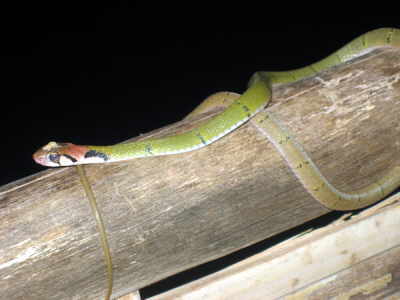
The three keelbacks at a glance #
All three are small to medium snakes (50–80 cm), all live around water, all have keeled body scales and all hunt frogs. The differences:
- Green Keelback (R. nigrocinctus): Olive-green to brown dorsum, distinctive black collar with red or pink neck patches behind it, pale belly. Widespread Thailand, dry-evergreen and wet forest both.
- Red-Necked Keelback (R. subminiatus): Olive-green dorsum, prominent red neck (no black collar), often with a yellow-orange flash zone behind the head. The dangerous one.
- Yellow-Spotted Keelback (R. chrysargos): Olive-brown with two rows of yellow spots running the length of the back. No red neck. Largely harmless.
If the snake has a clear red neck and no obvious black collar, default to “treat as Red-Necked Keelback” — the bite is potentially deadly and the species is the rear-fanged snake we treat with the most respect in Thailand. For the full story on that species, see our Red-Necked Keelback profile.
Where Green Keelbacks live #
Green Keelbacks are widespread across Thailand. They occupy a slightly drier, more forest-edge habitat than the other two species — we see them in dry-evergreen patches, semi-deciduous forest, scrub edges, and around the borders of rice paddies. Activity is largely nocturnal but they will hunt frogs at dusk in wet season. The species is far less aquatic than its cousins; you will more often find one moving through leaf litter or low grass than in actual water.
Diet is heavily frogs and toads. The species also takes the occasional small lizard or earthworm. Reproduction is oviparous — clutches of 8–17 eggs are laid in leaf litter at the start of the rainy season.
Bite picture #
This is where the species earns its “assumed venomous” historical label. The Green Keelback has rear fangs and produces venom, but the toxicity is much lower than its red-necked cousin. The few documented bite cases produce local pain, mild swelling and occasional bruising, with no documented systemic envenomations. There are no recorded fatalities. We treat R. nigrocinctus as a snake to handle with care but not to lose sleep over.
The clinical concern with all Rhabdophis bites is that the assessment depends on getting the species right. A bite from R. subminiatus can produce a dangerous coagulopathy 24–48 hours later — well after the initial bite “looks fine”. If a patient presents with a Rhabdophis-shaped bite from any species, watch them for delayed coagulopathy. For the practical day-to-day prevention, see our avoiding snakebites in Thailand guide.
If you find one #
Photograph from a metre, do not handle, and let the snake go. Green Keelbacks are useful frog-eaters and are not a meaningful threat. Most encounters last seconds — the snake usually moves into cover within a minute of being disturbed. If you keep a wider Thai snake field guide, our how to identify snakes in Thailand reference covers the keelback group in more detail.
External references: the Reptile Database entry for R. nigrocinctus for taxonomy, and the Wikipedia article on the genus Rhabdophis, which is unusual among snakes for sequestering toxins from its toad prey — a bit of weird natural history that applies to R. nigrocinctus as well as its more famous cousins.

Quick reference card #
- Where most often encountered: See the range and habitat section above. Encounter rates rise sharply during the species’ active season — for most Thai snakes, this is the wet season (May–November) with a smaller secondary peak around the end of the cool months.
- Activity period: Whether the snake is diurnal, nocturnal or crepuscular shapes the practical encounter risk. Nocturnal species are more often missed in the dark; diurnal species are more often photographed clearly.
- Bite risk to humans: Determined by whether the species is venomous, how readily it bites when disturbed, how often it is encountered in human-modified landscape, and how potent its venom is. The combination matters more than any single factor.
- Best behaviour on encounter: Stand back, photograph from a respectful distance (two metres or more), do not handle, and let the snake leave under its own power. The great majority of Thai snake encounters resolve themselves without intervention if the human steps back.
Frequently asked questions #
Is this species protected under Thai law?
Many Thai snakes are protected under the Wild Animal Reservation and Protection Act. King Cobras, Burmese Pythons, Reticulated Pythons and several smaller species are explicitly listed; killing or trading these species is technically a criminal offence even when enforcement is uneven. For other species the legal status is more permissive, but local rules vary by province and protected-area designation. When in doubt, do not kill — call the volunteer fire-brigade rescue team for free relocation.
What should I do if my pet was bitten?
Take the pet to a veterinarian immediately. Veterinarians in Thailand have access to the same antivenoms used for humans, and treatment success in dogs and cats is reasonable when the bite is recognised quickly. Do not waste time on folk remedies. Photograph the snake from a safe distance if you can — the species ID will help the vet pick the correct antivenom.
How can I keep this species out of my garden?
Three things reduce snake encounters in a garden setting: cut grass and dense ground cover short, store firewood and outdoor materials elevated rather than ground-piled, and reduce rodent populations (snakes follow rats). Lighting walking paths after dark also helps prevent foot-on-snake encounters. None of these are perfect — wild snakes will still pass through — but together they substantially reduce the chance of an encounter.
Are juveniles as dangerous as adults?
For venomous species, yes — juveniles are venomous from birth and the venom is the same potent toxin as in adults. The dose per bite is smaller, but small doses of potent venom can still be life-threatening. There is also a folk-belief that juveniles “cannot control” their venom delivery and inject more per bite than an adult; the evidence for this is mixed but the practical lesson is to treat juveniles with the same caution as adults.
Recently, in Cambodia, I encountered a yellow snake, it was about a metre in length and very skinny. I cannot find any reference to this snake, any thoughts?
How thin? Sounds like maybe a yellow form of Ahaetulla prasina.
Hi Marcus,
I live in Khao Sok National Park, and this snake is the most common on my property, I see one of them almost every day. They are amazingly beautiful and can’t be bothered when approached closely. Some of the local guides free handle them regularly. At night time though, when you disturb their sleep, they behave totally different. More aggressive…
If you ever want to visit Khao Sok, please contact me. We have so many snakes here, you’d love it.
Thanks! I’ll send you an email in a few minutes. Cheers