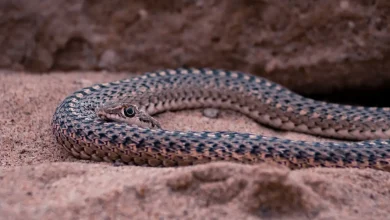
Many-Spotted Cat Snake (Boiga multomaculata) — Mildly Venomous, Strikingly Patterned

The Many-Spotted Cat Snake is one of those quiet small-to-medium snakes that lives almost everywhere in Thailand without anyone noticing. Boiga multomaculata is rear-fanged, mildly venomous, and not a meaningful threat to people, but the spotted pattern is genuinely striking — once you see one with a torch at the right angle, the species is unmistakable.
Identification #
Adults are 70–110 cm. The body is moderately slender and laterally compressed. Ground colour is a pale tan, cream or pinkish-grey, overlaid with two rows of large dark brown or black spots running the full length of the dorsum, alternating left and right. The head is broad, oval, with a pronounced pair of dark stripes running through the eyes. Eyes are large and gold-yellow, pupils vertical (this is the family cat-snake feature). Belly is white or pale yellow.
Look-alikes: juvenile Russell’s Vipers can show vaguely similar dark dorsal spots but have a triangular head, much bulkier body and round/elliptical eye pupils with a different head shape. Cat snakes are slim, evening-active, with the elongated head/wide neck differentiation visible at a glance. Russell’s Vipers are short and bulky — once you have seen one of each, the confusion ends.
Range and habitat #
The species is widespread across Southeast Asia. In Thailand it occurs across the entire mainland, from the deep south through the central plains and into the north. Habitat is broad — secondary forest, scrubland, suburban gardens, fruit orchards and rubber plantations. Activity is strictly nocturnal. Daytime is spent coiled in leaf bases, palm fronds, hollow trees or under bark; the snake emerges shortly after dusk and hunts until dawn.
Diet is mainly small lizards (geckos especially) and small birds, with the occasional rodent. Hunting is active rather than ambush — the snake quarters foliage carefully looking for sleeping geckos and roosting birds. Caudal-flicking and slow body movements help disguise the approach.
Behaviour and bite #
Defensive behaviour is theatrical: the snake throws itself into a tight S-curve, opens its mouth, and feigns lunges at the threat. Real strikes are uncommon and rarely connect with skin. The bite, if it happens, is a row of small puncture marks; the rear fangs are short and the venom yield is low. Documented Thai bite cases produce local swelling and minor bruising at most. There are no recorded systemic envenomations or fatalities.
Reproduction is oviparous. Clutches of 6–10 elongate eggs are laid in tree hollows or leaf-litter pockets, hatching in 70–80 days. Newborns are about 22 cm and immediately arboreal.
If you find one #
Watch and walk past. Many-Spotted Cat Snakes are useful gecko-eaters and the species is not a public-health concern. Photograph from a metre back if you want to (the spotted pattern photographs beautifully under a torch); never grab. If a snake is inside a house, gentle encouragement with a long broom — pushing it from the back rather than blocking its head — gets it out almost every time. Cat snakes prefer to be moving forward toward an exit.
For comparisons with the venomous tree snakes you might encounter at the same elevation, see our common venomous snakes reference. For the wider catalogue of small harmless snakes, our non-venomous overview covers the lookalike species.
External references: the Reptile Database entry for Boiga multomaculata for taxonomy, and the iNaturalist record for distribution from citizen-science observations.
Quick reference card #
- Where most often encountered: See the range and habitat section above. Encounter rates rise sharply during the species’ active season — for most Thai snakes, this is the wet season (May–November) with a smaller secondary peak around the end of the cool months.
- Activity period: Whether the snake is diurnal, nocturnal or crepuscular shapes the practical encounter risk. Nocturnal species are more often missed in the dark; diurnal species are more often photographed clearly.
- Bite risk to humans: Determined by whether the species is venomous, how readily it bites when disturbed, how often it is encountered in human-modified landscape, and how potent its venom is. The combination matters more than any single factor.
- Best behaviour on encounter: Stand back, photograph from a respectful distance (two metres or more), do not handle, and let the snake leave under its own power. The great majority of Thai snake encounters resolve themselves without intervention if the human steps back.
Frequently asked questions #
Is this species protected under Thai law?
Many Thai snakes are protected under the Wild Animal Reservation and Protection Act. King Cobras, Burmese Pythons, Reticulated Pythons and several smaller species are explicitly listed; killing or trading these species is technically a criminal offence even when enforcement is uneven. For other species the legal status is more permissive, but local rules vary by province and protected-area designation. When in doubt, do not kill — call the volunteer fire-brigade rescue team for free relocation.
What should I do if my pet was bitten?
Take the pet to a veterinarian immediately. Veterinarians in Thailand have access to the same antivenoms used for humans, and treatment success in dogs and cats is reasonable when the bite is recognised quickly. Do not waste time on folk remedies. Photograph the snake from a safe distance if you can — the species ID will help the vet pick the correct antivenom.
How can I keep this species out of my garden?
Three things reduce snake encounters in a garden setting: cut grass and dense ground cover short, store firewood and outdoor materials elevated rather than ground-piled, and reduce rodent populations (snakes follow rats). Lighting walking paths after dark also helps prevent foot-on-snake encounters. None of these are perfect — wild snakes will still pass through — but together they substantially reduce the chance of an encounter.
Are juveniles as dangerous as adults?
For venomous species, yes — juveniles are venomous from birth and the venom is the same potent toxin as in adults. The dose per bite is smaller, but small doses of potent venom can still be life-threatening. There is also a folk-belief that juveniles “cannot control” their venom delivery and inject more per bite than an adult; the evidence for this is mixed but the practical lesson is to treat juveniles with the same caution as adults.
Related on Thailand Snakes: snake removal phone numbers across Thailand, are Thailand snakes aggressive?, Thailand snake books and shirts.