Checkered Keelback (Fowlea piscator) — Mildly Venomous, Rarely Dangerous
 keelback-wolfgang-grossman.jpg" class="thailandsnakes-featured-img" alt="Xenochrophis Piscator Checkered Keelback Wolfgang Grossman" style="width:100%;height:auto;display:block;margin:0 0 1.6em 0;border-radius:4px;" loading="eager" fetchpriority="high" srcset="https://thailandsnakes.com/wp-content/uploads/2010/11/Xenochrophis-piscator-checkered-keelback-wolfgang-grossman.jpg 400w, https://thailandsnakes.com/wp-content/uploads/2010/11/Xenochrophis-piscator-checkered-keelback-wolfgang-grossman-300x225.jpg 300w, https://thailandsnakes.com/wp-content/uploads/2010/11/Xenochrophis-piscator-checkered-keelback-wolfgang-grossman-150x113.jpg 150w" sizes="(max-width: 400px) 100vw, 400px" />
If we had to pick the snake we run into most often around Thai rice paddies, drainage canals and slow-moving streams, the Checkered Keelback would be near the top of the list. Fowlea piscator (until recently classified as Xenochrophis piscator) is a thick-bodied water snake that earns its common name from the chequerboard pattern that runs the length of its back. People who spot one in their garden pond often assume it must be dangerous because of its size and willingness to flatten its neck and bluff. The truth is more nuanced — it has weak rear-fang venom, but it is not what we would call a deadly snake.
How to identify a Checkered Keelback #
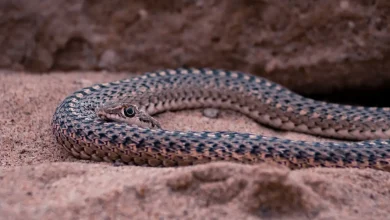
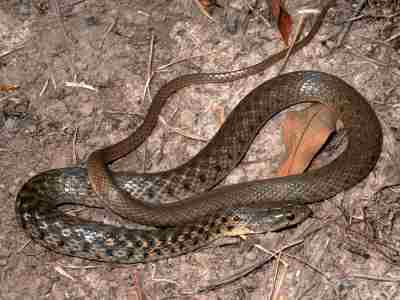
Adults usually measure 70–100 cm, with the largest examples we have measured pushing 120 cm. The body is stout for the snake’s length and the head is clearly distinct from the neck — a useful character because most non-venomous keelbacks have a head that blends straight into the body. The dorsal pattern is the most reliable feature: alternating dark and pale squares arranged in roughly four longitudinal rows, on a ground colour that runs from olive-green to grey-brown to almost black depending on the population. Two diagonal black streaks under each eye are another quick check — one in front of the eye, one behind, both pointing down toward the lip.
Juveniles are paler and the chequered pattern is more striking. The belly is creamy white, sometimes with darker pigment along the edges of the ventral scales. Scale count is 19 mid-body rows, ventrals 124–158, subcaudals 70–90, anal divided. People most often confuse this snake with the venomous Yellow-Spotted Keelback (Rhabdophis chrysargos) or the truly deadly Red-Necked Keelback (Rhabdophis subminiatus); if you would like a side-by-side, our guide on how to identify snakes in Thailand walks through the differences.
Where you will find them in Thailand #

The Checkered Keelback ranges from Pakistan eastward across India and Southeast Asia, and the entire mainland of Thailand is within its range. We have caught or photographed them in Krabi, Surat Thani, Nakhon Si Thammarat, Chumphon, Bangkok suburbs, Khon Kaen and Chiang Mai — basically anywhere there is permanent or seasonal fresh water. They are generalists. A neglected fishpond, a half-flooded paddy after the first heavy rain, a concrete drainage canal in a Bangkok village, the edge of a temple klong — all of these are fair game. They are equally happy hunting at the margins of rivers, in seasonal wetlands and around the edges of reservoirs.
This is one of the few Thai snakes you can readily encounter at any time of day. They bask in the sun on rocks and grass tussocks beside water and switch to active hunting in late afternoon and through the night. Cool nights slow them down. Hot, humid evenings after rain are when we see the most.
Behaviour, diet and breeding #
Diet is heavily fish (the species name piscator literally means “fisherman”), supplemented with frogs, tadpoles and the occasional small mammal that strays into shallow water. They strike fast underwater and swallow prey live; small fish are gone in a couple of seconds. They are also one of the few Thai snakes that will hunt actively in turbid floodwater, using a sense of vibration rather than sight.
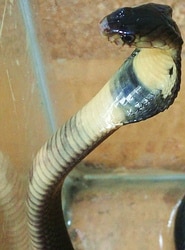
Defensive behaviour is dramatic but mostly bluff. A cornered Checkered Keelback flattens the front third of its body, lifts the head, hisses, and may strike repeatedly. We have had small juveniles strike at gloved hands a dozen times in a row. The performance is convincing enough that villagers regularly mistake them for cobras. They are oviparous — females lay 8 to 80 eggs per clutch (the larger numbers are unusual and come from large adults), and the female stays coiled around the clutch until it hatches in roughly 60 days.
Bite risk and venom #
This is technically a rear-fanged snake with mild venom delivered from enlarged grooved teeth at the back of the upper jaw. To get a clinically meaningful envenomation, the snake usually has to chew on the victim — a fast bite-and-release rarely transmits enough. The handful of documented bite cases produce localised swelling, mild bruising and pain, sometimes with prolonged bleeding from the bite site because the venom contains anticoagulant components. There is no recorded fatality from Fowlea piscator in the medical literature, and antivenom is not indicated. We treat it as an “annoying but not deadly” snake and put it in the same risk bucket as the Yellow-Spotted Keelback rather than the genuinely dangerous Red-Necked Keelback.
That said, every bite from a wild snake should be cleaned thoroughly and watched for swelling and infection. Anyone showing systemic symptoms after a keelback bite — wider bruising, bleeding from the gums, blood in urine — should head to a hospital, because that pattern matches the Red-Necked Keelback envenomation profile and the snake may have been misidentified. Our short overview of how to avoid getting bitten in Thailand is worth a read if you live near water.
What to do if one shows up #
The right answer is almost always: leave it alone. Checkered Keelbacks are doing useful work — they keep frog and fish populations in check, and we have seen them eat invasive tilapia fingerlings out of village ponds. If the snake is somewhere you cannot tolerate (inside a bathroom, under a child’s wading pool), call a local rescue rather than killing it. Most Thai municipalities now have free or low-cost snake-removal services through the volunteer fire brigade — see our list of snake removal numbers across Thailand.
If you must move it yourself, do not pick it up by hand. Use a long broom or stick to gently nudge it into a covered bin or pillowcase, then release it at least 500 m away in habitat with permanent water. Do not release it into a different watershed — that displaces the local genetics and, more practically, the snake will try to come back. For wider species comparisons against truly dangerous look-alikes, our reference page on Thailand’s common venomous snakes is a useful next step.
Independent species references we trust: the Reptile Database entry for Fowlea piscator for taxonomy and synonymy, and the IUCN Red List assessment for conservation status (currently Least Concern across most of its range, though local populations decline where wetlands are drained).
Quick reference card #
- Where most often encountered: See the range and habitat section above. Encounter rates rise sharply during the species’ active season — for most Thai snakes, this is the wet season (May–November) with a smaller secondary peak around the end of the cool months.
- Activity period: Whether the snake is diurnal, nocturnal or crepuscular shapes the practical encounter risk. Nocturnal species are more often missed in the dark; diurnal species are more often photographed clearly.
- Bite risk to humans: Determined by whether the species is venomous, how readily it bites when disturbed, how often it is encountered in human-modified landscape, and how potent its venom is. The combination matters more than any single factor.
- Best behaviour on encounter: Stand back, photograph from a respectful distance (two metres or more), do not handle, and let the snake leave under its own power. The great majority of Thai snake encounters resolve themselves without intervention if the human steps back.
Frequently asked questions #
Is this species protected under Thai law?
Many Thai snakes are protected under the Wild Animal Reservation and Protection Act. King Cobras, Burmese Pythons, Reticulated Pythons and several smaller species are explicitly listed; killing or trading these species is technically a criminal offence even when enforcement is uneven. For other species the legal status is more permissive, but local rules vary by province and protected-area designation. When in doubt, do not kill — call the volunteer fire-brigade rescue team for free relocation.
What should I do if my pet was bitten?
Take the pet to a veterinarian immediately. Veterinarians in Thailand have access to the same antivenoms used for humans, and treatment success in dogs and cats is reasonable when the bite is recognised quickly. Do not waste time on folk remedies. Photograph the snake from a safe distance if you can — the species ID will help the vet pick the correct antivenom.
How can I keep this species out of my garden?
Three things reduce snake encounters in a garden setting: cut grass and dense ground cover short, store firewood and outdoor materials elevated rather than ground-piled, and reduce rodent populations (snakes follow rats). Lighting walking paths after dark also helps prevent foot-on-snake encounters. None of these are perfect — wild snakes will still pass through — but together they substantially reduce the chance of an encounter.
Are juveniles as dangerous as adults?
For venomous species, yes — juveniles are venomous from birth and the venom is the same potent toxin as in adults. The dose per bite is smaller, but small doses of potent venom can still be life-threatening. There is also a folk-belief that juveniles “cannot control” their venom delivery and inject more per bite than an adult; the evidence for this is mixed but the practical lesson is to treat juveniles with the same caution as adults.