Kanburi Pit Viper (Trimeresurus kanburiensis) — Kanchanaburi Endemic
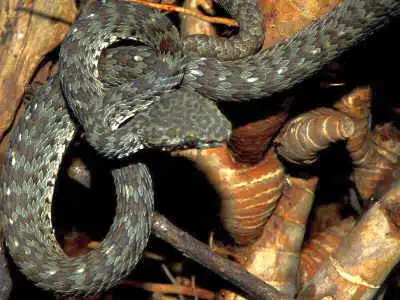
The Kanburi Pit Viper is one of those species that exists almost entirely on a single limestone hill range in central-western Thailand. Trimeresurus kanburiensis was described by the British herpetologist Malcolm Smith in 1943 from a female collected in the karst hills around Kanchanaburi (the original Thai name Kanburi survives in the species epithet). For most of the next eighty years it remained a name in textbooks rather than a snake people actually saw — even today, the great majority of records come from a small area in Kanchanaburi province.
How to recognise one #
This is not a green pit viper. The dorsum is greyish-brown to olive, with a heavy speckling of darker brown or black blotches along the back. The pattern is highly cryptic against limestone substrate — at rest on a lichen-covered rock or a dead leaf, an adult is almost invisible until it moves. Adults reach about 65–80 cm, with one published record approaching 1 m. The head is the broad triangular pit-viper shape, and the eye has a yellowish-grey iris with a vertical pupil. The tail is short and prehensile.
The closest look-alike is Trimeresurus venustus, the Brown-Spotted Pit Viper, which shares the same general limestone habitat and a similar speckled pattern but is generally a deeper warm brown with more contrasting spots and a more eastern distribution. Both species are sometimes recorded together at the same site. Genuine identification often needs a hemipenis count or a mid-body scale row count (kanburiensis: 21 mid-body rows; venustus: 21 also — so the count alone is not diagnostic). For most practical purposes, the location is the strongest hint: an adult speckled brown-grey pit viper from Kanchanaburi is almost certainly kanburiensis.
Range and habitat #

The species is restricted to limestone karst habitat in western and central Thailand. The strongholds are the karst towers and limestone hills in Kanchanaburi province, with scattered records across into Myanmar and possibly into Tak province further north. Within those hills the species favours the base of cliffs, the entrances of caves, and the heavily shaded leaf-litter zones at the foot of the limestone — habitats with stable humidity, plenty of cover and a healthy frog population.
Activity follows the rains. The species is essentially absent from view through the dry months from January to early April, then re-appears with the first heavy storms. Mating activity peaks in September and October — that is the window when most encounters happen, because males travel during the day looking for females. Females retreat into rock crevices to give birth in the early dry season.
Behaviour, diet and reproduction #
Like most Asian pit vipers in this genus, kanburiensis is an ambush hunter. Diet is mostly frogs and lizards taken at night, with small mammals and birds making up a smaller share. They climb a little — usually no more than a metre or two off the ground — but spend most of their time on or just above the leaf litter. Defensive behaviour is calm by viper standards: a cornered animal hisses, then goes very still, relying on camouflage. They rarely strike at first. Push too hard and the strike is fast and accurate.
This species is ovoviviparous; the female retains the eggs internally and gives birth to 4–10 live young. Newborns are about 18 cm and venomous from the moment they emerge.
Venom and bite #
Bites from T. kanburiensis are uncommon simply because the species is rare and lives in places few people visit. The few documented cases describe local effects very similar to a White-Lipped Pit Viper bite — severe pain, bruising, swelling spreading up the limb, and a coagulopathy that can take 24–72 hours to develop fully. There are no recorded fatalities in the published literature, but the species’ venom has not been as thoroughly characterised as the more common pit vipers, and we treat any kanburiensis bite as needing hospital observation and likely antivenom. The Thai green pit viper monovalent and hematological polyvalent antivenoms appear to have cross-reactivity but evidence is limited; clinicians manage the case primarily on the laboratory picture.
If you are working or hiking in the Kanchanaburi karst country, treat any pit viper as a serious bite. Check shoes and boots before pulling them on, do not put hands into rock crevices you cannot see into, and use a torch on tracks after dark. Our wider notes on avoiding snakebites in Thailand apply doubly in this terrain. For comparison with the more common ground-dwelling viper that is a far bigger public-health problem, see our Malayan Pit Viper profile.
Conservation and where this fits #
Restricted-range snakes like T. kanburiensis are vulnerable in proportion to how much of their habitat remains intact. The Kanchanaburi karsts are increasingly fragmented by quarrying for cement and limestone, by agriculture pushing up against the cliff bases, and by tourism infrastructure around cave temples. The IUCN currently lists the species under a “Least Concern” assessment (largely because Thai records have grown over the past two decades), but the local picture is more nuanced — populations appear stable inside protected karst, and decline rapidly where quarrying is active. If you encounter one outside an obvious quarry zone, photograph it from a respectful distance and submit the record to iNaturalist — that single act adds more to the species’ known distribution than almost anything else you can do.
For taxonomy and synonymy, the Reptile Database entry for Trimeresurus kanburiensis is the cleanest reference. For broader context on Thailand’s pit viper diversity, our overview of common venomous Thailand snakes covers the species you are most likely to bump into in the rest of the country.
Quick reference card #
- Where most often encountered: See the range and habitat section above. Encounter rates rise sharply during the species’ active season — for most Thai snakes, this is the wet season (May–November) with a smaller secondary peak around the end of the cool months.
- Activity period: Whether the snake is diurnal, nocturnal or crepuscular shapes the practical encounter risk. Nocturnal species are more often missed in the dark; diurnal species are more often photographed clearly.
- Bite risk to humans: Determined by whether the species is venomous, how readily it bites when disturbed, how often it is encountered in human-modified landscape, and how potent its venom is. The combination matters more than any single factor.
- Best behaviour on encounter: Stand back, photograph from a respectful distance (two metres or more), do not handle, and let the snake leave under its own power. The great majority of Thai snake encounters resolve themselves without intervention if the human steps back.
Frequently asked questions #
Is this species protected under Thai law?
Many Thai snakes are protected under the Wild Animal Reservation and Protection Act. King Cobras, Burmese Pythons, Reticulated Pythons and several smaller species are explicitly listed; killing or trading these species is technically a criminal offence even when enforcement is uneven. For other species the legal status is more permissive, but local rules vary by province and protected-area designation. When in doubt, do not kill — call the volunteer fire-brigade rescue team for free relocation.
What should I do if my pet was bitten?
Take the pet to a veterinarian immediately. Veterinarians in Thailand have access to the same antivenoms used for humans, and treatment success in dogs and cats is reasonable when the bite is recognised quickly. Do not waste time on folk remedies. Photograph the snake from a safe distance if you can — the species ID will help the vet pick the correct antivenom.
How can I keep this species out of my garden?
Three things reduce snake encounters in a garden setting: cut grass and dense ground cover short, store firewood and outdoor materials elevated rather than ground-piled, and reduce rodent populations (snakes follow rats). Lighting walking paths after dark also helps prevent foot-on-snake encounters. None of these are perfect — wild snakes will still pass through — but together they substantially reduce the chance of an encounter.
Are juveniles as dangerous as adults?
For venomous species, yes — juveniles are venomous from birth and the venom is the same potent toxin as in adults. The dose per bite is smaller, but small doses of potent venom can still be life-threatening. There is also a folk-belief that juveniles “cannot control” their venom delivery and inject more per bite than an adult; the evidence for this is mixed but the practical lesson is to treat juveniles with the same caution as adults.