White-Lipped Pit Viper (Trimeresurus albolabris) — Common, Venomous, Hospital-Worthy
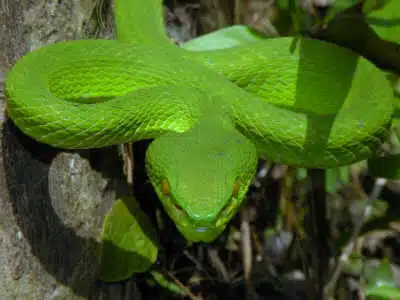
The White-Lipped Pit Viper is the green-snake-on-a-branch that most people in Thailand have at some point either seen, photographed or had a frightening encounter with. Trimeresurus albolabris is the most numerically common venomous snake across most of the country — far more bites are attributed to this species than to cobras or kraits. The bites are rarely fatal but they are painful, slow to heal, and a real reason to keep the lights on in your garden after dark.
Field identification #
Bright leaf-green dorsum, pale-yellow to white belly, and — crucially for the name — white or pale-yellow scales lining the upper lip. Adults are 60–90 cm, occasionally to 1 m. Females are larger and stouter than males. Both sexes show a thin white or yellowish ventrolateral line running the length of the body; in males it is more conspicuous than in females. The tail is rusty red-brown, used to lure frogs and small lizards close enough for a strike. Eyes are pale yellow with a vertical pupil, and the head is the classic broad triangular pit-viper shape, distinct from the slim neck.
The single most common ID mistake is confusing this snake with the harmless Oriental Whip Snake (Ahaetulla prasina). Whip snakes are slender with a pencil-thin head, a horizontal pupil, and they move in long, fluid waves. White-Lipped Pit Vipers sit still, coiled on a leaf or low branch, and the head is much wider than the neck. If you cannot see the head clearly, the size of the body relative to the neck is the giveaway.
Range and habitat in Thailand #
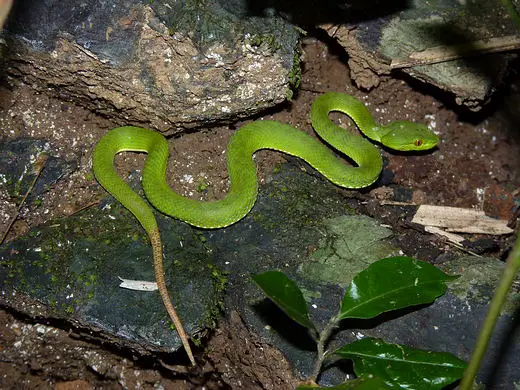
This species occurs in every region of Thailand, from the dry-evergreen patches of Isaan to the wet rainforest of the deep south, and across both islands and the mainland. They are happy in disturbed habitat: secondary forest, rubber plantations, fruit orchards, suburban gardens, even hotel landscaping if there is enough leaf litter and water. We have removed them from balcony plant pots in Phuket, kitchen window frames in Bangkok and the back of a guesthouse refrigerator in Krabi. They climb readily but rarely above 2–3 m off the ground.
Activity is mostly nocturnal but they will hunt at dusk and after rain in the cooler months. Females become more visible during the breeding season (rainy season into early dry season) when they aggregate around water and warm rocks.
Diet, behaviour and reproduction #
Diet is mainly frogs and lizards, with smaller amounts of small mammals and the occasional roosting bird. The hunting strategy is ambush: pick a perch overlooking a known game trail (often the edge of a pond or the lip of a wall) and wait. Prey detection uses heat-sensing pits below the eyes, vision, and chemical cues from a flicked tongue. They will hold a strike for hours after eating. Outside of the strike, they are placid — we have removed adults that allowed themselves to be hooked and bagged with no defensive display at all.
The species is ovoviviparous: females retain the eggs internally and give birth to 7–25 fully formed live young, usually in late rainy season. Newborns are 16–20 cm and immediately venomous. We see a noticeable bump in juvenile encounters from October to December.
Venom and bite first aid #
The venom is a complex mix dominated by procoagulant and anticoagulant components, plus tissue-damaging metalloproteinases. Effects appear within 30 minutes: severe local swelling, bruising and blistering at the bite site, sometimes spreading the entire limb. Systemic effects include consumption coagulopathy (your blood loses the ability to clot), with bleeding from gums, urine and old wounds. Pain is intense and the limb stays swollen for one to four weeks. Mortality is low — published Thai hospital series report <1% — but morbidity is real, with occasional finger or toe amputations from compartment syndrome and tissue necrosis.
If bitten: stay calm, immobilise the limb at heart level, remove rings and watches, and get to a hospital. Do not apply a tourniquet, do not cut, do not suck, do not ice. Photograph the snake from a safe distance only if it does not delay transport. Thai polyvalent antivenom (Queen Saovabha Memorial Institute Hemato Polyvalent) covers green pit viper bites and is held at most provincial hospitals. Our broader piece on avoiding snakebites in Thailand covers the practical day-to-day prevention; for a sense of how this species compares with the rest of the local viper community, see our common Thailand venomous snakes reference.
What to do if one is in your garden #
Step one: do not poke it. White-Lipped Pit Vipers will not chase, but they will hold their position and they strike fast and accurately within their reach. Identify it from at least two metres back. Step two: keep an eye on it and call a snake rescue. The volunteer fire brigades (asa samak ban prab pai) handle this for free across most provinces. If the snake is in foliage and not threatening anyone, the right call is often to just let it move on overnight — by morning it has usually relocated under its own power.
If you handle one professionally for relocation, use a hook-and-tube or hook-and-bag, never bare hands. Release at least 1 km away in equivalent habitat — forest edge, secondary growth or a plantation with leaf litter. Releasing into pristine national park is appealing but not always wise; the snake may not survive the unfamiliar territory. Released animals do best when moved a short distance into similar habitat. If you would like to compare bite severity with the other Thai vipers, our Malayan Pit Viper profile describes a different and arguably more dangerous bite.
External references we trust: the Reptile Database entry for Trimeresurus albolabris and the WHO snakebite envenoming hub for global treatment guidelines and antivenom advice.
Quick reference card #
- Where most often encountered: See the range and habitat section above. Encounter rates rise sharply during the species’ active season — for most Thai snakes, this is the wet season (May–November) with a smaller secondary peak around the end of the cool months.
- Activity period: Whether the snake is diurnal, nocturnal or crepuscular shapes the practical encounter risk. Nocturnal species are more often missed in the dark; diurnal species are more often photographed clearly.
- Bite risk to humans: Determined by whether the species is venomous, how readily it bites when disturbed, how often it is encountered in human-modified landscape, and how potent its venom is. The combination matters more than any single factor.
- Best behaviour on encounter: Stand back, photograph from a respectful distance (two metres or more), do not handle, and let the snake leave under its own power. The great majority of Thai snake encounters resolve themselves without intervention if the human steps back.
Frequently asked questions #
Is this species protected under Thai law?
Many Thai snakes are protected under the Wild Animal Reservation and Protection Act. King Cobras, Burmese Pythons, Reticulated Pythons and several smaller species are explicitly listed; killing or trading these species is technically a criminal offence even when enforcement is uneven. For other species the legal status is more permissive, but local rules vary by province and protected-area designation. When in doubt, do not kill — call the volunteer fire-brigade rescue team for free relocation.
What should I do if my pet was bitten?
Take the pet to a veterinarian immediately. Veterinarians in Thailand have access to the same antivenoms used for humans, and treatment success in dogs and cats is reasonable when the bite is recognised quickly. Do not waste time on folk remedies. Photograph the snake from a safe distance if you can — the species ID will help the vet pick the correct antivenom.
How can I keep this species out of my garden?
Three things reduce snake encounters in a garden setting: cut grass and dense ground cover short, store firewood and outdoor materials elevated rather than ground-piled, and reduce rodent populations (snakes follow rats). Lighting walking paths after dark also helps prevent foot-on-snake encounters. None of these are perfect — wild snakes will still pass through — but together they substantially reduce the chance of an encounter.
Are juveniles as dangerous as adults?
For venomous species, yes — juveniles are venomous from birth and the venom is the same potent toxin as in adults. The dose per bite is smaller, but small doses of potent venom can still be life-threatening. There is also a folk-belief that juveniles “cannot control” their venom delivery and inject more per bite than an adult; the evidence for this is mixed but the practical lesson is to treat juveniles with the same caution as adults.