Large-Eyed Pit Viper (Trimeresurus macrops) — The Bangkok Garden Pit Viper
If you live in Bangkok and you are ever going to see a venomous snake in your garden, the Large-Eyed Pit Viper is the most likely candidate. Trimeresurus macrops is the green pit viper of central Thailand and is unusually tolerant of disturbed and suburban habitat — it lives quietly in temple grounds, condominium garden beds, sub-soi parks and the green strips along Bangkok’s klongs. Its sister species T. albolabris is more common nationwide; macrops is more common inside the metro area.
Identification #
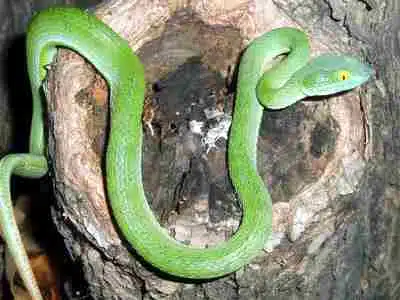
Adults are 60–80 cm, occasionally 95 cm. Bright leaf-green above, pale yellow-white below, with a thin pale ventrolateral stripe more pronounced in males. The tail is a moderately rusty brown. The species’ standout feature is the eye, which is genuinely larger relative to the head than in any other Thai green pit viper — almost cartoonishly so when you see one in good light. Iris colour is yellow-bronze, pupil vertical. The head is the standard broad triangular pit-viper shape, with a pronounced loreal pit between the nostril and the eye.
Closest look-alike is the White-Lipped Pit Viper. Quick separation: macrops has the bigger eye and lacks the obvious white upper lip. In central and eastern Thailand both species can occur in the same garden; in the north macrops drops out and Pope’s takes over. Mid-body scales 21 rows, ventrals 153–172.
Range and habitat #

The species ranges across Cambodia, southern Vietnam, central and eastern Thailand. In Thailand the densest records are from Bangkok and the central plains, with strong populations through Chonburi, Rayong, Chanthaburi and Trat. Records thin out west of the Tenasserim hills and north of about Phitsanulok. The southern peninsula is dominated by White-Lipped and Hagen’s; macrops is largely absent.
Habitat is broad. They are at home in mature evergreen forest but they are also remarkably tolerant of disturbed habitat — Bangkok parks, temple grounds, condominium gardens, fruit-tree orchards and even the green strip along expressway off-ramps. Activity is mostly nocturnal but they bask on cooler mornings and may hunt at dusk. Wet evenings during the rainy season are when we see the most.
Behaviour, diet and breeding #
Diet is mostly frogs and lizards, with a smaller share of small mammals — rats and house geckos make up a real fraction of the diet in suburban habitat. Hunting is standard pit-viper ambush. The famously large eyes give a useful real-world advantage: macrops hunts well in the dim light around streetlamps and house exterior lighting, where prey is easier to spot. Caudal luring with the rusty tail tip is common.
Defensive behaviour is typically calm. We have removed dozens of these from Bangkok properties without the snake making a single strike. When they do strike, the strike is fast and accurate; the calm temperament is not a guarantee. Reproduction is ovoviviparous, with 7–17 live young born in late rainy season. Hatchlings are about 16 cm.
Venom and bite #
The bite is medically similar to other Thai green pit vipers — severe local pain, swelling, bruising and a procoagulant/anticoagulant venom that produces coagulopathy over the first 24 hours. Spontaneous bleeding is the systemic warning sign; some patients show bleeding from old wounds, gums, or intravenous-access sites long after the bite. Mortality is low (under 1% with treatment) but local tissue damage, blistering and slow wound healing are common. Most published bite case series from Bangkok hospitals show the species accounts for a meaningful fraction of pit-viper bites in the metro area.
If bitten in Bangkok, the good news is the city has many hospitals stocked with the appropriate antivenom (Queen Saovabha Memorial Institute Hemato Polyvalent or its regional equivalents). Standard first-aid: stay calm, immobilise the limb at heart level, remove rings/watches, no tourniquet, no cut, no ice, get to a hospital. Our piece on avoiding snakebites in Thailand has the broader prevention picture; are Thailand snakes aggressive? answers the question we get most often from worried garden-owners.
Living alongside them #
The Large-Eyed Pit Viper is the snake we see in the most “I had no idea Bangkok had pit vipers” panic calls. The reality is that the species is widespread but unobtrusive — most adults will never strike a person and will leave a property under their own power within a day or two. If you find one in landscaping, the right move is almost always to leave it alone overnight and check again in the morning. If it is still there or if it is somewhere you cannot tolerate, call a snake rescue. Our list of snake removal numbers covers Bangkok and the surrounding provinces.
Practical preventive measures inside the metro: keep landscaping trimmed back from doors and windows, light walking paths after dark, and store outdoor cushions and tarps elevated rather than on the ground. The species hunts best in cluttered, dimly lit habitat; good housekeeping reduces encounters meaningfully.
External references: the Reptile Database entry for Trimeresurus macrops for taxonomy, and the IUCN Red List assessment for conservation status — the species is currently Least Concern, in part because it tolerates disturbed habitat better than most pit vipers.

Quick reference card #
- Where most often encountered: See the range and habitat section above. Encounter rates rise sharply during the species’ active season — for most Thai snakes, this is the wet season (May–November) with a smaller secondary peak around the end of the cool months.
- Activity period: Whether the snake is diurnal, nocturnal or crepuscular shapes the practical encounter risk. Nocturnal species are more often missed in the dark; diurnal species are more often photographed clearly.
- Bite risk to humans: Determined by whether the species is venomous, how readily it bites when disturbed, how often it is encountered in human-modified landscape, and how potent its venom is. The combination matters more than any single factor.
- Best behaviour on encounter: Stand back, photograph from a respectful distance (two metres or more), do not handle, and let the snake leave under its own power. The great majority of Thai snake encounters resolve themselves without intervention if the human steps back.
Frequently asked questions #
Is this species protected under Thai law?
Many Thai snakes are protected under the Wild Animal Reservation and Protection Act. King Cobras, Burmese Pythons, Reticulated Pythons and several smaller species are explicitly listed; killing or trading these species is technically a criminal offence even when enforcement is uneven. For other species the legal status is more permissive, but local rules vary by province and protected-area designation. When in doubt, do not kill — call the volunteer fire-brigade rescue team for free relocation.
What should I do if my pet was bitten?
Take the pet to a veterinarian immediately. Veterinarians in Thailand have access to the same antivenoms used for humans, and treatment success in dogs and cats is reasonable when the bite is recognised quickly. Do not waste time on folk remedies. Photograph the snake from a safe distance if you can — the species ID will help the vet pick the correct antivenom.
How can I keep this species out of my garden?
Three things reduce snake encounters in a garden setting: cut grass and dense ground cover short, store firewood and outdoor materials elevated rather than ground-piled, and reduce rodent populations (snakes follow rats). Lighting walking paths after dark also helps prevent foot-on-snake encounters. None of these are perfect — wild snakes will still pass through — but together they substantially reduce the chance of an encounter.
Are juveniles as dangerous as adults?
For venomous species, yes — juveniles are venomous from birth and the venom is the same potent toxin as in adults. The dose per bite is smaller, but small doses of potent venom can still be life-threatening. There is also a folk-belief that juveniles “cannot control” their venom delivery and inject more per bite than an adult; the evidence for this is mixed but the practical lesson is to treat juveniles with the same caution as adults.