
Found a New Snake — Is It Oligodon inornatus?
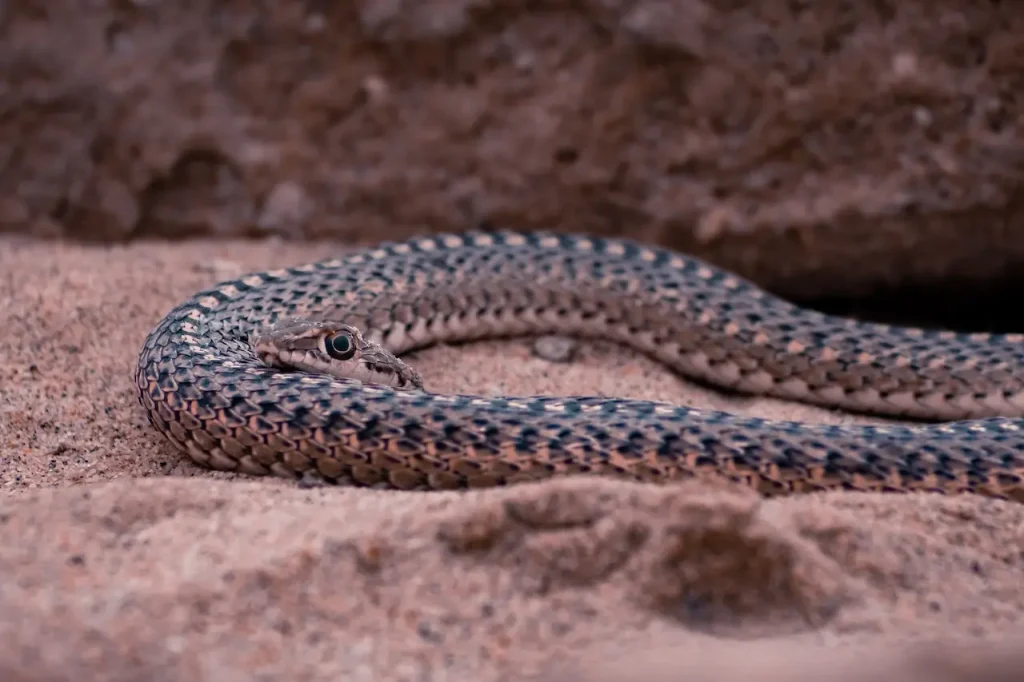
Reader submission: a small snake found in central Thailand that the reader could not identify. Photograph showed a slim, brown-and-black snake about 35 cm long with a clear “V” pattern on the head. Our best ID is one of the kukri snakes (genus Oligodon), possibly Oligodon inornatus or one of its close relatives. The genus is poorly known, with several species in Thailand that are easy to confuse, and the field separation requires close examination of head pattern and scale counts. This is the longer write-up of how we got to that ID and why.

What kukri snakes are #
The genus Oligodon is a group of small Asian colubrids notable for one anatomical feature: enlarged, blade-like rear maxillary teeth that are used to slit open reptile eggs (the genus is essentially specialised for egg-eating). The teeth are shaped roughly like a kukri knife, hence the English name. Most species are 30–50 cm, slim, with patterned bodies and characteristic head markings. There are over a dozen Thai species, several still being described, and the taxonomy is in active flux.
The genus is essentially harmless to humans. The blade-like teeth are designed for prey eggs, and the snake’s bite on a person is small and superficial. Some species do produce mild Duvernoy’s gland venom but documented bite cases are negligible.
The reader’s photo #
The photo showed a small slender snake with brown ground colour, faint dark crossbands, and a clear darker “V” or chevron mark on the top of the head running from the eyes back to the neck. Eye small, round pupil. Tail relatively short. Approximate length 35 cm. Habitat: garden compost heap in central Thailand. The reader had turned over a log while clearing the heap.
Field marks consistent with Oligodon: small size, slender body, head pattern with chevron, leaf-litter habitat. The chevron pattern is shared by several species in the genus, including Oligodon inornatus (the Plain Kukri Snake), O. signatus, O. cinereus (Common Kukri Snake) and a few others. Confirming species requires either close-up of head plate count and pattern or a hand examination — neither possible from the reader’s photo.
How to narrow it down #
If you find a similar snake and want a confident species ID, three things help:
- Head plate photo. A clear top-down photo of the head shows the arrangement of scales — the precise count of supralabials, internasals and prefrontals separates many Oligodon species.
- Body pattern photo. Different species have different dorsal markings. Get a side photo showing the full pattern.
- Location. Several Thai Oligodon species are regional; knowing the province narrows the candidates substantially.
Even with these, some Thai Oligodon are not separable in the field and require examination of preserved specimens. The genus is one of the most difficult in Thai snake taxonomy.
What to do if you find one #
Photograph and walk past. Kukri snakes are harmless and beneficial — they eat reptile eggs, including some pest geckos. They will not enter buildings unless following prey. Compost heaps and old fruit-tree leaf litter are productive habitat. The snake will leave on its own within hours.
For our reader-submission archive see snake ID reader submissions. For the wider catalogue of small harmless Thai snakes see common non-venomous Thailand snakes.
External references: the Reptile Database covers all current Oligodon species, and the iNaturalist genus page shows distribution and photographic ID examples from across Asia.
Key takeaways #
- Context matters more than rules of thumb. Thailand’s snake fauna varies meaningfully by region, by season, and by habitat. Advice that holds in southern wet forest does not always hold in northern hill country or in the central agricultural plains.
- Prevention is high-leverage. Most serious snake-related incidents in Thailand are downstream of three preventable behaviours — reaching where you cannot see, walking forest paths at night without a torch, and attempting to handle or kill snakes rather than call professional removal.
- Hospital access is the real safety net. Thai provincial hospitals stock the standard polyvalent antivenoms. The single biggest predictor of bad outcome from a serious bite is delay in reaching one of those hospitals.
- Citizen-science records help. Even casual photographs with location data, posted to platforms like iNaturalist, contribute to the regional knowledge base. Most Thai snake species have surprisingly thin distribution data; one well-documented sighting can fill a real gap.
Common questions #
How likely am I to see a snake on a casual visit to Thailand?
Lower than you probably expect. A casual three-hour daytime forest hike in southern Thailand has roughly a 5–10% chance of producing any snake encounter at all, and roughly a 0.5–1% chance of producing a venomous-species sighting. Visitors who deliberately go looking — at night, in good habitat — see far more, but the casual exposure is genuinely low.
What time of year has the most snake activity?
The wet season (May through October) produces by far the most snake encounters across most of Thailand. Within that, two peaks: the start of the rains (April–June) when males are moving for breeding, and late wet season (September–November) when juvenile cohorts disperse from nest sites. The dry season (December–March) is genuinely quieter for snake-watching, particularly in the north and northeast.
Are Thai snakebite outcomes really that good?
For patients who reach a hospital within an hour or two of a venomous bite, yes — Thai outcomes are excellent by international standards. Mortality with appropriate antivenom and supportive care runs under 1% for most species. The deaths that do happen are concentrated in cases of significant pre-hospital delay, mis-identification of species, or in patients with serious co-morbidities. The Thai system is robust; the failure modes are mostly upstream of the hospital.
What is the single best preventive measure?
A torch at night. The single biggest reducer of Thai snakebite risk is consistent, eyes-down torch use on every walking path after dark. Most preventable bites in southern Thailand are foot-on-snake events on the ground at night, and a torch beam on the trail at metre-down angle prevents the great majority of them. Closed footwear is the second-biggest improvement; long trousers in dense vegetation is third.
Has a snout built for burrowing and it reminds me of a kukri snake. Probobly is a rare subspecies from the area – I would love to find something as strange as that!
Everyone was pretty stumped, even with the scale counts – so likely a new snake in the area.