
Big Burmese Python Found in Phuket — Field Notes
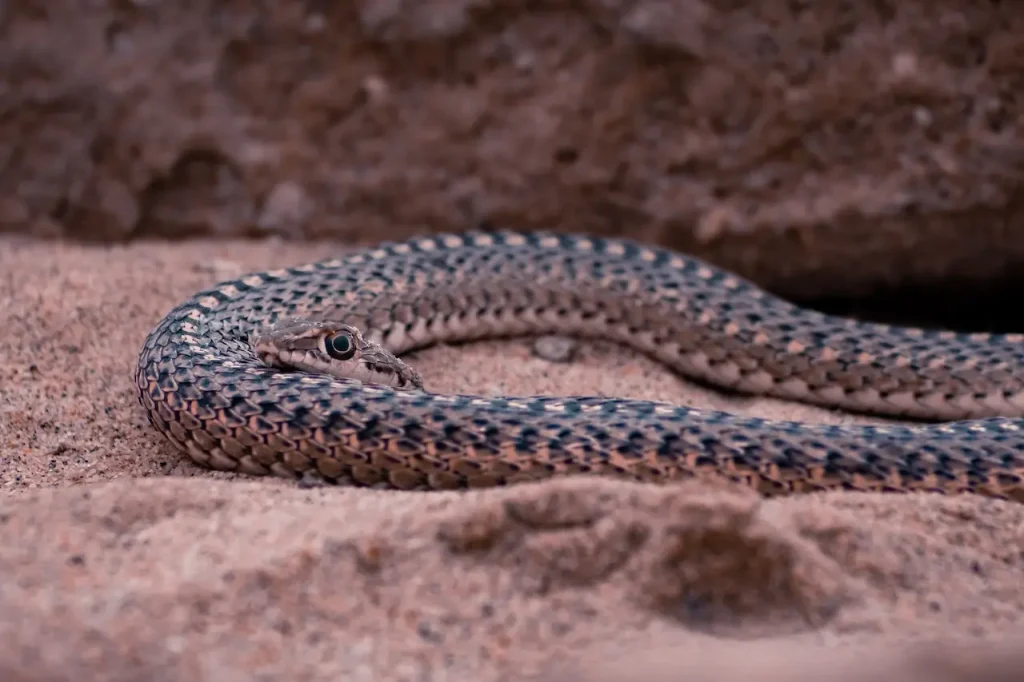
A 4 m Burmese Python was found behind a Phuket guesthouse last month — the kind of headline that sounds dramatic but is actually fairly routine for southern tourist areas. We were called in for the photograph and the rescue dispatch coordination. The episode is worth writing up because it illustrates how big pythons live alongside humans in Phuket, what to do when one shows up, and why the species is more numerous around tourist areas than people realise.

The find #
A Phuket guesthouse owner phoned us at 06:30 with an “enormous snake” near the back compost heap. We were on site within 30 minutes. The snake was an adult female Burmese Python, around 4.0 m, body condition good, behaving placidly. The animal had clearly come up from the network of canals and storm drains that run behind the soi, and was probably looking for a quieter daytime hide-out.
The Phuket fire brigade rescue team arrived 45 minutes after our call. Capture took about 20 minutes with three people, hooks, and a heavy bag. The snake was relocated to a forest reserve about 30 km north — far enough that it cannot easily return, close enough to be released into appropriate habitat. The owner of the guesthouse was relieved and curious in equal measure.
Why pythons live in Phuket #
Phuket has a dense network of canals, reservoirs, secondary forest patches and unmanaged marginal land that is ideal Burmese Python habitat. The species is generalist enough that it tolerates substantial human disturbance, and the food supply is rich — rats, feral cats, small dogs, ducks, the occasional jungle fowl. We have records of resident Burmese Pythons in most Phuket neighbourhoods, and the actual population is probably substantially higher than the documented sightings suggest. Most pythons live their whole lives in this environment without being seen by people.
The species is non-venomous but the bite from an adult is a serious soft-tissue injury — long recurved teeth, strong jaw, the python tends to hold and constrict. The danger is not toxic but mechanical. See our why Burmese Python is dangerous notes for the longer version.
What to do if you find one #
Three steps: get yourself and family back at least three metres, do not try to handle, call the fire-brigade rescue service. Phuket has a competent rescue team and the call-out is free. Most small dogs and outdoor cats in Phuket should be considered at risk if a python is in the vicinity; bring pets indoors until removal is complete. Do not feed the python, do not throw things, do not try to “drive it off” with a hose — provoking it is the only way to make it dangerous.
For the contact list, our snake removal phone numbers across Thailand covers Phuket. For the species background see our main Burmese Python species page; for handling protocols see the related danger profile.
External references: the Reptile Database entry for Python bivittatus for taxonomy, and the IUCN Red List assessment — the species is listed Vulnerable globally with significant habitat-loss pressure.
Key takeaways #
- Context matters more than rules of thumb. Thailand’s snake fauna varies meaningfully by region, by season, and by habitat. Advice that holds in southern wet forest does not always hold in northern hill country or in the central agricultural plains.
- Prevention is high-leverage. Most serious snake-related incidents in Thailand are downstream of three preventable behaviours — reaching where you cannot see, walking forest paths at night without a torch, and attempting to handle or kill snakes rather than call professional removal.
- Hospital access is the real safety net. Thai provincial hospitals stock the standard polyvalent antivenoms. The single biggest predictor of bad outcome from a serious bite is delay in reaching one of those hospitals.
- Citizen-science records help. Even casual photographs with location data, posted to platforms like iNaturalist, contribute to the regional knowledge base. Most Thai snake species have surprisingly thin distribution data; one well-documented sighting can fill a real gap.
Common questions #
How likely am I to see a snake on a casual visit to Thailand?
Lower than you probably expect. A casual three-hour daytime forest hike in southern Thailand has roughly a 5–10% chance of producing any snake encounter at all, and roughly a 0.5–1% chance of producing a venomous-species sighting. Visitors who deliberately go looking — at night, in good habitat — see far more, but the casual exposure is genuinely low.
What time of year has the most snake activity?
The wet season (May through October) produces by far the most snake encounters across most of Thailand. Within that, two peaks: the start of the rains (April–June) when males are moving for breeding, and late wet season (September–November) when juvenile cohorts disperse from nest sites. The dry season (December–March) is genuinely quieter for snake-watching, particularly in the north and northeast.
Are Thai snakebite outcomes really that good?
For patients who reach a hospital within an hour or two of a venomous bite, yes — Thai outcomes are excellent by international standards. Mortality with appropriate antivenom and supportive care runs under 1% for most species. The deaths that do happen are concentrated in cases of significant pre-hospital delay, mis-identification of species, or in patients with serious co-morbidities. The Thai system is robust; the failure modes are mostly upstream of the hospital.
What is the single best preventive measure?
A torch at night. The single biggest reducer of Thai snakebite risk is consistent, eyes-down torch use on every walking path after dark. Most preventable bites in southern Thailand are foot-on-snake events on the ground at night, and a torch beam on the trail at metre-down angle prevents the great majority of them. Closed footwear is the second-biggest improvement; long trousers in dense vegetation is third.
Hi,
that´s a ball python (from africa). Somebody must have set it free…
ha! I wouldn’t doubt it… I looked at some Burmese pythons today in the cages and the pattern is not the same as this one – at all. I’m not good at Pythons though. You could be right Paul!
its a ball python i work at a zoo and i handle those all the time, it is definitely a ball python, the pattern is completely different to a burm
Do you handle the Burmese pythons all the time too? Just seems strange that a ball python in Thailand is running loose. Guess someone could have bought it at the Chatuchak market in Bangkok, and when it got too big – freed it in Phuket. Funny stuff… Yeah, the pattern is definitely quite different from the Burmese pythons we have in Krabi – and we’re only 150km away. Thanks Will…
Yeah, that’s definitely a Ball Python. I have 3 myself and an Albino Burmese. Balls are heavier bodied (relative to their size) but at maturity are smaller than Burmese. Ball Pythons average 3.5 to 4 feet with some rare specimens reaching 5 to 6 feet. The most noticeable difference at a glance though is the patterning.
OK, thanks for your vote. Can the ball pythons mate with the Burmese, do you think? I’m sure it’s been tried – anyone know the result of that?
it is a burmball – Burmese python x ball python
Shyt that might be mine, my ball python ran away 1 yeah agoif you find that can you please call me (his name is Rudy btw) 0836410665
1000% west african Ball Python, not even close to a Burmese python, the head, patterning, build is all wrong. Btw I have a Ball Python at home :)