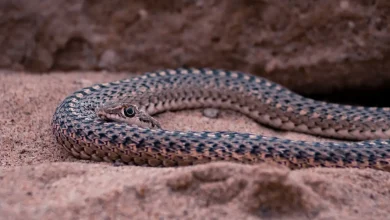
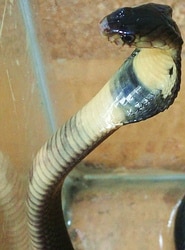
Caught a Malayan Krait — Field Notes from Southern Thailand
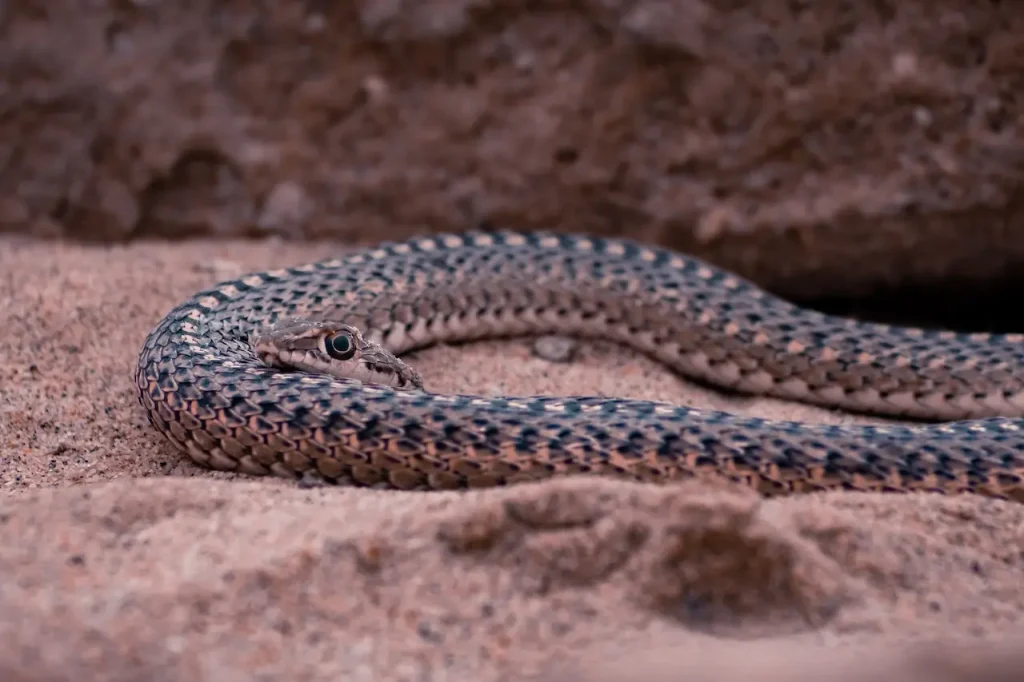
The Malayan Krait is one of the snakes we treat with the most respect on every Thai herping trip. Bungarus candidus is mild-mannered, slow, and capable of killing a person with a bite that often produces no immediate pain at all. They are also rare enough on the surface that finding one is a minor event. We caught and bagged one this past weekend on a southern Thailand night herping trip — the first kraitof the year for us, and a useful chance to write up the species’ behaviour on the surface.

The catch #
22:30, late wet-season night, light recent rain. We were walking a familiar forest trail in southern Thailand when one of our team caught the slow movement of a striped body across the trail edge — a juvenile-to-subadult Malayan Krait, perhaps 80 cm, moving slowly across damp sandy substrate. The animal was clearly intent on its own course and gave us about ten seconds of unhurried observation before we got the snake hook out.
Bagging took about a minute with two people — one with a long hook to control the head and body, the other holding a wide-mouth bag at ground level. The krait did not strike, did not lunge, and did not even noticeably accelerate its movement. We have caught much faster snakes; the Malayan Krait at night is methodical rather than urgent.
What this told us about the species #
The behaviour matched the medical literature exactly. Kraits are reluctant to bite during quiet handling, and most documented Malayan Krait bites are people who have stepped on the snake or had it crawl onto bedding. The slow, almost listless quality of surface movement is part of the reason kraits are dangerous: people see them, do not register them as a threat, and act with insufficient caution. By the time the bite happens, it has already happened — krait bites are often painless and may not even be noticed.
Our caught animal was bagged for photography and released at the original capture site about three hours later. Body condition good, no apparent injuries. The bag was double-wrapped — krait fangs are short but the bite is dangerous regardless of fang length.
The species in southern Thailand #
Malayan Kraits are present across southern Thailand but encounter rate is low. We average two to three captures a year across our southern circuit, with most encounters in the wet season (June through November). Surface activity is heavily weather-dependent — warm wet nights produce most of our records, and dry-season encounters are rare.
The species is the most dangerous of the three Thai kraits in terms of bite mortality. The bite is often painless, the venom is potent, and the slow onset of paralysis means people sometimes go to bed feeling fine and never wake up. For the species profile see our main Malayan Krait page; for the wider krait identification see how to identify deadly kraits.
Catch protocol notes #
Our standard krait catch protocol:
- Two people minimum. One controls the snake; the other handles the bag.
- Long-handled snake hook (60 cm minimum). Never reach with hands.
- Wide-mouth bag with secure closure. We use double-wrapped cotton.
- Photograph after the snake is bagged, not during catch.
- Release at the capture site within 24 hours unless there is a specific research reason to retain.
- Report any bite, no matter how minor it seems, immediately. Krait envenomations can be silent for hours.
We do not catch venomous snakes for fun and we do not encourage anyone else to. The catch above was for ID confirmation and photography of a species we are tracking in a small monitored area. For most readers, the right response to finding a krait is to step back, call professional removal if needed, and never attempt the catch yourself. Our list of snake removal phone numbers across Thailand covers the volunteer fire-brigade teams who handle these.
External references: the Reptile Database entry for Bungarus candidus for taxonomy, and the WHO snakebite envenoming hub for international treatment guidelines on krait bites.
Key takeaways #
- Context matters more than rules of thumb. Thailand’s snake fauna varies meaningfully by region, by season, and by habitat. Advice that holds in southern wet forest does not always hold in northern hill country or in the central agricultural plains.
- Prevention is high-leverage. Most serious snake-related incidents in Thailand are downstream of three preventable behaviours — reaching where you cannot see, walking forest paths at night without a torch, and attempting to handle or kill snakes rather than call professional removal.
- Hospital access is the real safety net. Thai provincial hospitals stock the standard polyvalent antivenoms. The single biggest predictor of bad outcome from a serious bite is delay in reaching one of those hospitals.
- Citizen-science records help. Even casual photographs with location data, posted to platforms like iNaturalist, contribute to the regional knowledge base. Most Thai snake species have surprisingly thin distribution data; one well-documented sighting can fill a real gap.
Common questions #
How likely am I to see a snake on a casual visit to Thailand?
Lower than you probably expect. A casual three-hour daytime forest hike in southern Thailand has roughly a 5–10% chance of producing any snake encounter at all, and roughly a 0.5–1% chance of producing a venomous-species sighting. Visitors who deliberately go looking — at night, in good habitat — see far more, but the casual exposure is genuinely low.
What time of year has the most snake activity?
The wet season (May through October) produces by far the most snake encounters across most of Thailand. Within that, two peaks: the start of the rains (April–June) when males are moving for breeding, and late wet season (September–November) when juvenile cohorts disperse from nest sites. The dry season (December–March) is genuinely quieter for snake-watching, particularly in the north and northeast.
Are Thai snakebite outcomes really that good?
For patients who reach a hospital within an hour or two of a venomous bite, yes — Thai outcomes are excellent by international standards. Mortality with appropriate antivenom and supportive care runs under 1% for most species. The deaths that do happen are concentrated in cases of significant pre-hospital delay, mis-identification of species, or in patients with serious co-morbidities. The Thai system is robust; the failure modes are mostly upstream of the hospital.
What is the single best preventive measure?
A torch at night. The single biggest reducer of Thai snakebite risk is consistent, eyes-down torch use on every walking path after dark. Most preventable bites in southern Thailand are foot-on-snake events on the ground at night, and a torch beam on the trail at metre-down angle prevents the great majority of them. Closed footwear is the second-biggest improvement; long trousers in dense vegetation is third.