
Indochinese Sand Snake (Psammophis indochinensis) — A Rare Find in Northeast Thailand
The Indochinese Sand Snake is one of those species you almost never see unless you are deliberately looking. Psammophis indochinensis is a slim, fast, mildly rear-fanged snake of dry deciduous forest in northeast Thailand and adjacent Cambodia and Laos. We have caught fewer than five in twenty years, and finding one is a genuine event. This is the field write-up of one we photographed near a forest track in Buri Ram province.

Identification
Adults reach 90–110 cm, occasionally 130 cm. The body is unusually slender for the length — a sand snake at 1 m is barely thicker than a finger. The dorsum is a pale tan, sandy-brown or greyish-brown, often with subtle paler longitudinal stripes. The belly is whitish-yellow. The head is long and oval, distinct from the neck, with a prominent dark stripe through the eye. Eyes are large and pale yellow with round pupils. The tail is long and tapering — sand snakes have a higher tail-to-body ratio than most colubrids.
The closest look-alikes in Isan are the various racers and the Indo-Chinese Rat Snake. Practical differences: sand snakes are thinner and paler than rat snakes, with a longer tail; they are also far more terrestrial than the climbing-prone rat snakes. Once you have seen one in the field the slim “sandy” look is distinctive.
Range and habitat
The species ranges across mainland Southeast Asia in dry forest and savanna habitat. In Thailand, records are essentially restricted to the northeast — Buri Ram, Surin, Sisaket, Ubon Ratchathani, Mukdahan and adjacent provinces with intact dry-deciduous forest. The species avoids wet evergreen forest and is replaced by other genera in the south.
Habitat is sandy substrate with low scrub, scattered rocky outcrops, and seasonally dry forest floor. They hunt on the surface during the heat of the day — one of the few Thai snakes that is genuinely diurnal even in the middle of summer. Cool nights are inactive periods.
Diet and behaviour
Diet is dominated by lizards (skinks, small agamids), small mammals and the occasional bird. Hunting is active pursuit at high speed — sand snakes are among the fastest snakes in the Thai fauna. We watched one cover three metres of open sandy ground in less than a second. Prey is usually subdued by the rear-fang venom, which immobilises lizards quickly but is not medically significant for humans.
Defensive behaviour is essentially flight. Cornered snakes will hiss and may attempt a small bite, but the species is not aggressive and the bite is harmless.
Our find
10:30 in the morning, hot dry day, dry-deciduous forest in Buri Ram. The sand snake was hunting on a sandy track, moving methodically with regular tongue-flicks. We had about 15 seconds of photography from 4 m before the snake noticed us and disappeared into low scrub at speed. Body size estimated at 95 cm. No capture, no handling — the species is uncommon enough that the right response to a sighting is photograph and walk past.
For the broader Isan herping context see our northeast Thailand snake trip notes; for region-by-region species distribution see where the snakes are in Thailand.
External references: the Reptile Database entry for Psammophis indochinensis for taxonomy, and the IUCN Red List assessment.
Quick reference card
- Where most often encountered: See the range and habitat section above. Encounter rates rise sharply during the species’ active season — for most Thai snakes, this is the wet season (May–November) with a smaller secondary peak around the end of the cool months.
- Activity period: Whether the snake is diurnal, nocturnal or crepuscular shapes the practical encounter risk. Nocturnal species are more often missed in the dark; diurnal species are more often photographed clearly.
- Bite risk to humans: Determined by whether the species is venomous, how readily it bites when disturbed, how often it is encountered in human-modified landscape, and how potent its venom is. The combination matters more than any single factor.
- Best behaviour on encounter: Stand back, photograph from a respectful distance (two metres or more), do not handle, and let the snake leave under its own power. The great majority of Thai snake encounters resolve themselves without intervention if the human steps back.
Frequently asked questions
Is this species protected under Thai law?
Many Thai snakes are protected under the Wild Animal Reservation and Protection Act. King Cobras, Burmese Pythons, Reticulated Pythons and several smaller species are explicitly listed; killing or trading these species is technically a criminal offence even when enforcement is uneven. For other species the legal status is more permissive, but local rules vary by province and protected-area designation. When in doubt, do not kill — call the volunteer fire-brigade rescue team for free relocation.
What should I do if my pet was bitten?
Take the pet to a veterinarian immediately. Veterinarians in Thailand have access to the same antivenoms used for humans, and treatment success in dogs and cats is reasonable when the bite is recognised quickly. Do not waste time on folk remedies. Photograph the snake from a safe distance if you can — the species ID will help the vet pick the correct antivenom.
How can I keep this species out of my garden?
Three things reduce snake encounters in a garden setting: cut grass and dense ground cover short, store firewood and outdoor materials elevated rather than ground-piled, and reduce rodent populations (snakes follow rats). Lighting walking paths after dark also helps prevent foot-on-snake encounters. None of these are perfect — wild snakes will still pass through — but together they substantially reduce the chance of an encounter.
Are juveniles as dangerous as adults?
For venomous species, yes — juveniles are venomous from birth and the venom is the same potent toxin as in adults. The dose per bite is smaller, but small doses of potent venom can still be life-threatening. There is also a folk-belief that juveniles “cannot control” their venom delivery and inject more per bite than an adult; the evidence for this is mixed but the practical lesson is to treat juveniles with the same caution as adults.
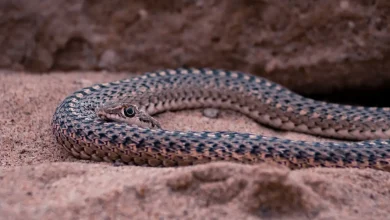
seen one of these at the road towards Khao Sok National Park in Suratthani a few weeks ago. Quite fast snakes they are. Didn’t have any chance to take a photo INDOCHINESE SAND SNAKE
I think those are known to be strictly northern snakes. Possible, I guess.
We saw one today in Redang Panjang (very south of Thailand). Looking at the pictures I am quite sure that its a Indo-chinese sand snake. He was 50 cm away from my feet but he was even more scared of me than I was of him. Unfortunatly I was unable to take a picture.
I think there are no records for anywhere near Southern Thailand. You may have seen a bronzeback snake, or a kukri snake – both have similar patterns. Cheers!
just had one in a bungalow here on koh Chang, about one meter so can’t be a kukri and didn’t have the red tail
strips was not wide enough to be a bronze back to
how can I send a picture ?
Send using contact form – https://thailandsnakes.com/contact/