
Worldwide Snake Identification Resources — What We Use Beyond Thailand
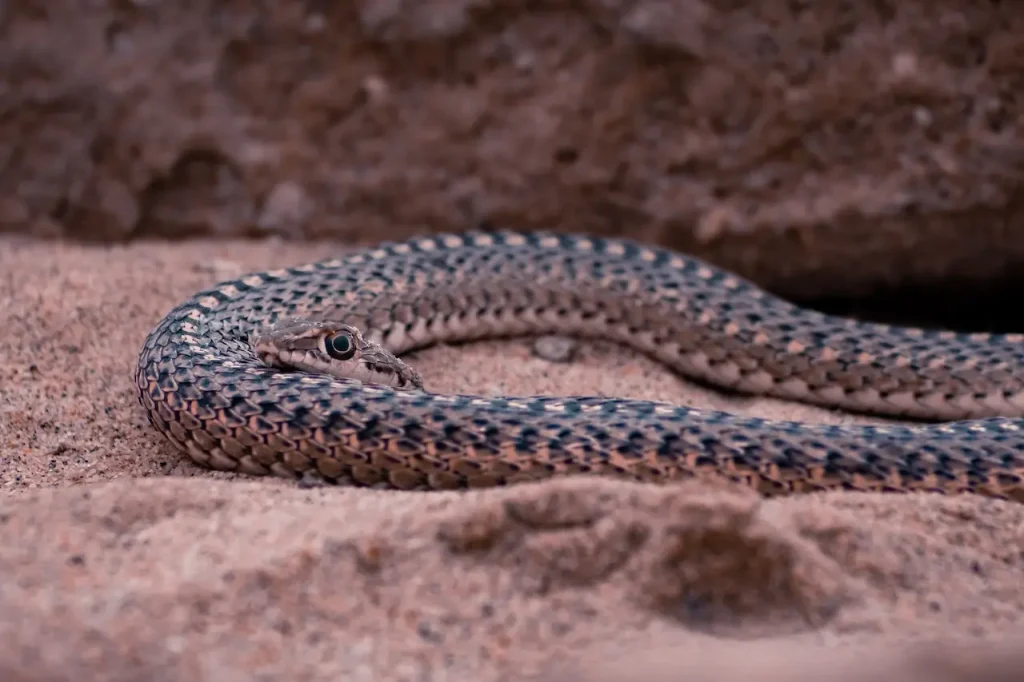
This site is focused on Thailand, but readers regularly send us photos of snakes from other countries — Malaysia, India, Australia, the Americas. We are not the right people to ID those, but we can recommend the worldwide resources we use ourselves when a Thai snake question crosses into international territory. This is the practical international snake-ID toolkit.

The reference databases #
- Australia: the Clinical Toxinology Resources at the University of Adelaide is the best single reference for Australian and global venomous-snake clinical data.
- USA: The Save The Snakes network and various state-level herpetological societies. Excellent regional photo databases.
- India: The Madras Crocodile Bank Trust and the network of Indian wildlife biologists working on snakebite. Good regional information on the “Big Four” Indian snakes.
- Africa: African snake conservation initiatives and regional university herpetology programs.
- South America: The Instituto Butantan in Brazil — analogous role to Queen Saovabha in Thailand, central reference for Brazilian and broader Neotropical species.
For Thai readers asking about other countries #
If you have a snake photograph from another country and you cannot find a clear ID, try this sequence:
- Post to iNaturalist with location. The crowd ID is usually fast and reliable for common species.
- Search Reptile Database for species in the country and compare photos.
- Search IUCN Red List for “snakes [country]” to get an overview of the local fauna.
- If still uncertain, reach out to a relevant national herpetology group.
For Thai-specific IDs see our snake identification decision tree and the how to identify snakes in Thailand reference. For our broader research approach see Thailand snake database research.
External references: in addition to the resources above, the Wikipedia article on snakes is a reasonable starting point for general reading and links to many more specialist sources.
- Reptile Database (reptile-database.reptarium.cz). The canonical taxonomy reference for every described reptile species globally. Updated regularly. Each species page has synonymy, distribution, references and often photographs. We cite this site at the bottom of nearly every species article on Thailand Snakes.
- IUCN Red List (iucnredlist.org). Conservation status assessments for every assessed species. Threat categories, range maps, population trends. Essential for understanding which species are in trouble and where.
- iNaturalist (inaturalist.org). Citizen-science observations with crowd-sourced IDs. Best for “what is this snake from this location” questions. Also the easiest place to contribute records yourself.
- GBIF (gbif.org). Global Biodiversity Information Facility — aggregates occurrence records from many sources. Useful for regional distribution questions.
Regional sites we trust #
- Australia: the Clinical Toxinology Resources at the University of Adelaide is the best single reference for Australian and global venomous-snake clinical data.
- USA: The Save The Snakes network and various state-level herpetological societies. Excellent regional photo databases.
- India: The Madras Crocodile Bank Trust and the network of Indian wildlife biologists working on snakebite. Good regional information on the “Big Four” Indian snakes.
- Africa: African snake conservation initiatives and regional university herpetology programs.
- South America: The Instituto Butantan in Brazil — analogous role to Queen Saovabha in Thailand, central reference for Brazilian and broader Neotropical species.
For Thai readers asking about other countries #
If you have a snake photograph from another country and you cannot find a clear ID, try this sequence:
- Post to iNaturalist with location. The crowd ID is usually fast and reliable for common species.
- Search Reptile Database for species in the country and compare photos.
- Search IUCN Red List for “snakes [country]” to get an overview of the local fauna.
- If still uncertain, reach out to a relevant national herpetology group.
For Thai-specific IDs see our snake identification decision tree and the how to identify snakes in Thailand reference. For our broader research approach see Thailand snake database research.
External references: in addition to the resources above, the Wikipedia article on snakes is a reasonable starting point for general reading and links to many more specialist sources.
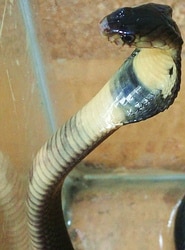
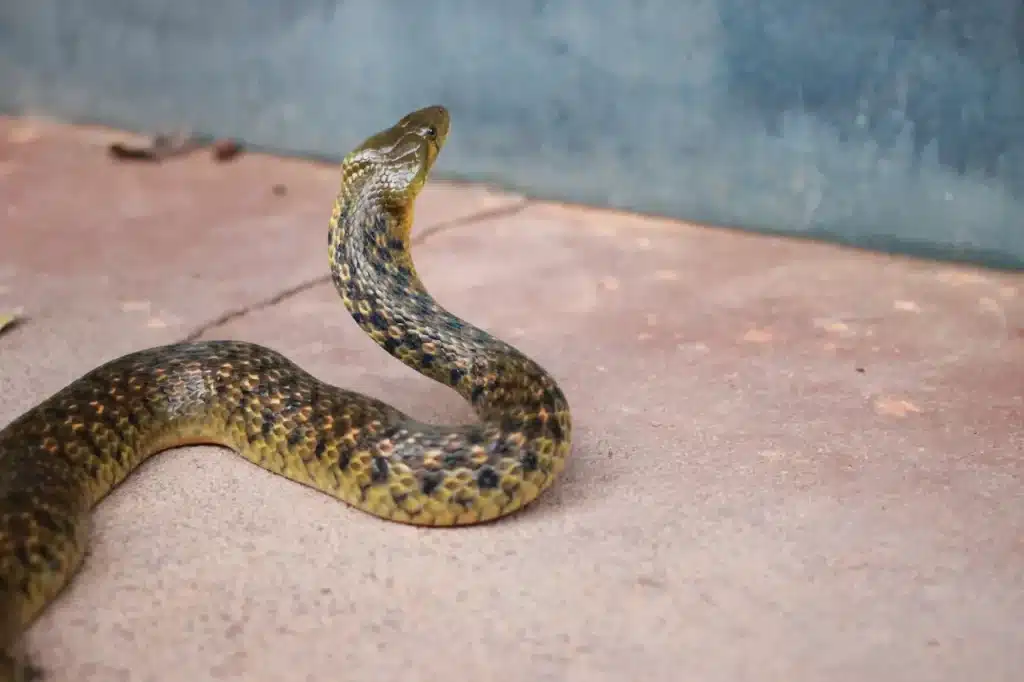 Banded Krait — black and yellow banded body" class="wp-image-69" />
Key takeaways #
- Context matters more than rules of thumb. Thailand’s snake fauna varies meaningfully by region, by season, and by habitat. Advice that holds in southern wet forest does not always hold in northern hill country or in the central agricultural plains.
- Prevention is high-leverage. Most serious snake-related incidents in Thailand are downstream of three preventable behaviours — reaching where you cannot see, walking forest paths at night without a torch, and attempting to handle or kill snakes rather than call professional removal.
- Hospital access is the real safety net. Thai provincial hospitals stock the standard polyvalent antivenoms. The single biggest predictor of bad outcome from a serious bite is delay in reaching one of those hospitals.
- Citizen-science records help. Even casual photographs with location data, posted to platforms like iNaturalist, contribute to the regional knowledge base. Most Thai snake species have surprisingly thin distribution data; one well-documented sighting can fill a real gap.
Common questions #
How likely am I to see a snake on a casual visit to Thailand?
Lower than you probably expect. A casual three-hour daytime forest hike in southern Thailand has roughly a 5–10% chance of producing any snake encounter at all, and roughly a 0.5–1% chance of producing a venomous-species sighting. Visitors who deliberately go looking — at night, in good habitat — see far more, but the casual exposure is genuinely low.
What time of year has the most snake activity?
The wet season (May through October) produces by far the most snake encounters across most of Thailand. Within that, two peaks: the start of the rains (April–June) when males are moving for breeding, and late wet season (September–November) when juvenile cohorts disperse from nest sites. The dry season (December–March) is genuinely quieter for snake-watching, particularly in the north and northeast.
Are Thai snakebite outcomes really that good?
For patients who reach a hospital within an hour or two of a venomous bite, yes — Thai outcomes are excellent by international standards. Mortality with appropriate antivenom and supportive care runs under 1% for most species. The deaths that do happen are concentrated in cases of significant pre-hospital delay, mis-identification of species, or in patients with serious co-morbidities. The Thai system is robust; the failure modes are mostly upstream of the hospital.
What is the single best preventive measure?
A torch at night. The single biggest reducer of Thai snakebite risk is consistent, eyes-down torch use on every walking path after dark. Most preventable bites in southern Thailand are foot-on-snake events on the ground at night, and a torch beam on the trail at metre-down angle prevents the great majority of them. Closed footwear is the second-biggest improvement; long trousers in dense vegetation is third.
Always interested in snakes and acquiring better knowledge