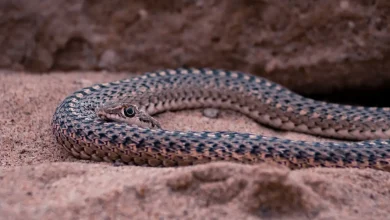
Shaw’s Sea Snake (Hydrophis curtus) — Common, Stout, Bycatch-Famous
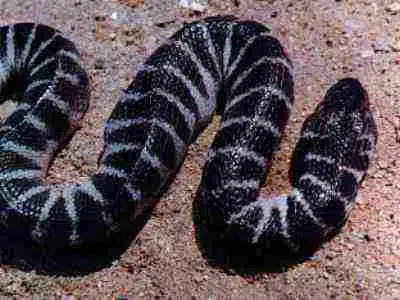
Shaw’s Sea Snake is the true sea snake we run into most often in Thai waters. Hydrophis curtus (older literature: Lapemis curtus or Lapemis hardwickii) is a stout, grey-banded sea snake found across the Andaman Sea and the Gulf of Thailand. Unlike the amphibious sea kraits, Shaw’s Sea Snake is fully marine — it gives birth in the water and almost never comes ashore voluntarily. The species is best known to Thai trawl-fishermen, who pull it up in their nets in numbers, and to the small medical literature on Thai sea-snake bites, where Shaw’s accounts for a meaningful share of cases.
Field identification #
Adults are 60–100 cm, occasionally 120 cm. The body is unusually stout for a sea snake — almost cylindrical at the front and laterally compressed at the rear, with a paddle-shaped tail. Ground colour is grey to olive-grey above, paler below, with 25–45 broad dark crossbands that may extend onto or stop short of the belly depending on individual. The head is moderately broad, slightly distinct from the neck, and the eyes are small with round pupils. Adults often have a noticeably thickset look — fishermen call them “fat-tail” sea snakes for this reason.
The closest look-alikes in Thai waters are other Hydrophis species, several of which are more slender and have narrower heads. The unmistakable Yellow-Lipped Sea Krait has bold yellow head pattern, full body bands, and an amphibious habit (you can find it on beaches); Shaw’s almost never beaches. If a banded sea snake is washed up on shore on the Thai mainland it is much more likely to be a sea krait than a true Hydrophis.
Range and habitat #

The species is widespread across the Indian Ocean, Andaman Sea, South China Sea, Gulf of Thailand and on into the western Pacific. Thai records come from both the Andaman side and the Gulf, with particularly high numbers in shallow, soft-sediment areas — the species lives where the prey lives. Shaw’s hunts demersally over sand and mud bottoms in 5–50 m of water, moving constantly and probing crevices for prey. Unlike sea kraits, they do not need to come ashore and rarely do.
Activity is mostly diurnal. The species needs to surface every 20–60 minutes to breathe. Trawl nets that scrape the bottom catch them in numbers because the snake hunts exactly where the trawl door drags.
Diet, behaviour and breeding #
Diet is dominated by small benthic fish, with squid and prawns as smaller components. The species is one of the more aggressive hunters in the sea snake family — it actively pursues prey rather than relying on ambush. Defensive behaviour to humans is variable: in calm water with no contact, divers can approach within a metre and the snake ignores them. Once handled (which happens routinely in fishing nets), Shaw’s is the most likely Thai sea snake to actually bite, and the bite is real.
Shaw’s is fully viviparous (live-bearing) — pups are born in the water, the female does not come ashore. Litters are 1–14 with a typical 3–6, born from December through March in Thai waters. Newborns are about 25 cm and venomous from birth.
Venom and bite #
The venom is the standard sea-snake mix: predominantly neurotoxic with a muscle-toxic (myotoxic) component. The clinical picture in serious cases includes descending paralysis (drooping eyelids, slurred speech, difficulty breathing), and crucially also rhabdomyolysis — muscle breakdown — which causes severe muscle pain, dark urine and the risk of acute kidney failure. Local pain is often minimal at first, which makes the bite easy to underestimate. Most documented bites in Thailand are fishermen handling snakes pulled up in nets.
Treatment: pressure-immobilisation bandage on the limb if you have one, immobilise, get to a hospital with sea-snake antivenom (CSL or Thai Queen Saovabha). Mortality with prompt antivenom is low; without antivenom the mortality from severe sea-snake envenomation is meaningful. Do not try to “milk” the bite, do not cut. Our broader piece on avoiding snakebites in Thailand applies; the Yellow-Lipped Sea Krait profile covers the related amphibious species.
If you see one #
From a boat: do not touch. From scuba or snorkel: stay back at least a metre, do not corner the animal against the substrate, and do not block its path to the surface (sea snakes need to breathe; cornering one between you and the surface is provoking it). On a beach: a Shaw’s on a beach is almost always a sick or net-stranded animal. Do not handle. Call local marine park staff or a sea-life rescue. If you live somewhere with regular trawl bycatch and want to read the wider context, see our common Thailand venomous snakes overview.
External references: the Reptile Database entry for Hydrophis curtus for taxonomy and synonymy, and the IUCN Red List assessment — the species is currently Least Concern across its range, but bycatch in shallow trawl fisheries is a meaningful pressure on regional populations.
Quick reference card #
- Where most often encountered: See the range and habitat section above. Encounter rates rise sharply during the species’ active season — for most Thai snakes, this is the wet season (May–November) with a smaller secondary peak around the end of the cool months.
- Activity period: Whether the snake is diurnal, nocturnal or crepuscular shapes the practical encounter risk. Nocturnal species are more often missed in the dark; diurnal species are more often photographed clearly.
- Bite risk to humans: Determined by whether the species is venomous, how readily it bites when disturbed, how often it is encountered in human-modified landscape, and how potent its venom is. The combination matters more than any single factor.
- Best behaviour on encounter: Stand back, photograph from a respectful distance (two metres or more), do not handle, and let the snake leave under its own power. The great majority of Thai snake encounters resolve themselves without intervention if the human steps back.
Frequently asked questions #
Is this species protected under Thai law?
Many Thai snakes are protected under the Wild Animal Reservation and Protection Act. King Cobras, Burmese Pythons, Reticulated Pythons and several smaller species are explicitly listed; killing or trading these species is technically a criminal offence even when enforcement is uneven. For other species the legal status is more permissive, but local rules vary by province and protected-area designation. When in doubt, do not kill — call the volunteer fire-brigade rescue team for free relocation.
What should I do if my pet was bitten?
Take the pet to a veterinarian immediately. Veterinarians in Thailand have access to the same antivenoms used for humans, and treatment success in dogs and cats is reasonable when the bite is recognised quickly. Do not waste time on folk remedies. Photograph the snake from a safe distance if you can — the species ID will help the vet pick the correct antivenom.
How can I keep this species out of my garden?
Three things reduce snake encounters in a garden setting: cut grass and dense ground cover short, store firewood and outdoor materials elevated rather than ground-piled, and reduce rodent populations (snakes follow rats). Lighting walking paths after dark also helps prevent foot-on-snake encounters. None of these are perfect — wild snakes will still pass through — but together they substantially reduce the chance of an encounter.
Are juveniles as dangerous as adults?
For venomous species, yes — juveniles are venomous from birth and the venom is the same potent toxin as in adults. The dose per bite is smaller, but small doses of potent venom can still be life-threatening. There is also a folk-belief that juveniles “cannot control” their venom delivery and inject more per bite than an adult; the evidence for this is mixed but the practical lesson is to treat juveniles with the same caution as adults.