Indochinese Spitting Cobra (Naja siamensis) — Black-and-White, Common, Dangerous
If we had to pick one Thai snake that everyone working in agriculture or living in a rural village should be able to recognise on sight, it would be the Indochinese Spitting Cobra. Naja siamensis is common, widely distributed across Thailand, and unique among the country’s cobras in being able to spray venom forward at the face of a perceived threat from up to 2.5 metres. It is not the snake responsible for most cobra bites in Thailand (that distinction goes to the Monocled Cobra) but it does account for the great majority of cobra spat-venom eye injuries.
Identifying an Indochinese Spitting Cobra #
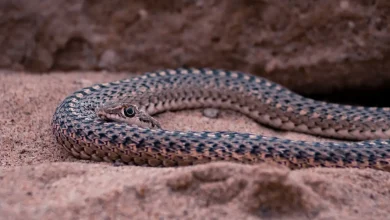
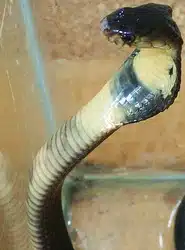
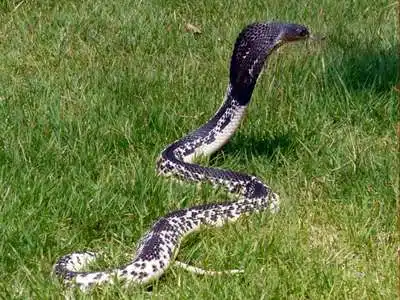
This is a medium-sized cobra — adults usually 1.0 to 1.4 m, occasionally 1.6 m. Three colour morphs occur across Thailand. The most striking is the contrasting black-and-white form: jet-black ground colour with broad cream or white bands or splotches across the back. The second is a uniform grey, brown or olive form with little or no banding. The third is a partially banded form with thin pale crossbars on a dark ground. The hood pattern, when it is spread, usually shows a single pale rounded blotch with no enclosed dark spots — this is the classic feature that separates siamensis (no eye-pattern in the hood) from the Monocled Cobra (single ringed “monocle”) and the Equatorial Spitting Cobra (no clear marking, restricted to deep south).
The eye is medium-sized with a round pupil, the body cylindrical, and the head only modestly distinct from the neck — until the cobra rises and spreads its hood, at which point the family ID becomes obvious. Juveniles are smaller versions of the adult pattern and start spitting from very early in life.
Where you find them in Thailand #

The species is widespread across the central plains, the north and the northeast, and overlaps in distribution with the Monocled Cobra in many provinces. South of the Isthmus of Kra it becomes uncommon and is replaced by Naja sumatrana. They occupy a very wide range of habitats: rice paddies, sugar-cane fields, dry secondary forest, village edges, rubber plantations and disturbed open scrub. Wherever there are rats and toads in some quantity, expect spitting cobras within a few hundred metres. We have removed adults from grain stores, chicken coops, restaurant kitchens and one memorable case from inside a temple bell tower in Khon Kaen.
They are largely diurnal but become crepuscular and nocturnal in the hot season. Activity peaks during the early rainy season when toads emerge in numbers.
Behaviour, diet and breeding #
Diet is dominated by amphibians (especially toads), small mammals and other snakes. Spitting cobras are confident, alert hunters that quarter open ground methodically. The defensive display is the famous one: rear the front third, spread the hood, and either bite or aim a stream of venom at the attacker’s eyes. The spit is genuinely aimed — these cobras will track the eyes specifically and adjust the angle of the head to compensate. Range is 2 to 2.5 m for an adult; less for juveniles, but still well over arm’s reach.
This species is oviparous. Females lay 13–28 eggs in May or June and stay coiled around the clutch until hatching about two months later. Hatchlings are 22–28 cm and immediately venomous. They begin spitting within their first week.
Venom — bite versus spit #
The venom is a postsynaptic neurotoxin mix with a strong cytotoxic (tissue-destroying) component. Bites cause severe local swelling and tissue necrosis around the bite site, which is the most clinically significant feature — many bite victims lose tissue, occasionally fingers or toes, even with prompt antivenom. Systemic neurotoxicity (drooping eyelids, slurred speech, difficulty breathing) is less common in N. siamensis than in the Monocled Cobra and tends to develop more slowly when it occurs. Mortality is reported around 1–2 percent in published Thai hospital series with antivenom and modern critical-care support.
Spat venom in the eyes causes immediate severe pain, conjunctival inflammation and, if not flushed quickly, corneal ulceration and even permanent vision loss. The first-aid is the same as for any chemical eye injury: copious flushing with whatever clean water or saline is to hand, for fifteen to twenty minutes, and a hospital visit afterwards. Do not rub the eyes. For the broader picture of cobra bites in Thailand and how spitters fit into it, see our notes on spitting cobras and the related Monocled Cobra profile.
What to do if one shows up #
The Indochinese Spitting Cobra is one of the few Thai snakes where standing back at “rough estimate of two metres” is not safe — that is exactly the spit range. Get back further than that, eye level below the height of the cobra if possible, and do not corner the animal. If you must remove the snake, wear safety glasses or a clear face shield (a bicycle visor will do), keep the head pinned with a hook, and bag without ever bringing the head close to your face. Better still, call professional removal — most provinces have free volunteer fire-brigade snake-rescue teams. Our list of snake removal phone numbers across Thailand covers the main ones.
If venom does land in your eyes, flush continuously while moving toward help. Do not stop to find a sterile saline; tap water or any drinkable bottled water is fine. Then go to the nearest hospital emergency department. Most are familiar with cobra eye injuries and will continue irrigation and check for corneal damage. Outcomes are excellent if irrigation starts in the first minute or two; worse the longer the venom sits.
External references: the Reptile Database entry for Naja siamensis for taxonomy, and the WHO snakebite envenoming page for international treatment guidelines on cobra bites.
 Banded Krait — black and yellow banded body" class="wp-image-69" />
Quick reference card #
- Where most often encountered: See the range and habitat section above. Encounter rates rise sharply during the species’ active season — for most Thai snakes, this is the wet season (May–November) with a smaller secondary peak around the end of the cool months.
- Activity period: Whether the snake is diurnal, nocturnal or crepuscular shapes the practical encounter risk. Nocturnal species are more often missed in the dark; diurnal species are more often photographed clearly.
- Bite risk to humans: Determined by whether the species is venomous, how readily it bites when disturbed, how often it is encountered in human-modified landscape, and how potent its venom is. The combination matters more than any single factor.
- Best behaviour on encounter: Stand back, photograph from a respectful distance (two metres or more), do not handle, and let the snake leave under its own power. The great majority of Thai snake encounters resolve themselves without intervention if the human steps back.
Frequently asked questions #
Is this species protected under Thai law?
Many Thai snakes are protected under the Wild Animal Reservation and Protection Act. King Cobras, Burmese Pythons, Reticulated Pythons and several smaller species are explicitly listed; killing or trading these species is technically a criminal offence even when enforcement is uneven. For other species the legal status is more permissive, but local rules vary by province and protected-area designation. When in doubt, do not kill — call the volunteer fire-brigade rescue team for free relocation.
What should I do if my pet was bitten?
Take the pet to a veterinarian immediately. Veterinarians in Thailand have access to the same antivenoms used for humans, and treatment success in dogs and cats is reasonable when the bite is recognised quickly. Do not waste time on folk remedies. Photograph the snake from a safe distance if you can — the species ID will help the vet pick the correct antivenom.
How can I keep this species out of my garden?
Three things reduce snake encounters in a garden setting: cut grass and dense ground cover short, store firewood and outdoor materials elevated rather than ground-piled, and reduce rodent populations (snakes follow rats). Lighting walking paths after dark also helps prevent foot-on-snake encounters. None of these are perfect — wild snakes will still pass through — but together they substantially reduce the chance of an encounter.
Are juveniles as dangerous as adults?
For venomous species, yes — juveniles are venomous from birth and the venom is the same potent toxin as in adults. The dose per bite is smaller, but small doses of potent venom can still be life-threatening. There is also a folk-belief that juveniles “cannot control” their venom delivery and inject more per bite than an adult; the evidence for this is mixed but the practical lesson is to treat juveniles with the same caution as adults.