
King Cobra Hatchling Found! — A Juvenile Naja Found in Southern Thailand
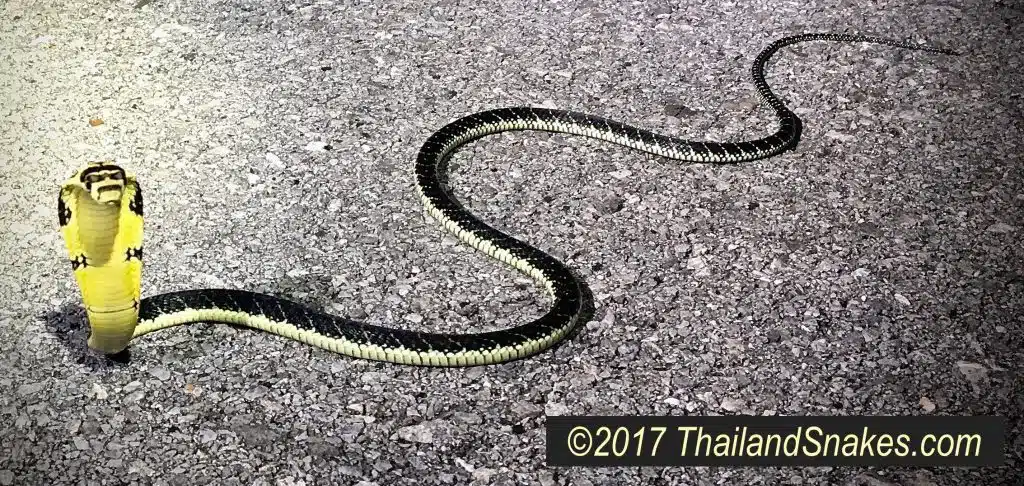
One of the most exciting finds we have logged in southern Thailand is a juvenile king cobra. Ophiophagus hannah hatchlings emerge from the mother’s leaf-mound nest at about 50 cm long and are venomous, alert, and capable of feeding from day one. Adult king cobras are the longest venomous snake in the world and one of the most respected — finding a hatchling is a quiet thrill, because it means there is a breeding adult somewhere in the same forest, and the species’ future in that landscape is at least temporarily intact.

What a King Cobra hatchling looks like #
Newborn king cobras are 45–55 cm long and look completely different from adults. Where adults are predominantly olive-brown to grey-tan with a faint pale chevron pattern, hatchlings are boldly banded — black bodies with bright yellow or whitish-yellow narrow crossbands, often with a yellow chevron at the back of the head. The pattern fades over the first eighteen months of life. By the time a king cobra is over a metre long, the bold bands have softened into a subtler chevron, and adults of two metres or more are basically uniform.
The most common ID confusion is with juvenile Banded Kraits (Bungarus fasciatus) or the harmless Banded Mangrove Snake (Boiga dendrophila) — both are also bold-banded snakes. Differences: kraits have triangular bodies in cross section and very different head shape; the Banded Mangrove has yellow and black bands but the body is much more slender. King Cobra hatchlings have rounder bodies and a noticeably proud, alert head-up posture even at rest.
Why a hatchling matters #
King cobras are the only snakes in the world known to build a nest. The female gathers leaf litter into a mound, lays 20–40 eggs in the centre, and stays guard until the eggs hatch. After hatching the female leaves and the hatchlings disperse. Finding a hatchling means a successful nest happened in the same forest. King cobras are not abundant anywhere — even the best Thai sites for the species have densities measured in adults per square kilometre, not adults per hectare. Each successful clutch matters.
The species is in decline across most of its Thai range due to habitat loss, road mortality and direct killing. The southern peninsula has retained better king cobra habitat than the central plains; finding a hatchling in southern Thailand is a positive indicator for the local population. For the wider species story see our King Cobra stories from Thailand and the largest venomous snake in the world reference.
Hatchlings are venomous from birth #
Critical practical point: a king cobra hatchling has fully functional venom and fangs from the moment it emerges from the egg. The venom dose per bite is smaller than for an adult, but the venom itself is the same potent neurotoxin. A bite from a 50 cm hatchling has produced fatalities in the documented record. Treat any king cobra — at any size — as fully envenomating.
If you find a hatchling, the right response is the same as for any king cobra: photograph from a respectful distance, do not handle, and notify professional rescue if removal is needed. Our list of snake removal phone numbers across Thailand covers the volunteer fire-brigade teams who handle these professionally.
Where the species nests #
King cobras prefer forest with reasonable cover, plenty of leaf litter for nest construction, and a healthy snake prey base (king cobras eat other snakes — rat snakes, kraits, and the occasional pit viper). In southern Thailand, productive habitat is mature rubber estates with adjacent forest, mixed peat-swamp and lowland evergreen, and the gallery forest along permanent streams. The species is much rarer in oil-palm landscape, where the prey base is thinner and the leaf-litter resource for nest construction is missing.
Hatching season is roughly April through July in southern Thailand, with most hatchlings emerging in May and June. Encounters with hatchlings cluster heavily in those months. We have not seen a hatchling between September and March in any year on our records.
External references: the Reptile Database entry for Ophiophagus hannah covers taxonomy (the species was recently split into multiple regional species in some publications), and the IUCN Red List assessment classifies the king cobra as Vulnerable, with declining trends across most of its range.

Key takeaways #
- Context matters more than rules of thumb. Thailand’s snake fauna varies meaningfully by region, by season, and by habitat. Advice that holds in southern wet forest does not always hold in northern hill country or in the central agricultural plains.
- Prevention is high-leverage. Most serious snake-related incidents in Thailand are downstream of three preventable behaviours — reaching where you cannot see, walking forest paths at night without a torch, and attempting to handle or kill snakes rather than call professional removal.
- Hospital access is the real safety net. Thai provincial hospitals stock the standard polyvalent antivenoms. The single biggest predictor of bad outcome from a serious bite is delay in reaching one of those hospitals.
- Citizen-science records help. Even casual photographs with location data, posted to platforms like iNaturalist, contribute to the regional knowledge base. Most Thai snake species have surprisingly thin distribution data; one well-documented sighting can fill a real gap.
Common questions #
How likely am I to see a snake on a casual visit to Thailand?
Lower than you probably expect. A casual three-hour daytime forest hike in southern Thailand has roughly a 5–10% chance of producing any snake encounter at all, and roughly a 0.5–1% chance of producing a venomous-species sighting. Visitors who deliberately go looking — at night, in good habitat — see far more, but the casual exposure is genuinely low.
What time of year has the most snake activity?
The wet season (May through October) produces by far the most snake encounters across most of Thailand. Within that, two peaks: the start of the rains (April–June) when males are moving for breeding, and late wet season (September–November) when juvenile cohorts disperse from nest sites. The dry season (December–March) is genuinely quieter for snake-watching, particularly in the north and northeast.
Are Thai snakebite outcomes really that good?
For patients who reach a hospital within an hour or two of a venomous bite, yes — Thai outcomes are excellent by international standards. Mortality with appropriate antivenom and supportive care runs under 1% for most species. The deaths that do happen are concentrated in cases of significant pre-hospital delay, mis-identification of species, or in patients with serious co-morbidities. The Thai system is robust; the failure modes are mostly upstream of the hospital.
What is the single best preventive measure?
A torch at night. The single biggest reducer of Thai snakebite risk is consistent, eyes-down torch use on every walking path after dark. Most preventable bites in southern Thailand are foot-on-snake events on the ground at night, and a torch beam on the trail at metre-down angle prevents the great majority of them. Closed footwear is the second-biggest improvement; long trousers in dense vegetation is third.
Good question. I don’t get many reports of snakes from Koh Phi Phi. Probably they have cobras, malayan pit vipers, maybe a green viper, and possibly a king cobra, but I think most or all have been killed by now. Still, one could swim from a neighboring island or the mainland. Cheers…