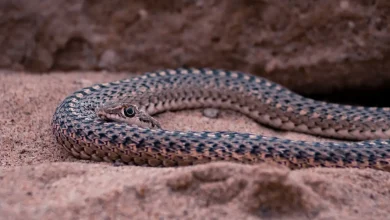
Ao Nang Snake Show in Krabi — What It Is and Why You Should Skip It
The Ao Nang and Krabi snake shows are one of the most-Googled “Thailand wildlife experiences” by tourists. They are not what most tourists imagine. The snakes are typically held in poor conditions, the handlers’ “performances” stress the animals significantly, and the educational content is minimal. We have visited several over the years for direct comparison and we are confident in saying — politely — skip the snake show. There are better ways to see and learn about Thai snakes.

What you actually see
The standard show in Ao Nang and the Krabi area runs about 30-40 minutes. A handler brings out 4-6 snakes — usually a Monocled Cobra, a Banded Krait, a King Cobra, a python, and one or two others — and demonstrates handling. The shows often include a “kiss the cobra” stunt and various small theatrics. The handlers are sometimes skilled, sometimes not. Bites do happen — there have been documented bites at Krabi snake shows over the years, usually to the handlers themselves, occasionally fatal.
The educational content is minimal — a few facts repeated by rote, often factually shaky. The snakes themselves are typically well-handled by the standards of street performance but living in conditions that would not pass any modern zoo welfare standard.
Why we suggest skipping
Three reasons:
- Queen Saovabha Memorial Institute (Bangkok). The central Thai antivenom production facility, with educational displays. The snakes are kept in much better conditions than commercial shows. Open to visitors with regular educational sessions. See our notes from our visit.
- Guided night herping with a reputable operator. A few local Krabi-based herpers run reasonable, ethical night-walking tours. You see snakes in their habitat, briefly, and learn meaningful natural history. This is genuinely educational.
- Snake Farm at Queen Saovabha (specifically). The “Snake Farm” inside the Institute compound has a public area with the major Thai species and proper interpretation. Worth the visit if you are in Bangkok.
- Khao Sok or Khao Yai national park visits. Both have ranger-led wildlife walks and are likely to produce snake encounters during the wet season.
What if you have already been?
Don’t beat yourself up. Most tourists go once and don’t think about it. The point of writing this is the next decision, not the last. If your interest in Thai snakes was sparked by a snake show — which has happened to many people — channel it into one of the alternatives above. Read our common venomous Thailand snakes overview to start. Your money goes further on a guided night-walk and you actually learn something.
External references: the Queen Saovabha Memorial Institute for the official Thai antivenom and snake research centre, and World Animal Protection for broader background on tourist-attraction animal welfare.
- Animal welfare. The snakes live in small enclosures, are handled multiple times daily, and most have reduced lifespans relative to wild equivalents. Defanging (illegal but practiced in some venues) is also a welfare concern.
- Education quality. The educational content is poor. You learn more from one good field guide or one careful guided night-walk than from any of the shows we have attended.
- It funds the practice. Tourist money is what keeps the shows running. The fewer tickets sold, the less incentive to keep operating.
Better alternatives
If you want to see Thai snakes responsibly:
- Queen Saovabha Memorial Institute (Bangkok). The central Thai antivenom production facility, with educational displays. The snakes are kept in much better conditions than commercial shows. Open to visitors with regular educational sessions. See our notes from our visit.
- Guided night herping with a reputable operator. A few local Krabi-based herpers run reasonable, ethical night-walking tours. You see snakes in their habitat, briefly, and learn meaningful natural history. This is genuinely educational.
- Snake Farm at Queen Saovabha (specifically). The “Snake Farm” inside the Institute compound has a public area with the major Thai species and proper interpretation. Worth the visit if you are in Bangkok.
- Khao Sok or Khao Yai national park visits. Both have ranger-led wildlife walks and are likely to produce snake encounters during the wet season.
What if you have already been?
Don’t beat yourself up. Most tourists go once and don’t think about it. The point of writing this is the next decision, not the last. If your interest in Thai snakes was sparked by a snake show — which has happened to many people — channel it into one of the alternatives above. Read our common venomous Thailand snakes overview to start. Your money goes further on a guided night-walk and you actually learn something.
External references: the Queen Saovabha Memorial Institute for the official Thai antivenom and snake research centre, and World Animal Protection for broader background on tourist-attraction animal welfare.
Key takeaways
- Context matters more than rules of thumb. Thailand’s snake fauna varies meaningfully by region, by season, and by habitat. Advice that holds in southern wet forest does not always hold in northern hill country or in the central agricultural plains.
- Prevention is high-leverage. Most serious snake-related incidents in Thailand are downstream of three preventable behaviours — reaching where you cannot see, walking forest paths at night without a torch, and attempting to handle or kill snakes rather than call professional removal.
- Hospital access is the real safety net. Thai provincial hospitals stock the standard polyvalent antivenoms. The single biggest predictor of bad outcome from a serious bite is delay in reaching one of those hospitals.
- Citizen-science records help. Even casual photographs with location data, posted to platforms like iNaturalist, contribute to the regional knowledge base. Most Thai snake species have surprisingly thin distribution data; one well-documented sighting can fill a real gap.
Common questions
How likely am I to see a snake on a casual visit to Thailand?
Lower than you probably expect. A casual three-hour daytime forest hike in southern Thailand has roughly a 5–10% chance of producing any snake encounter at all, and roughly a 0.5–1% chance of producing a venomous-species sighting. Visitors who deliberately go looking — at night, in good habitat — see far more, but the casual exposure is genuinely low.
What time of year has the most snake activity?
The wet season (May through October) produces by far the most snake encounters across most of Thailand. Within that, two peaks: the start of the rains (April–June) when males are moving for breeding, and late wet season (September–November) when juvenile cohorts disperse from nest sites. The dry season (December–March) is genuinely quieter for snake-watching, particularly in the north and northeast.
Are Thai snakebite outcomes really that good?
For patients who reach a hospital within an hour or two of a venomous bite, yes — Thai outcomes are excellent by international standards. Mortality with appropriate antivenom and supportive care runs under 1% for most species. The deaths that do happen are concentrated in cases of significant pre-hospital delay, mis-identification of species, or in patients with serious co-morbidities. The Thai system is robust; the failure modes are mostly upstream of the hospital.
What is the single best preventive measure?
A torch at night. The single biggest reducer of Thai snakebite risk is consistent, eyes-down torch use on every walking path after dark. Most preventable bites in southern Thailand are foot-on-snake events on the ground at night, and a torch beam on the trail at metre-down angle prevents the great majority of them. Closed footwear is the second-biggest improvement; long trousers in dense vegetation is third.
Related on Thailand Snakes: snake identification decision tree, how to identify snakes in Thailand, avoiding snakebites in Thailand.