
Notes on the Grant Thompson Monocled Cobra Case — Lessons for Snake Keepers
In 2015, a Texas-based YouTube reptile keeper named Grant Thompson was bitten by a captive Monocled Cobra (Naja kaouthia) and was found dead the next morning. The case received international attention and remains one of the most-discussed examples of what goes wrong when an inexperienced keeper handles a high-risk venomous species. We are not in a position to comment on the personal aspects of the case — the family deserves dignity — but the lessons for Thai pet snake keepers are real and worth writing up.
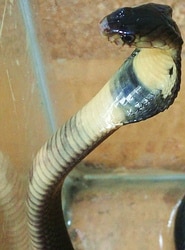
The species and the bite
Naja kaouthia is the Monocled Cobra of Thailand and Southeast Asia. The species is responsible for the largest share of fatal cobra bites in Thailand. Venom is post-synaptic neurotoxin with a strong cytotoxic component — bites cause local tissue death plus progressive paralysis. Onset of neurological symptoms is typically 1-3 hours; mortality without antivenom is meaningful, with antivenom and respiratory support it is low.
For the species profile see our main Monocled Cobra page. The species is widely kept by reptile enthusiasts internationally despite its danger.
Lessons for keepers
The recurring lessons from documented serious captive cobra bites:
- Never handle alone. A second adult in the room with eyes on the snake at all times is the bare minimum. Many fatalities are people who were alone when the bite happened.
- Plan for the worst-case before opening the enclosure. Where is the antivenom? What hospital? What is the route? Does the responder know the species? These should be answered before you start, not afterward.
- Use proper equipment. Snake hooks, tongs, and shift boxes. Never bare-handed handling, ever.
- Do not handle when impaired. Tired, distracted, after a meal, after alcohol. The handle conditions need to be 100%.
- Do not “test” with hands. The most common bite scenario in captive accidents is reaching into an enclosure briefly to “just check something”. The snake reacts faster than you do.
- Wash off all rodent or feeder smell before handling. Cobras are extremely scent-driven and a hand that smells like the last meal is at higher risk.
The Thai pet-keeper situation
Captive cobras are kept by a small number of permitted Thai keepers, mostly within the formal antivenom and education systems (Queen Saovabha Memorial Institute, the Snake Farm). Private pet keeping of dangerous Thai venomous species requires Wildlife Reservation Act permits and is correspondingly rare. Internationally, however, the species is kept by enthusiasts in countries with very different regulatory regimes — and that is where the Grant Thompson case happened.
The lesson for any reader thinking about keeping a dangerous Thai snake — even with the appropriate permits — is that the practical risk is real and underestimated by people who have not done it. Antivenom availability is uneven internationally; many countries’ major hospitals do not stock the specific Thai polyvalent antivenoms required for the species. Plan accordingly.
If you are bitten
The first 60 seconds matter. Get to a phone, call emergency services, and start telling them the species name and the antivenom needed. Sit down (do not exert), keep the limb at heart level, do not apply tourniquets or cut the wound. If you are alone, your single most important action is to phone for help immediately — the window for self-help is short and gets shorter as paralysis develops.
For the first-aid practice see our snakebite first-aid guide and the related snakebite timeline.
External references: the WHO snakebite envenoming hub for international treatment guidelines, and the Queen Saovabha Memorial Institute for Thai antivenom information.
Key takeaways
- Context matters more than rules of thumb. Thailand’s snake fauna varies meaningfully by region, by season, and by habitat. Advice that holds in southern wet forest does not always hold in northern hill country or in the central agricultural plains.
- Prevention is high-leverage. Most serious snake-related incidents in Thailand are downstream of three preventable behaviours — reaching where you cannot see, walking forest paths at night without a torch, and attempting to handle or kill snakes rather than call professional removal.
- Hospital access is the real safety net. Thai provincial hospitals stock the standard polyvalent antivenoms. The single biggest predictor of bad outcome from a serious bite is delay in reaching one of those hospitals.
- Citizen-science records help. Even casual photographs with location data, posted to platforms like iNaturalist, contribute to the regional knowledge base. Most Thai snake species have surprisingly thin distribution data; one well-documented sighting can fill a real gap.
Common questions
How likely am I to see a snake on a casual visit to Thailand?
Lower than you probably expect. A casual three-hour daytime forest hike in southern Thailand has roughly a 5–10% chance of producing any snake encounter at all, and roughly a 0.5–1% chance of producing a venomous-species sighting. Visitors who deliberately go looking — at night, in good habitat — see far more, but the casual exposure is genuinely low.
What time of year has the most snake activity?
The wet season (May through October) produces by far the most snake encounters across most of Thailand. Within that, two peaks: the start of the rains (April–June) when males are moving for breeding, and late wet season (September–November) when juvenile cohorts disperse from nest sites. The dry season (December–March) is genuinely quieter for snake-watching, particularly in the north and northeast.
Are Thai snakebite outcomes really that good?
For patients who reach a hospital within an hour or two of a venomous bite, yes — Thai outcomes are excellent by international standards. Mortality with appropriate antivenom and supportive care runs under 1% for most species. The deaths that do happen are concentrated in cases of significant pre-hospital delay, mis-identification of species, or in patients with serious co-morbidities. The Thai system is robust; the failure modes are mostly upstream of the hospital.
What is the single best preventive measure?
A torch at night. The single biggest reducer of Thai snakebite risk is consistent, eyes-down torch use on every walking path after dark. Most preventable bites in southern Thailand are foot-on-snake events on the ground at night, and a torch beam on the trail at metre-down angle prevents the great majority of them. Closed footwear is the second-biggest improvement; long trousers in dense vegetation is third.
The autopsy report came out today, he was bitten several times about both arms. He was on drugs, they are certain it was suicide.
Another commenter left this on my contact page, I think better to drop it here –
***
Lance Hollister
Hi Vern,
Was reading your website today and I believe I read on your site about the young man in Austin TX died from a monocled cobra bite. I lived in Dallas when that happened. Sadly it was a suicide. The snake was found dead not too far away having been run over by a vehicle.
Regards from Colorado
Cheers for that Lance